

🏙️ Perugia webcams online — watch the city in real time
1 cameras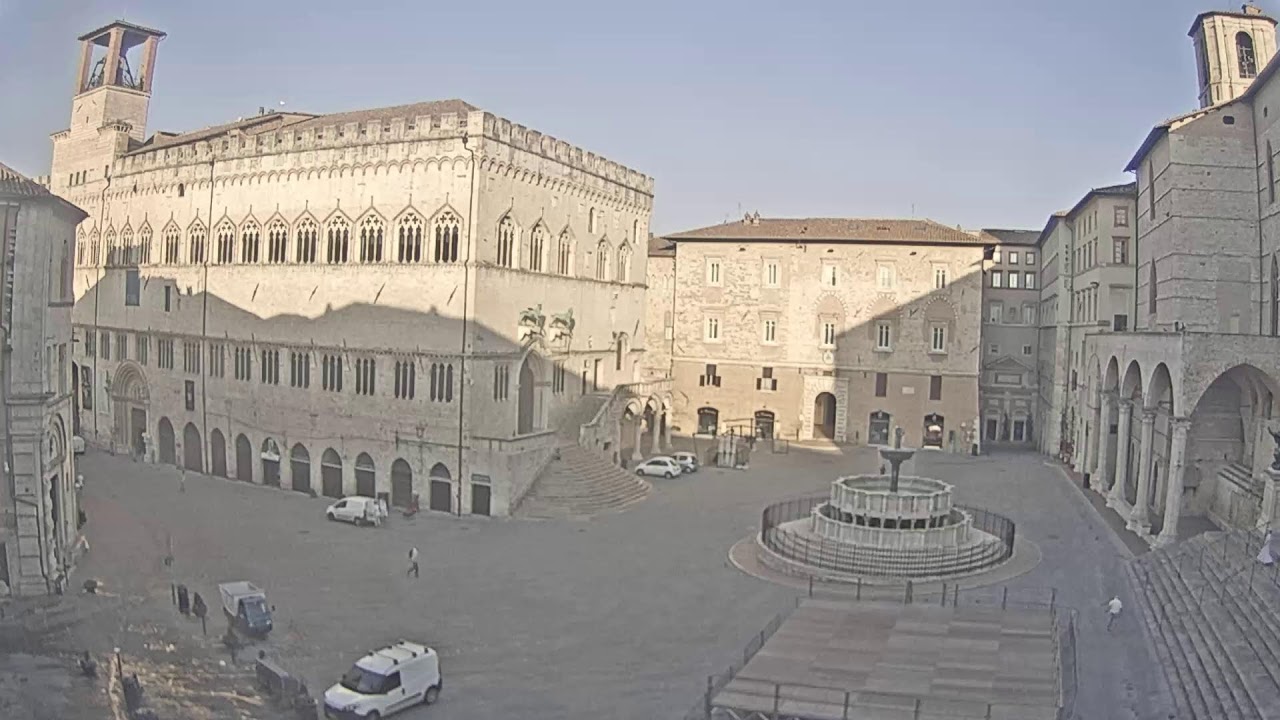
Perugia — the Heart of Umbria with Three Thousand Years of History
Perugia stretches across the hills of central Italy, remaining the capital of the Umbria region. The city traces its history back to the Umbri tribe, and then to the Etruscans, who founded it in the 6th century BC under the name Perusia. Today, about 162 thousand people live here, and the historic center sits at an altitude of 493 meters above sea level.
What makes Perugia unique is its layered history. Here Roman ruins stand alongside medieval towers, and Renaissance palaces next to Baroque churches. The city is divided into upper and lower parts, connected by a network of escalators and elevators, making it easy to explore even for first-time visitors. During the Roman era, Perugia became the colony of Perusia, and in 40 BC it was captured by Octavian. In the 6th century it became the center of a Lombard duchy.
In the Middle Ages, the city was the scene of bloody conflicts between the Oddi and Baglioni families, and the papacy often found refuge within its walls — five papal conclaves took place here. Today Perugia is famous for its annual Umbria Jazz festival, which attracts musicians and audiences from around the world.
Underground City: Rocca Paolina and the Etruscans
One of Perugia's most impressive sights lies underground. Rocca Paolina — an underground fortress built by Pope Paul III between 1540 and 1543. It was constructed in response to a citizen uprising during the "Salt War" and became a symbol of papal suppression of the city's rebellious spirit. Above the entrance is the inscription "adcoercendam Perusinorum audaciam" — "to suppress the audacity of the Perugians."
The underground complex reaches a depth of about 15 meters. Today it is a labyrinth of medieval streets, arches, and tunnels where you can see remains of 6th century BC Etruscan temples, Roman residential houses, and hidden storage rooms. Entry is free, accessible via escalators from Piazza Patigani or Corso Vannucci. Cultural events and exhibitions are often held here.
The Etruscans left other traces in Perugia. The Etruscan Well (Pozzo Etrusco), built in the second half of the 3rd century BC, is a unique double water collection structure — a well fed by spring water and a cistern collecting rainwater. Above it stands the palace of the Sorbelli family, who still own the building. Its alternate name is Pozzo Sorbelli. It served as the main water reservoir during Etruscan and Roman times.
Research has revealed traces of a sacred area with a 6th century BC temple dedicated to the goddess Uni (the Roman equivalent of Juno). For millennia, this place remained a sacred center of the city, where beliefs of different eras intertwined. Underground Perugia is considered one of the most significant archaeological monuments of Umbria.
The Chocolate Capital of Italy: Perugina and Eurochocolate
Perugia is famous not only for history but also for chocolate. The Perugina factory, founded in 1922 as a small workshop originally making candied almonds, became a legend thanks to the creation of "Baci Perugina" — chocolates with a whole hazelnut covered in signature dark chocolate, containing romantic notes wrapped in silver foil.
Within five years, production had distributed a hundred million of these chocolates. In 1939, the factory opened its first US store on Fifth Avenue. In 1997, Casa del Cioccolato opened — a museum-factory where visitors can see the manufacturing process, taste chocolate straight from the conveyor, walk on an elevated bridge above the production line, visit the Chocolate School, and even try a special white version of Baci. CNN named this place one of the five best in the world for chocolate lovers.
Every year during the Eurochocolate festival, the Perugina team creates a giant Baci measuring 2.15 m tall, 7.26 m wide, and weighing almost 6 tons (5,980 kg), which is recorded in the Guinness Book of Records and requires over 1,000 hours of work.
The story of Baci's creation is romantic: Luisa Spagnoli mixed hazelnut crumbs, added a whole nut, and coated it in the unique dark chocolate Luisa®. She named it "Cazzotto" ("Fist") because the shape resembles a punch. The success of Baci® Perugina® is stunning thanks to its unique recipe, romantic surprise notes, and silver paper wrapping.
University for Foreigners and Cultural Life
Università per Stranieri di Perugia is one of three historic universities for foreign students in Italy, founded by royal decree in 1925. In 2025 it celebrates its 100th anniversary. It is located in the historic Palazzo Gallenga Stuart in the center of Perugia.
It is one of three historic universities for foreign students in Italy, alongside those in Siena and Reggio Calabria. In the 2017-2018 academic year it had 944 undergraduate students and 61 master's students. Among undergraduates, approximately two-thirds are women, and slightly over a third are from outside Italy.
Despite its name, it is not exclusively for foreign students, but covers all fields that make Italy attractive to foreigners. It offers bachelor's degrees in international communications, digital humanities, "Made-in-Italy Food and Hospitality," and other subjects, and also prepares Italian students to become teachers of Italian language and culture worldwide.
Architectural Masterpieces and Squares
Perugia's main square — Piazza IV Novembre — is surrounded by historic buildings, among which the Cathedral of San Lorenzo and Palazzo dei Priori stand out. The Maggiore Fountain, created in the 13th century, is also located here.
The Etruscan Arch (Arco Etrusco), built in the 1st century AD on the site of an earlier Etruscan monumental entrance, still serves as a symbol of the union of Roman and Etruscan architectural traditions. The stone arch with two towers and rich architectural decoration is about 4.4 m wide. When architect Sangallo built Rocca Paolina, he did not demolish the monument but hid it inside a brick bastion — thereby preserving it.
Among Perugia's famous natives is the artist Pietro Perugino, Raphael's teacher. His works adorn not only local churches but also museums around the world.
What the Cameras Show
Perugia webcams online allow you to see the city in real time, without leaving home. Transmissions from the city center show the main squares, historic buildings, and everyday life of the locals. You can watch Perugia webcams at any time of day — during the day you'll see busy streets, and at night — quiet alleys under the starry sky.
The online broadcast of Perugia is available on our website — choose the camera you're interested in and enjoy the views of this amazing Italian city.