Railway Avenue Webcam in Canmore — Live Stream
Railway Avenue — the Main Artery of Mountain Canmore
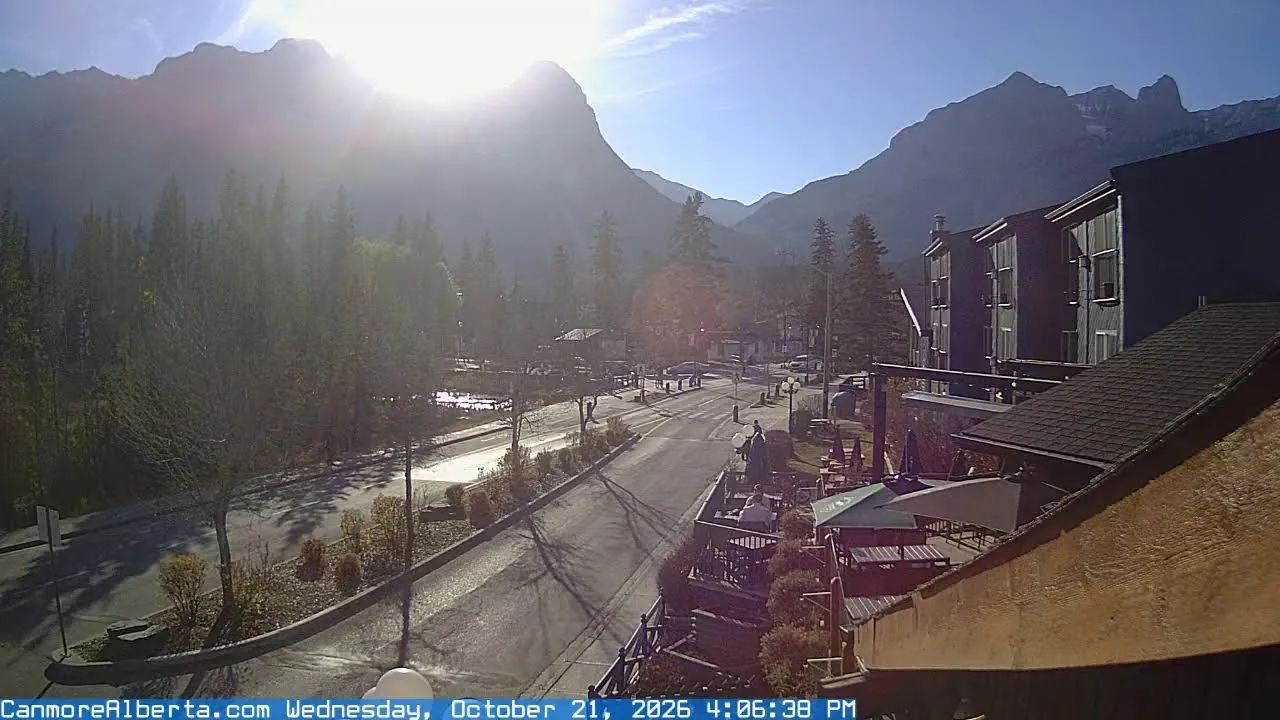
Railway Avenue is not just a street — it's the very backbone of Canmore, Alberta, around which the entire life of the city has revolved for over a century. This is where tourist routes, local way of life, and the flow of travelers coming to the Canadian Rockies all intersect. The Railway Avenue online camera lets you see this place in real time — a lively intersection with crosswalks, traffic lights, cars, and pedestrians against a backdrop of buildings and green lawns. In the frame is the vertical sign of "The Drake Screaming Retriever" restaurant and brewery, featuring a memorable illustration of a dog and a duck that immediately sets the mood for this corner of Canmore.
Canmore is located in the Bow Valley, 80 kilometers west of Calgary, at the eastern entrance to Banff National Park. The city sits at an altitude of approximately 1,385 meters above sea level and is surrounded by the majestic peaks of the Canadian Rockies. Railway Avenue — officially 8th Street — historically served as the main commercial and transportation artery connecting the coal mines with the railway station. Today it is the pedestrian heart of the city, where restaurants, galleries, shops, and historic buildings stand side by side.
History of the Coal Town and the Railway
Canmore's existence is inextricably linked to coal mining and the construction of the Canadian Pacific Railway. Coal was discovered along Canmore Creek in 1884, leading to the founding of the town. That was when industrial development of the deposits began, attracting workers and their families to this valley among the mountains.
The town received its name in that same year, 1884 — it was given by the director of the Canadian Pacific Railway, Donald A. Smith (later 1st Baron Strathcona and Mount Royal). The railway branch determined the layout of the settlement: Railway Avenue ran parallel to the tracks, becoming the main street along which shops, workers' barracks, and administrative buildings were constructed.
Coal mining was the backbone of life in Canmore from the 1880s until 1979, when Canmore Mines Ltd. ceased operations. For nearly a hundred years the town lived off the mines, and when they closed, Canmore was on the verge of disappearing. However, the transition to tourism and proximity to Banff National Park saved the settlement — today it is one of the most attractive mountain towns in Canada with a population of about 15,000 people.
Canmore's Main Street: Features and Atmosphere
Canmore's main street is officially called 8th Street and is also known as Railway Avenue. This name is a direct legacy of the town's railway past. The street stretches east to west through the entire downtown area, and it is here that the main commercial and cultural life is concentrated.
One of the notable features of Railway Avenue is that during the summer months the street is closed to vehicle traffic, turning into a pedestrian zone. This creates a special European side-street atmosphere: people stroll between cafés and shops, street musicians perform right on the pavement, and restaurants set out tables on the sidewalk. The Railway Avenue camera captures a section with vehicle traffic — an intersection where cars coexist with crosswalks and road markings.
The street's architecture is a mix of historic early-20th-century wooden buildings and modern mountain-style constructions. Many facades preserve the spirit of the old mining town, but inside you'll find modern restaurants, boutiques, and tourist services. The parking area visible in the background of the frame indicates that cars still remain an important element of the infrastructure here, despite pedestrian initiatives.
Attractions Around Railway Avenue
A walk along Railway Avenue is a journey through the layers of Canmore's history. One of the most significant buildings is the North-West Mounted Police barracks, built in 1893. This is the oldest police station in the province still standing in its original location. The building recalls the times when the mounted police maintained order in the mining settlement and guarded the border with the United States.
On the main street itself stands the famous "Big Head" sculpture by artist Henderson. This work of contemporary art has become one of Canmore's symbols — the enormous head, executed in the artist's characteristic style, draws the attention of tourists and serves as a popular photo spot.
For fine art enthusiasts, the Carter-Ryan Gallery showcases works by Indigenous artist Jason Carter — vibrant paintings and soapstone sculptures. This is a unique opportunity to experience contemporary Indigenous Canadian art right on the main street of a mountain town.
Active recreation enthusiasts will find the Canmore Climbing Gym at 1404 Railway Avenue. This is one of the largest climbing gyms in the region, attracting both locals and tourists training for ascents on the real rock faces of the Rockies.
Mountain Views and the Nature of Bow Valley
Railway Avenue is set against the stunning backdrop of the Canadian Rockies — the Three Sisters, Lady Macdonald, Ha Ling Peak, and other summits dominate the city and are visible from many points along the street. The mountain backdrop is what makes Canmore unique among Alberta's towns.
The Canmore Engine Bridge connects Railway Avenue on the east with the Bow River on the west and offers some of the most beautiful views in the city with a mountain backdrop. This pedestrian bridge over the Bow River is a must-visit for walks: from here you get a panorama of the valley, the riverbed, and the surrounding peaks.
A forest trail connects Railway Avenue to the bridge at the Bow River. The path runs through a pine forest typical of this Rocky Mountain zone and leads out to the river, where you can observe beavers, waterfowl, and enjoy views of the mountain slopes. The Railway Avenue webcam gives an idea of what the urban environment looks like at the junction of civilization and wilderness.
Practical Information for Tourists
Canmore is located a 90-minute drive from Calgary via the Trans-Canada Highway (Highway 1). From there, you take Highway 1A, which leads directly to Railway Avenue. Public transportation is available via bus routes from Calgary, but most tourists arrive in rental cars.
Parking on Railway Avenue includes both free street parking and paid lots in the alleys. During peak season (July-August and December-March), finding a spot can be challenging, so many people leave their cars on the outskirts and walk to the center. The camera shows the parking area in the background — its fullness gives an indication of how busy the tourist season is.
The best time to visit Canmore depends on your goals: in summer — hiking, cycling, and rock climbing; in winter — skiing and snowboarding at nearby resorts (Nakiska, Mount Norquay, Sunshine Village). Railway Avenue remains a center of attraction year-round — restaurants, souvenir shops, and tourist information centers operate here.
What You Can See on the Camera
The Railway Avenue online camera broadcasts an intersection in the central part of Canmore. In the foreground are road markings, crosswalks, and traffic lights regulating the flow of traffic. Cars move along the roadway, pedestrians walk along the sidewalks. On the right side of the frame is the vertical sign of "The Drake Screaming Retriever" restaurant and brewery, with its colorful illustration of a dog and a duck, which serves as a good landmark for determining the camera's location.
In the background of the frame are one- and two-story buildings in the characteristic Canmore style, green lawns, trees, and a parking area with parked cars. From the frame you can assess the intensity of street traffic, how full the parking is, and the overall atmosphere of the main street of a mountain town. At the bottom of the image is a text overlay indicating the broadcast source, date, and time.
This real-time webcam is useful for tourists planning a trip to Canmore: from the picture you can tell how lively the street is at the moment, what the weather is like in the city (visibility of the mountains, presence of snow or greenery), and how busy the downtown is. For those who have already been here, the broadcast is a chance to once again immerse themselves in the atmosphere of mountain Canmore without leaving home.
Similar cameras
Find similar