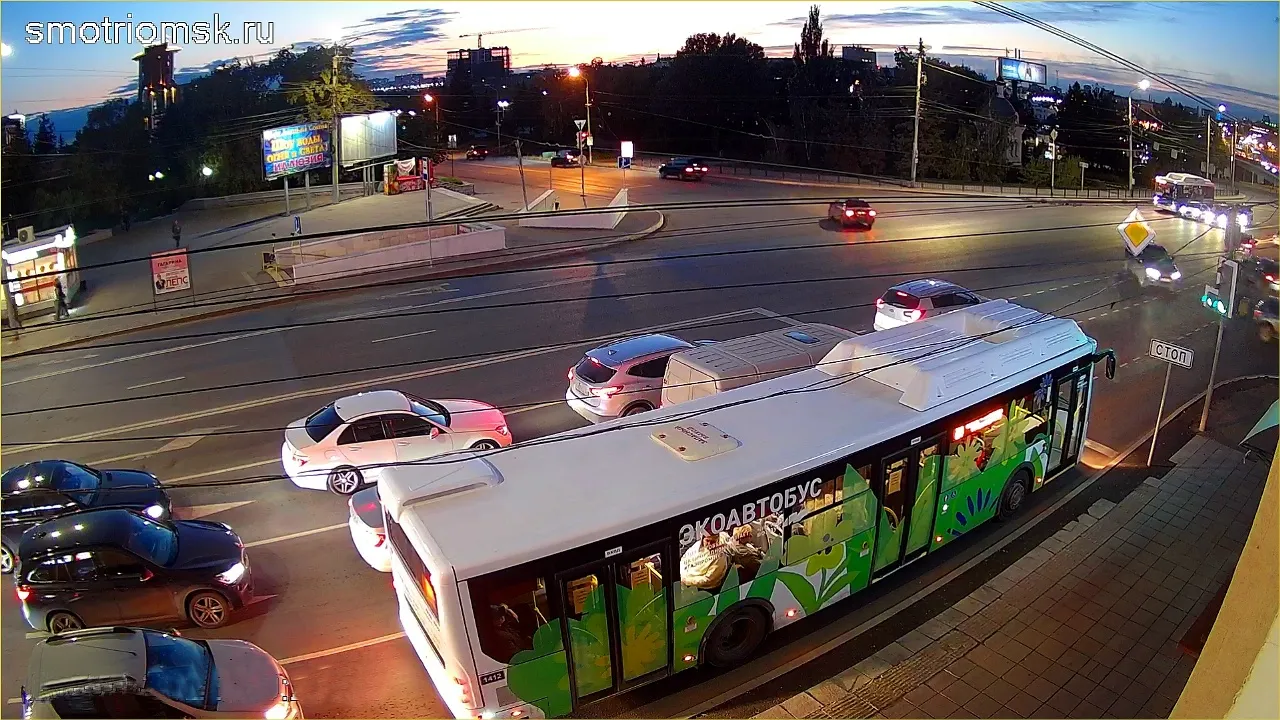
Karl Marx Avenue in Omsk — Online Webcam with Live View
Omsk's Main Artery: From Fortstadt to Avenue
Karl Marx Avenue is one of those streets where you can trace the entire history of Omsk. The live webcam broadcast opens up a view of a wide multi-lane highway, along which pre-revolutionary industrial buildings, Stalinist-era construction, and modern retail outlets coexist. This is the city's central transportation artery, and the traffic here never stops for a minute — buses, cars, green zones with lawns and trees create a typical portrait of a bustling Siberian metropolis.
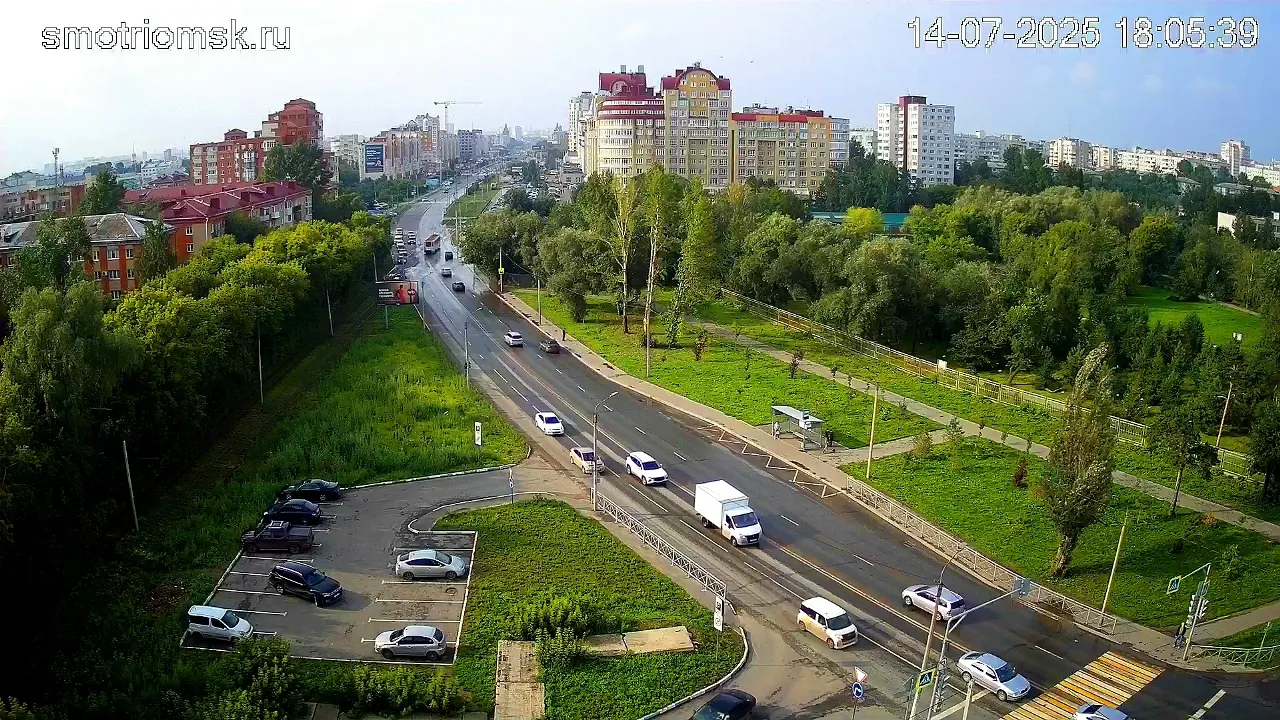
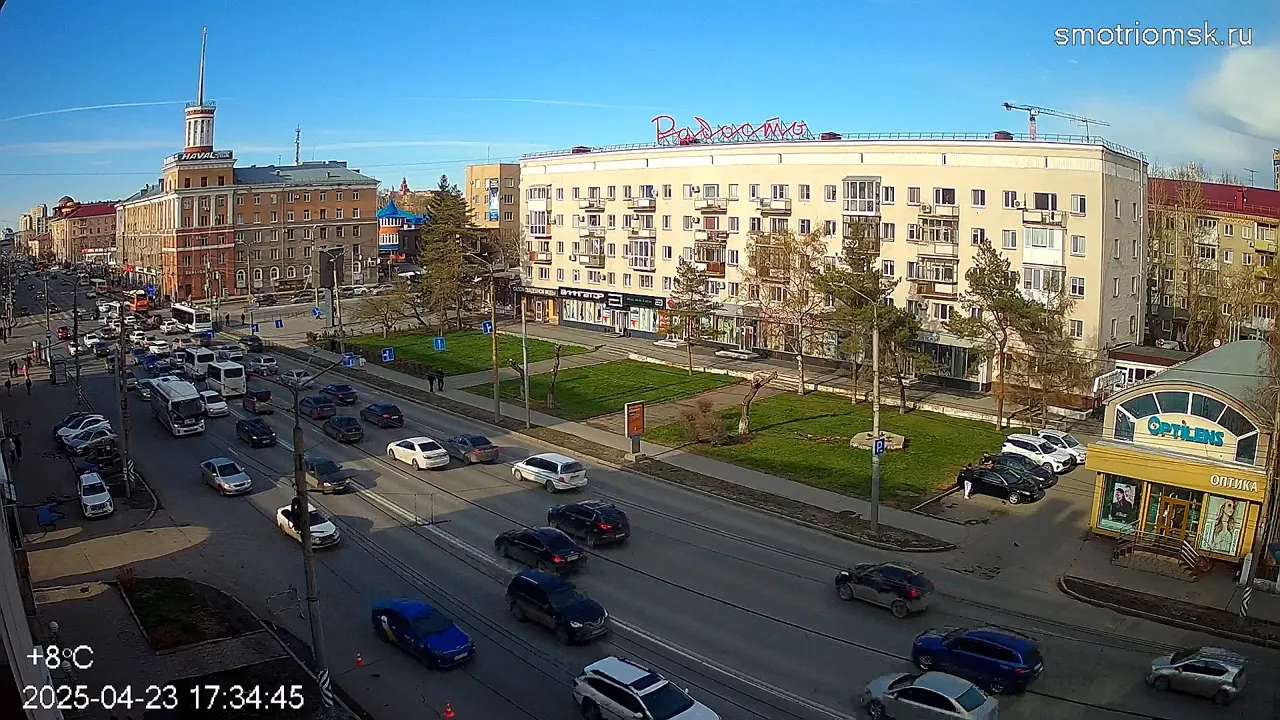
The real-time webcam shows not just a road, but a genuine architectural cross-section of eras. In the background rises the famous "House with a Spire" — an example of Stalinist Empire style from the post-war period. On the right you can see a commercial building with an optical store, in the center — a large retail outlet with a sign on the roof. And in the distance looms a construction crane, a reminder that the avenue continues to change.
How Novoslobodskoy Fortstadt Became Karl Marx Avenue
The street has traveled a long way from an outlying road to one of the city's main thoroughfares. Originally it was called Novoslobodskoy Fortstadt and was located on the border of Omsk. The southern territory of the present avenue was then the city's outskirts, where active construction was just beginning.
The turning point came in 1920, when the Omsk Provincial Revolutionary Committee issued a decree on the mass renaming of streets. On February 9, 1920, the names of 119 streets, lanes, and squares were changed — effectively half of all city toponyms. Novoslobodskoy Fortstadt became Karl Marx Avenue in honor of the founder of the communist movement.
The second wave of renaming swept through Omsk in the 1930s, but the avenue's name had already been established. In the mid-20th century, the street officially received avenue status, underscoring its growing importance in the city's structure.
House with a Spire: Symbol of Stalinist Omsk
One of the most recognizable landmarks in the broadcast is the House with a Spire, built in 1951 in the Empire style. This is a characteristic example of Stalinist architecture, which defined the appearance of central streets in Soviet cities during the post-war decade. The tall spire crowning the building serves as a visual landmark on the avenue and is clearly visible on the webcam.
The Stalinist-era development on Karl Marx Avenue is not just a backdrop for traffic. It's an entire architectural layer that tells the story of post-war reconstruction and the ambitions of the Soviet state. In the 1950s, wooden barracks still stood on the avenue, and trees adorned the sidewalks. The modern appearance was formed gradually, and the live webcam shows the result of this years-long transformation.
Mechanical-Technological School: Pre-Revolutionary Heritage
At Karl Marx Avenue, 18/2 and 18/6 is the mechanical-technological school — a building constructed in 1912. This is a monument of regional architectural significance, one of the few surviving examples of pre-revolutionary development on the avenue.
Nearby is the building at Karl Marx Avenue, 82 — a former industrial structure made of brick with characteristic arched portals. Its expressive architecture stands out against the backdrop of later buildings. Today it is an administrative building, but its facade preserves the memory of the avenue's industrial past.
The real-time webcam allows you to examine these architectural details: arched windows, brickwork, decorative facade elements. For urban architecture enthusiasts, Karl Marx Avenue is a real discovery, where eras coexist in a single frame.
Leningrad Square and the Irtysh River
The camera covers not only the avenue itself but also Leningrad Square, located between Karl Marx Avenue and the bank of the Irtysh River. This is an important transportation hub and public space in the city.
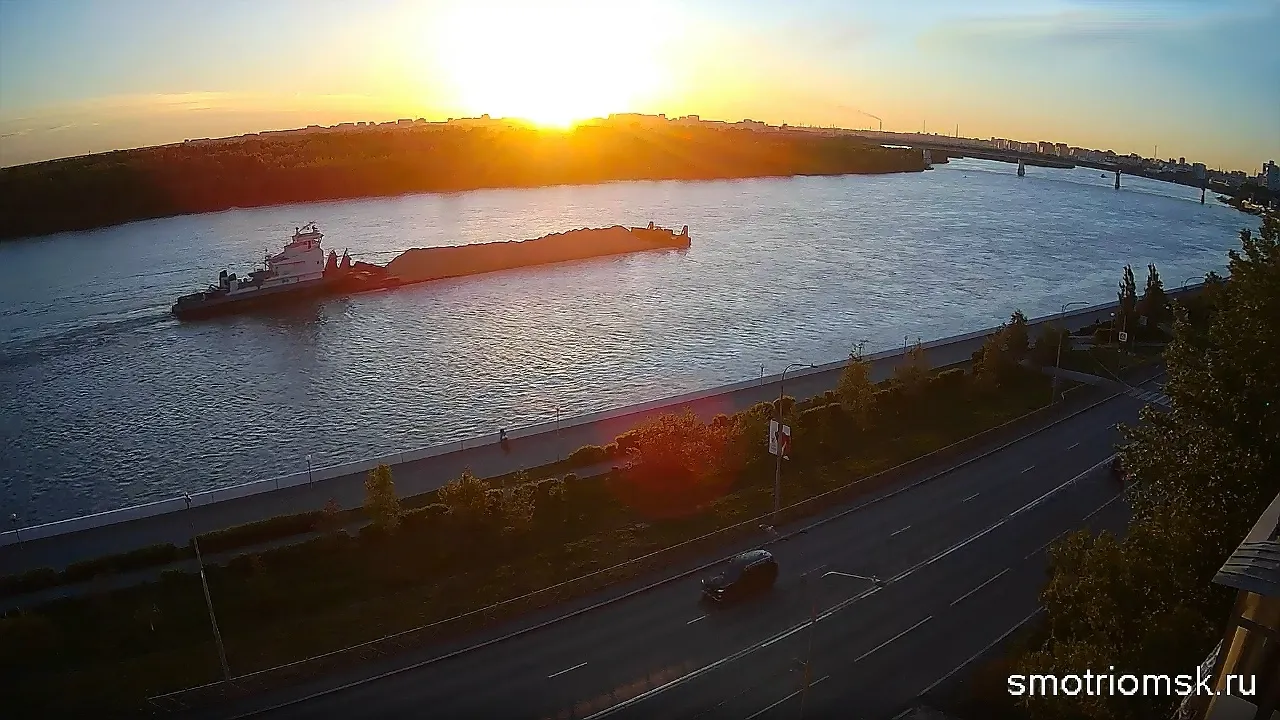
The Irtysh is Omsk's main waterway, one of the largest tributaries of the Ob River. The shoreline near Leningrad Square forms a distinctive landscape that complements the urban development. The live webcam shows how Karl Marx Avenue approaches the river valley, connecting the city's central area with the embankment.
The "Radost" Sign: Unofficial Symbol of the Avenue
Among the avenue's visual landmarks, a special place is occupied by the "Radost" (Joy) sign — an iconic object that has long become a symbol of this part of Omsk. It attracts the attention of passersby and tourists, and for local residents serves as a reference point for navigating the city.
The sign is an example of how commercial advertising can become part of a city's identity. On the real-time webcam, it can be seen in the context of the surrounding development: Stalinist buildings, modern retail outlets, intense traffic — all this serves as the backdrop for one of Omsk's most famous visual images.
Theater Square — The Beginning of the Avenue
Karl Marx Avenue originates from Theater Square — one of Omsk's key public spaces. It is here that the avenue begins its path through the city center, stretching to Vokzalnaya Square and the railway station.
Theater Square sets the tone for the entire avenue: monumental architecture, large-scale buildings, the feeling of a major city center. The webcam on Karl Marx Avenue shows the opposite end of the thoroughfare, but the connection with Theater Square is felt in the appearance of the development — Stalinist buildings in the background continue this line of monumentality.
Vokzalnaya Square — The End of the Route
The length of Karl Marx Avenue is several kilometers: from Theater Square to Vokzalnaya Square. Omsk's railway station is the endpoint of this thoroughfare, and the avenue serves as the main link between the station and the city center.
For those arriving in Omsk by train, Karl Marx Avenue becomes their first introduction to the city's architecture. The live webcam shows the part of the avenue closer to the center, but the entire thoroughfare functions as a single transportation corridor through which passengers disperse across the city.
Transport Life of the Avenue
The live webcam on Karl Marx Avenue demonstrates the intense traffic typical of Omsk's central streets. The wide multi-lane highway handles streams of cars, while buses — the city's main form of public transport — run along the sides.
Green zones with lawns and trees separate the traffic flows and create a more comfortable environment for pedestrians. Parking lots along the avenue indicate that the car remains an important element of urban mobility. The real-time webcam captures all this movement: from hurrying passengers to unhurried drivers.
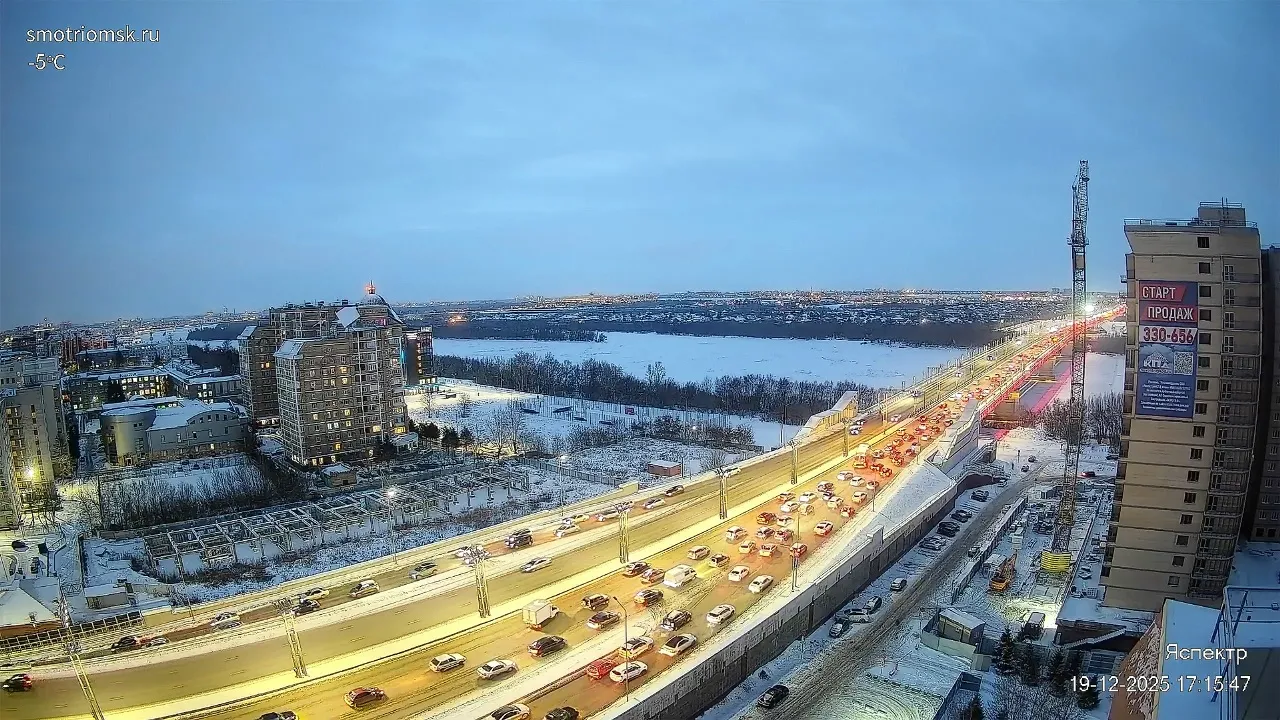
The construction crane in the background of the frame is evidence that the avenue continues to develop. New buildings appear alongside old ones, and the appearance of Omsk's central artery changes before our eyes. The webcam on Karl Marx Avenue allows you to observe this process in real time.
What You Can See on the Camera
The webcam overlooking Karl Marx Avenue in Omsk broadcasts an urban landscape with several characteristic elements. In the foreground — a wide multi-lane highway with intense car traffic and buses. Along the avenue are green zones with lawns and trees, as well as parking lots.
In the background rises the historical Stalinist-era development, including the famous "House with a Spire" built in 1951 in the Empire style. On the right you can see a commercial building with an optical store, in the center of the frame — a large retail building with a sign on the roof. In the distance, a construction crane is visible.
The camera also covers Leningrad Square, located between Karl Marx Avenue and the bank of the Irtysh River. The live broadcast allows you to observe in real time the flow of traffic, the operation of construction equipment, and the everyday life of one of Omsk's main avenues. The live webcam is a window into the urban environment, accessible to anyone who wants to see a Siberian metropolis without having to travel there.
Similar cameras
Find similar