Intersection of Karl Marx Avenue and Lermontov Street in Omsk — online webcam
Historical Intersection in the Heart of Omsk
The intersection of Karl Marx Avenue and Lermontov Street is one of those Omsk crossroads where history literally seeps through the asphalt. Pre-revolutionary merchant buildings, Stalinist Empire style, and modern urban infrastructure intertwine here. The online webcam allows you to observe this living hub of the city in real time — cars, buses, pedestrians, and architectural monuments that are already over a century old.
Omsk is a city with a rich past, and this intersection is an excellent illustration of its multi-layered history. Once upon a time, Moskovskaya and Tomskaya streets ran through here, and today it is a busy transport hub in the central part of the city.
Karl Marx Avenue: Three Streets in One
The modern Karl Marx Avenue is the result of a large-scale reconstruction in the 1920s. By the decree of the Omsk Gubrevkom dated February 19, 1920 three streets — Aptekarskaya, Artilleryyskaya, and Moskovskaya — were merged into a single avenue. This decision radically changed the appearance of Omsk's central axis, turning it into the city's main thoroughfare.
The avenue became a symbol of a new era: administrative buildings, workers' housing, and representative institutions lined up along it. Today, looking at the webcam, you can see how modern urban traffic flows along this thoroughfare — from passenger cars to public transport.
Lermontov Street: A Name Given a Century Before the Revolution
Lermontov Street has its own history of renaming. Originally called Tomskaya, in 1914, by decision of the City Duma, it was renamed Lermontovskaya — on the 100th anniversary of the poet's birth. This happened three years before the revolution, and the name stuck with the street forever, surviving all subsequent political eras.
Interestingly, the renaming was initiated not by the Soviet authorities, but by the Tsarist City Duma — a tribute to the great Russian poet whose life was tragically cut short in a duel at the age of 26. Lermontov Street became one of the few in Omsk to preserve its pre-revolutionary cultural name.
Architectural Heritage of the Intersection
The corner buildings at the intersection are true architectural monuments. Building No. 1 on Karl Marx Avenue (also No. 20 on Lermontov Street) was built in 1937 by architect A.I. Yumakaev in the Stalinist Empire style. This is a residential building for workers of the Tire Factory, with the status of a historical monument (object number 5500433000).
A memorial plaque is installed on this same building: from 1959 to 1962, Elena Vladimirovna Kalugina — founder of the Omsk State Russian Folk Choir lived here. Her name became an important part of Omsk's cultural history.
The other corner building — No. 27 on Lermontov Street — is even older. It was built in 1901 and is an architectural monument of regional significance (number 5500035000). It was here that the first meeting of the Omsk Council of Workers' Deputies took place — an event that foreshadowed revolutionary changes.
Building No. 56 on Karl Marx Avenue also preserves revolutionary memory: in 1907, it housed an underground printing house of the Omsk organization of the RSDLP. Today the building has the status of an architectural monument under number 5500000659.
Cossack Sloboda and Pre-Revolutionary Appearance
Before the 1917 revolution, the intersection was located in the area of the historical Cossack Sloboda. Moskovskaya Street (part of the future Marx Avenue) and Tomskaya (future Lermontov) were built up mainly with wooden houses. Until the late 1950s, wooden buildings still stood at the intersection, which were then gradually dismantled, giving way to stone construction.
This transition from wooden Omsk to stone Omsk is one of the characteristic features of urban transformation during the Soviet period. The webcam today shows the result of this long-term reconstruction: capital buildings, wide roadways, sidewalks, and green spaces.
Modern Life of the Intersection
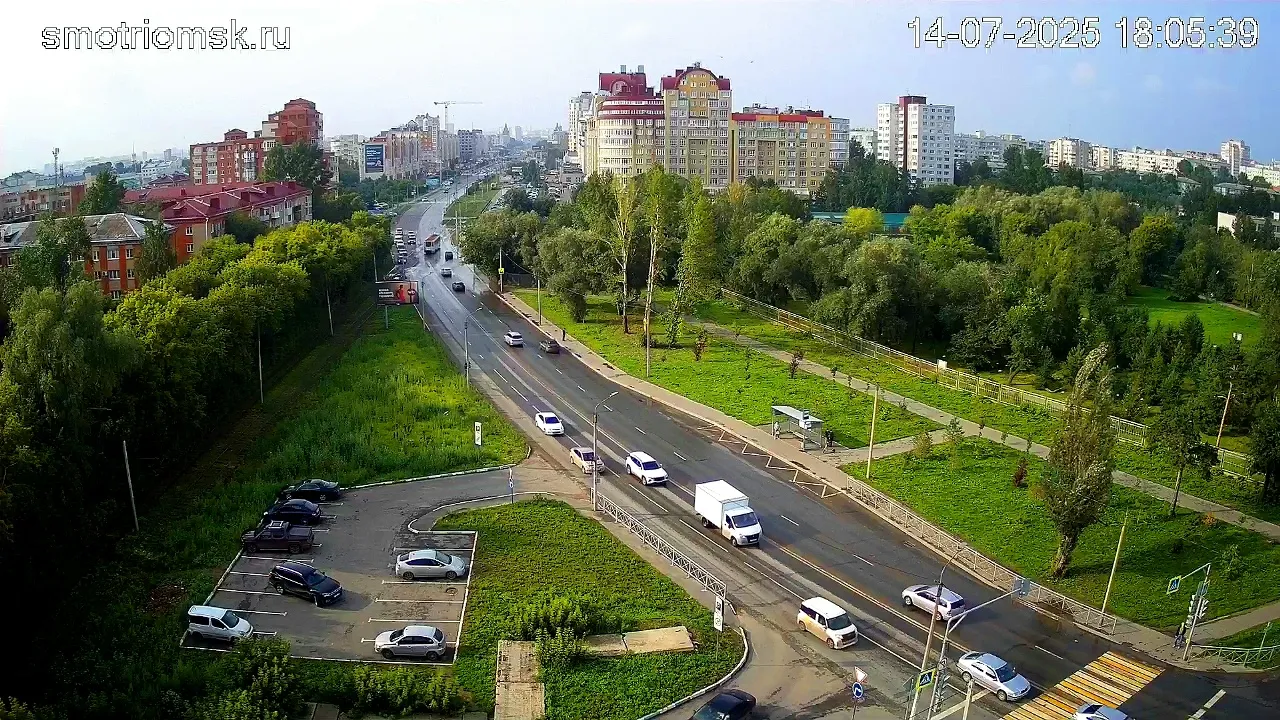
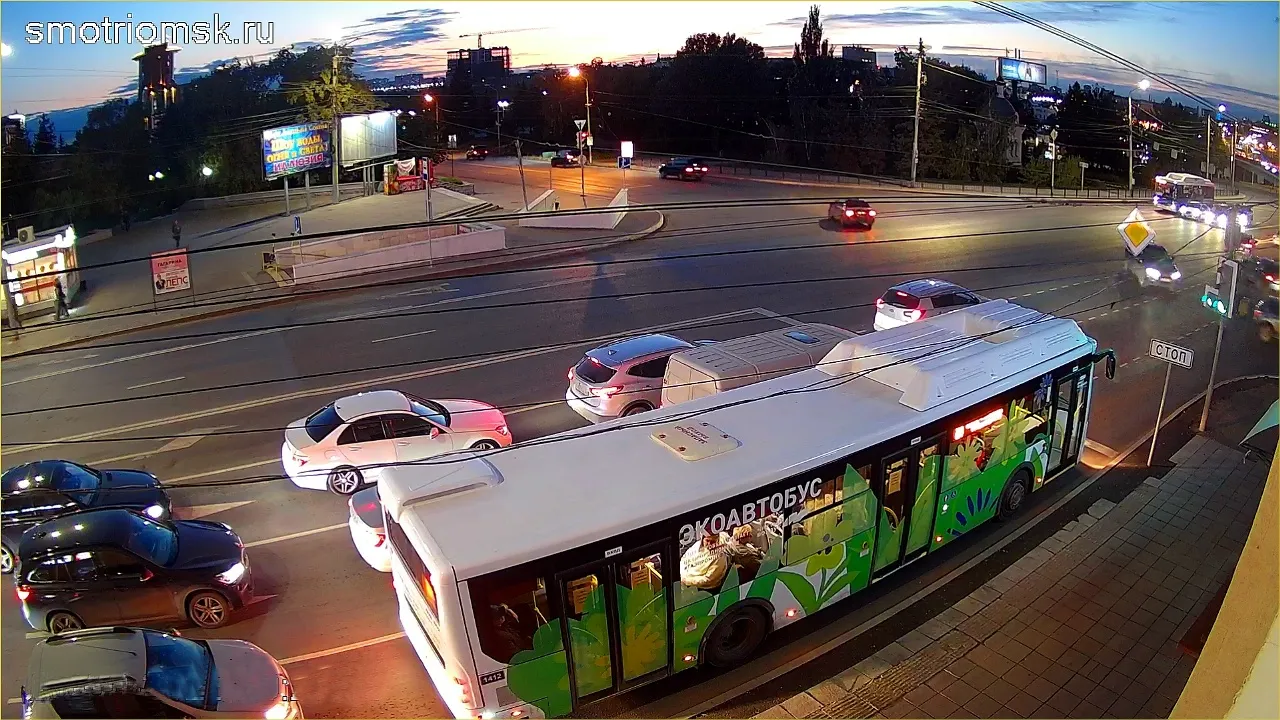
Today, the intersection of Karl Marx Avenue and Lermontov Street is a busy transport hub in Omsk. There is a public transport stop here, equipped with appropriate road signs. Multi-lane traffic runs along the avenue, regulated by traffic lights.
The area maintains a mixed character of development: both residential and commercial buildings, advertising structures, and street lighting are visible in the background. Trees and greenery create a pleasant contrast with asphalt and stone. The intersection is equipped with pedestrian zones and sidewalks, making it convenient for pedestrians as well.
What the Camera Shows
The camera overlooking the intersection of Karl Marx Avenue and Lermontov Street broadcasts a panorama of urban movement in real time. In the foreground is a public transport stop where buses and minibuses can be seen at different times. The intersection is constantly busy: passenger cars move in several lanes, obeying traffic light signals.
To the right of the roadway, a public transport stop sign is installed. In the background — billboards, street lights, greenery, residential and commercial buildings. Pedestrian zones and sidewalks are visible. The camera covers the entire intersection, allowing you to observe the rhythm of Omsk life — from heavy traffic during rush hours to calmer movement in the evening.
Similar cameras
Find similar