

🏙️ Pushkin webcams online — watch in real time
2 cameras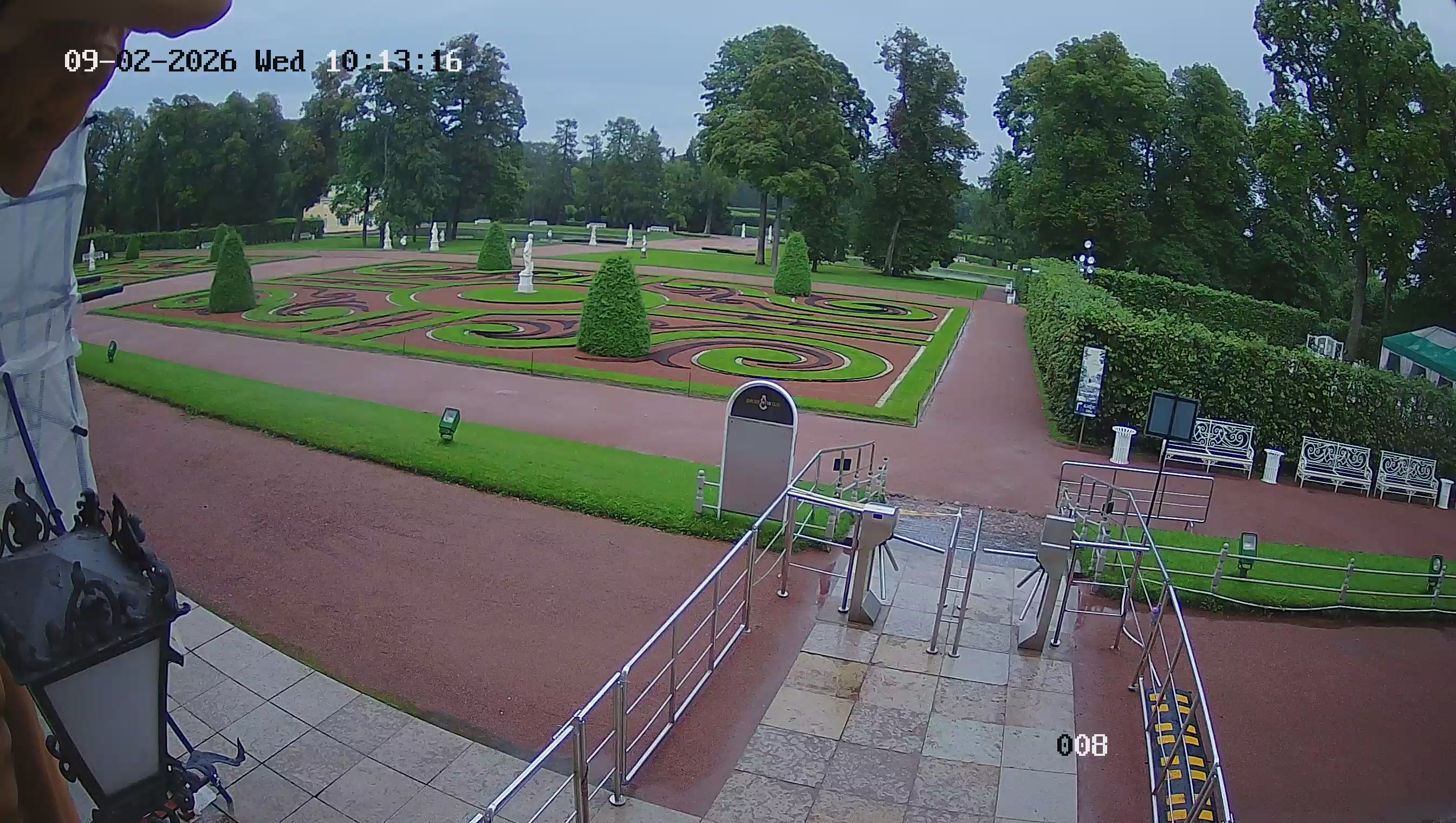

The Imperial Residence That Became a City of Poetry
The city of Pushkin, known as Tsarskoye Selo until 1937, is a former imperial country residence located 25 kilometers south of St. Petersburg. The history of this place is inextricably linked to the Romanov dynasty, Russia's great poet, and masterpieces of world art. Today, Pushkin webcams allow you to see the places where the history of the Russian Empire was made.
The first mention of the settlement dates back to the 16th century, when these lands belonged to Sweden. After victory in the Great Northern War, Peter I gifted them to his wife Catherine, and in 1717 the construction of a summer residence began. Thus Tsarskoye Selo — the "tsar's village" — was born, becoming a symbol of luxury and power.
The Catherine Palace: From Baroque to the Present Day
The heart of Pushkin is the majestic Catherine Palace, founded in 1717 by order of Empress Catherine I. The original building, constructed by the German architect Johann-Friedrich Braunstein, consisted of modest "stone chambers." The grand opening in 1724 was accompanied by cannon fire — 13 shots, one for each province of the Russian Empire.
The palace gained true fame under Empress Elizabeth, who began its reconstruction in 1743. The renowned Italian architect Francesco Bartolomeo Rastrelli created a masterpiece of Elizabethan Baroque — a 325-meter facade adorned with white columns and gilded stucco. About 100 kilograms of pure gold were used to gild the interiors. On July 30, 1756, the palace was presented to the empress and foreign ambassadors, arousing universal admiration.
Under Catherine II, the palace's appearance was enhanced by works from Scottish architect Charles Cameron — the Lyon Room and Arabesque Room appeared, decorated in the then-fashionable neoclassical style. The empress called the baroque palace "whipped cream" and preferred stricter interiors.
The Amber Room: A Mystery Still Unsolved
The main mystery of Pushkin is the lost Amber Room, created by German masters Karl Friedrich Gottlieb and Johann Wolfgang Schänzel between 1701 and 1709. Initially, the amber panels were installed at Charlottenburg Castle in Prussia, and in 1716 King Frederick William I gifted them to Peter I.
After several relocations, in 1762 the masterpiece took its place in the grand hall of the Catherine Palace. In 1941, when German troops occupied Tsarskoye Selo, the room was dismantled and transported to Königsberg. The further fate of the original remains one of the greatest mysteries of World War II — theories range from secret Berlin vaults to sunken Baltic ships.
In the 1970s, Soviet restorers began recreating the legendary room using surviving blueprints and photographs. In 2003, for the 300th anniversary of St. Petersburg, a full-scale replica was ceremoniously unveiled in the restored palace hall. Today, Pushkin webcams show the building where this recreated masterpiece resides.
The Tsarskoye Selo Lyceum: Cradle of Russian Literature
In 1811, the Imperial Tsarskoye Selo Lyceum opened in the wing of the Catherine Palace — an elite educational institution for children of the nobility. Among the first students was twelve-year-old Alexander Pushkin, admitted thanks to his writer uncle Vasily Lvovich Pushkin.
The six years spent at the Lyceum became for the poet a time of worldview formation and the beginning of his creative path. Here he found loyal friends — Anton Delvig, Wilhelm Küchelbecker, Ivan Pushchin — friendships he carried throughout his life. Pushkin's first poems were published in 1814 in the journal "Vestnik Yevropy," and the same year he was admitted to the exclusive literary society "Arzamas."
The educational system was truly innovative: young, passionate educators taught the students, learning proceeded without corporal punishment, and great attention was paid to languages, history, and literature. October 19, the day of the Lyceum's opening, was celebrated by Pushkin as the greatest holiday of his life until his dying day.
The Catherine Park: A Museum of Landscape Art
Around the palace stretches the magnificent Catherine Park — over 100 hectares of carefully planned landscape. Here the regular French style intertwines with the fashionable English landscape park of the 18th century.
Among the park's architectural gems are the Cameron Gallery connecting the garden to the pond, the "Turkish Bath" pavilion, the Admiralty on the shore of the Grand Pond, and the famous Agate Rooms. In the 1790s, by order of Catherine II, Giacomo Quarenghi built the Alexander Palace for her grandson, the future Emperor Alexander I, around which grew the vast Alexander Park spanning nearly 190 hectares.
Locals and guides tell of mystical phenomena in the park: at night near the Marble Bridge, the clatter of horse hooves is supposedly heard, and by the Cameron Gallery a "white lady" in a long dress appears. Whispers in the Tower Ruin are attributed to the spirit of a worker who died during its collapse. These legends lend a special charm to walks through the park.
Restoration from Ruins: The Feat of Restorers
The Great Patriotic War became a terrible trial for Pushkin. In 1941, the city was occupied and the Catherine Palace severely damaged. Of the 58 halls destroyed during the war, 32 have been restored — work continues to this day.
In 1947, the Leningrad school of restorers began large-scale restoration on a strictly scientific basis. The process was led by outstanding masters: N. V. Baranov, A. A. Kedrinsky, N. E. Tumanova, and I. P. Sautov. A total of 350 specialists from various professions were involved — gilders, stucco workers, woodcarvers, and painters.
On May 23, 2010, the restored Throne Hall and Arabesque Room were ceremonially reopened. In April 2019, the first major restoration in a century and a half of the palace's Resurrection Church was completed after four years of work. The church interior conservation project won the international "Golden Trezzini-2020" competition.
Traditions of the Imperial Family: From Hospitals to New Year Trees
The life of the imperial family in Tsarskoye Selo was filled not only with court ceremonies but also with touching traditions. In the early 20th century, the all-Russian tradition of New Year trees was born here — in 1898, Nicholas II and Alexandra Feodorovna first decorated a forest beauty in the Catherine Palace.
The five royal children grew up in an atmosphere free from excess: they wore ordinary noble clothing, studied from the same textbooks as gymnasium students, and rode bicycles along park paths with abandon. During World War I, the empress redirected funds intended for celebrations to open more than 80 military hospitals and infirmaries. In the palace halls where balls were once danced, white beds for the wounded stood.
Easter holidays were accompanied by the gifting of luxurious Fabergé eggs, while summer evenings brought secret tea parties in the garden accompanied by chamber concerts. Winter featured night masquerade balls with fireworks, and the traditional "royal" hunt with hounds was an essential attribute of the autumn season.
From Tsarskoye Selo to Pushkin: Three Names of One Place
The history of renaming reflects the complex turns of Russian history. On August 29, 1808, under Alexander I, Tsarskoye Selo received city status. After the revolution, on November 7, 1918, the Petrograd Soviet issued a decree renaming it Detskoye Selo of Uritsky — the idea of turning the "tsar's kingdom" into a "children's kingdom" belonged to People's Commissar of Education Anatoly Lunacharsky.
In 1937, on the centenary of the poet's death, the city received its current name — Pushkin. This decision by the Soviet authorities cemented the memory of the great Lyceum student in the name of the place where he spent his best years. Today, Pushkin webcams broadcast views of a city where every street preserves echoes of the imperial past and the poet's Lyceum youth.
What the Cameras Show
This page features Pushkin webcams broadcasting views of the city's main attractions. You can observe the Catherine Palace, park walking areas, and historic streets in real time. Online streams allow you to see what the city looks like at any time of year — from golden autumn to snowy winter.
Watching Pushkin webcam streams is possible right now: choose a location of interest and enjoy views of the former imperial residence. The cameras are positioned to cover the city's key points — from museum entrances to quiet park paths. This is an excellent opportunity to plan a future trip or simply take a virtual walk through the places where history was made.