

🏙️ Kudrovo webcams online — watch the city in real time
1 cameras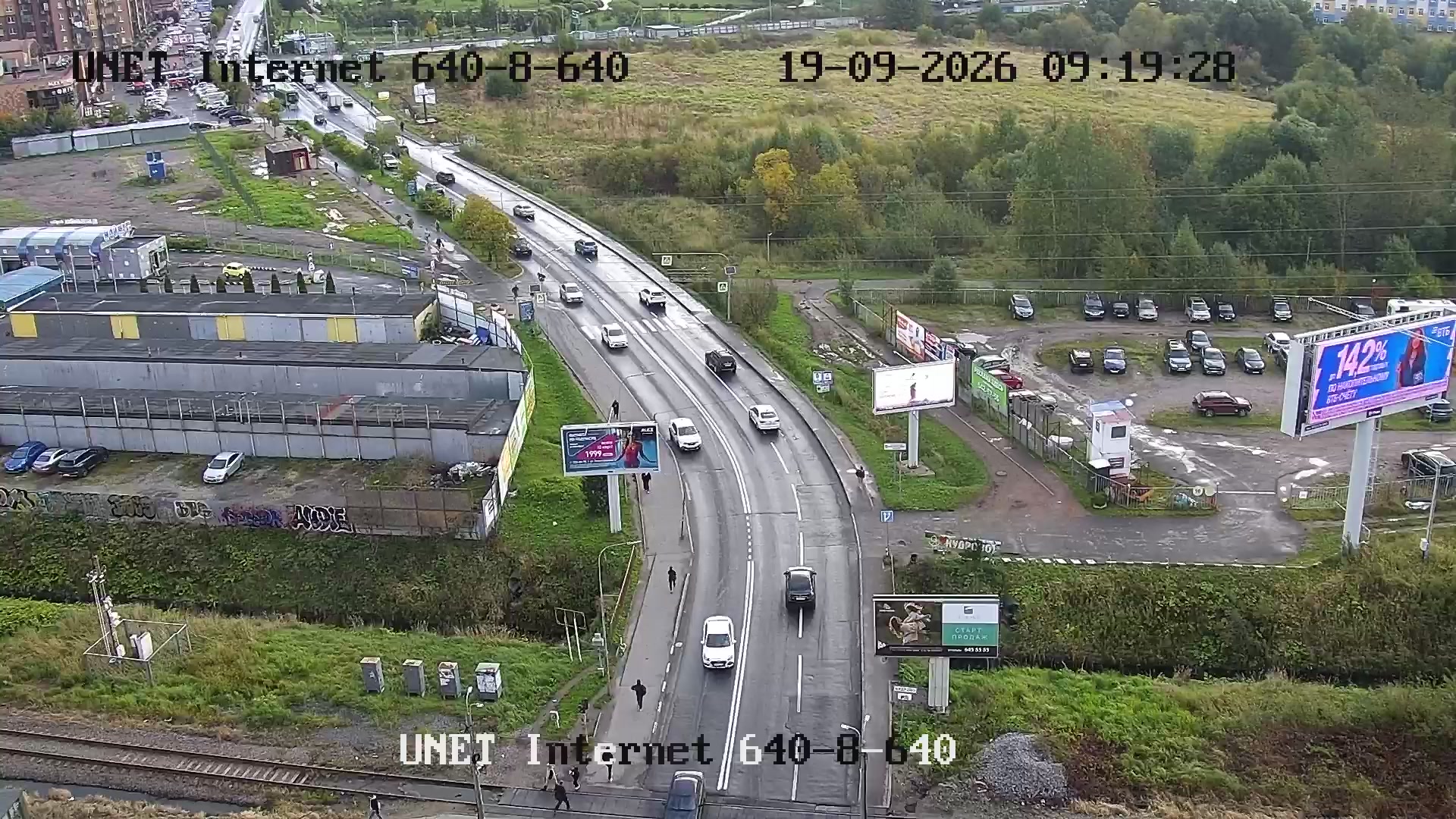
Kudrovo: from village to city in a decade
Kudrovo is one of the most striking examples of urbanization in Russia. Back in 2007, only 91 people lived here, and today it is a full-fledged city with a population of 68,384 people. Kudrovo was granted city status on June 28, 2018, which was the logical outcome of the territory's rapid development.
Located in the Leningrad Region, Kudrovo borders St. Petersburg and is just 2 kilometers from the "Ulitsa Dybenko" metro station. The population density here reaches 9,815.8 people/km² — one of the highest rates in the region.
History of the name: communards and landowners
The name "Kudrovo" has several origin versions. According to one of them, in 1925, the first communards from the Luga uyezd of Petrograd Governorate arrived at the site of the dying agricultural artel "Krasnaya Zarya." Twelve large families led by communists Vasily Ivanovich Evstifeev and Ivan Pavlovich Yolkin founded a new settlement, which they named Kudrovo — in honor of the commune that already existed there.
Another version links the name to the surname of landowner Kudrov, who owned an estate here. In the center of the modern city, remnants of the estate complex have been preserved, including a two-story stone building and three parks descending to the Okkervil River — a left tributary of the Okhta.
Kudrovo during the Great Patriotic War
During the Siege of Leningrad, Kudrovo played an important role in the city's defense. There was an airfield here where U-2 aircraft — the famous "Night Witches" of the 13th Army — were based in 1942. The defense line ran along the railway and local parks, and concrete pillboxes and trenches have survived to this day.
On the territory of Kudrovo was one of the most productive collective farms in the Leningrad Region — "Yablonovka." Rural women grew vegetables for besieged Leningrad, and the plant breeders of the "Kudrovo" collective farm springized over 30,000 potato sprouts using remnants from personal households. Thanks to its proximity to Lake Ladoga, Kudrovo participated in the work of the "Road of Life" — the only transport highway connecting the besieged city with the "mainland."
Kudrovo Forest: the green lungs of the city
Kudrovo Forest is a large area of mixed broadleaf and coniferous plantations located in the southwestern part of the St. Petersburg agglomeration. The territory covers more than 300 hectares and preserves more than 500 plant species, including rare and protected species listed in the Red Book of Russia.
The forest is home to hares, foxes, owls, black storks, and badgers. It is an important ornithological and biological reserve that helps clean the air from urban pollution and maintains the microclimate. A network of hiking and cycling trails, small lakes, and observation decks makes it a popular recreation spot for Kudrovo residents.
Transport situation: traffic jams and hope for the metro
Today, Kudrovo residents are forced to reach the nearest "Ulitsa Dybenko" metro station along the perpetually congested Murmansk Highway. However, the situation should change: construction of the "Kudrovo" metro station is planned for 2035.
The station will be the terminus of the Lakhtinsko-Pravoberezhnaya line, following "Ulitsa Dybenko." The project provides for a pylon station of deep burial — about 70 meters with an island platform 162 meters long. The appearance of the metro will be an incentive for new projects: developers are already planning to launch additional phases of residential complexes with an emphasis on proximity to the station.
Residential infrastructure: a city within a city
In recent years, more than 2 million square meters of housing have been built in Kudrovo. Residential complexes "Vienna," "London," "Kudrov-Haus," "Austrian Quarter," "Birch Grove," "Vernisazh," "ParkLand," and "KudroVO!" shape the architectural appearance of the city. The average price per square meter ranges from 170 to 200 thousand rubles — lower than in neighboring districts of St. Petersburg.
Commercial infrastructure is represented by major chains: IKEA, "Spar," "Semya," "Dixy," "Lenta," "Auchan," "Magnit." About 350 individual entrepreneurs and about 500 legal entities operate in the territory, making Kudrovo a self-sufficient urban entity.
"Nevsky Pyatachok" microdistrict: memory of the siege
The "Nevsky Pyatachok" microdistrict got its name from a historical military site — a Soviet bridgehead on the left bank of the Neva opposite Nevskaya Dubrovka. In 1941–1943, during the Siege of Leningrad, this small piece of land, shaped like a spot (pyatok), was held by Soviet troops as a bridgehead for the future breakthrough of the siege.
From this distinctive silhouette came the name "Nevsky Pyatachok," which was later adopted for the residential area built in that location. Today it is one of the districts of Kudrovo, where people live whose ancestors defended Leningrad on this very bridgehead.
What the cameras show in the city
Kudrovo webcams allow you to observe the life of the city in real time. Our page collects broadcasts from key points: central streets, residential complexes, park areas, and transport interchanges. You can watch Kudrovo online — see how the new city is being built, how its architecture is changing, and how its residents live.
Cameras in Kudrovo are an opportunity to observe one of the fastest-growing cities in Russia, which in a decade has transformed from a village with a population of 91 into a full-fledged city with nearly 70,000 residents. Watch Kudrovo webcams online and become witnesses to the history of this amazing place.