

🏙️ Lampedusa Webcams Online — Watch the Sea in Real Time
1 cameras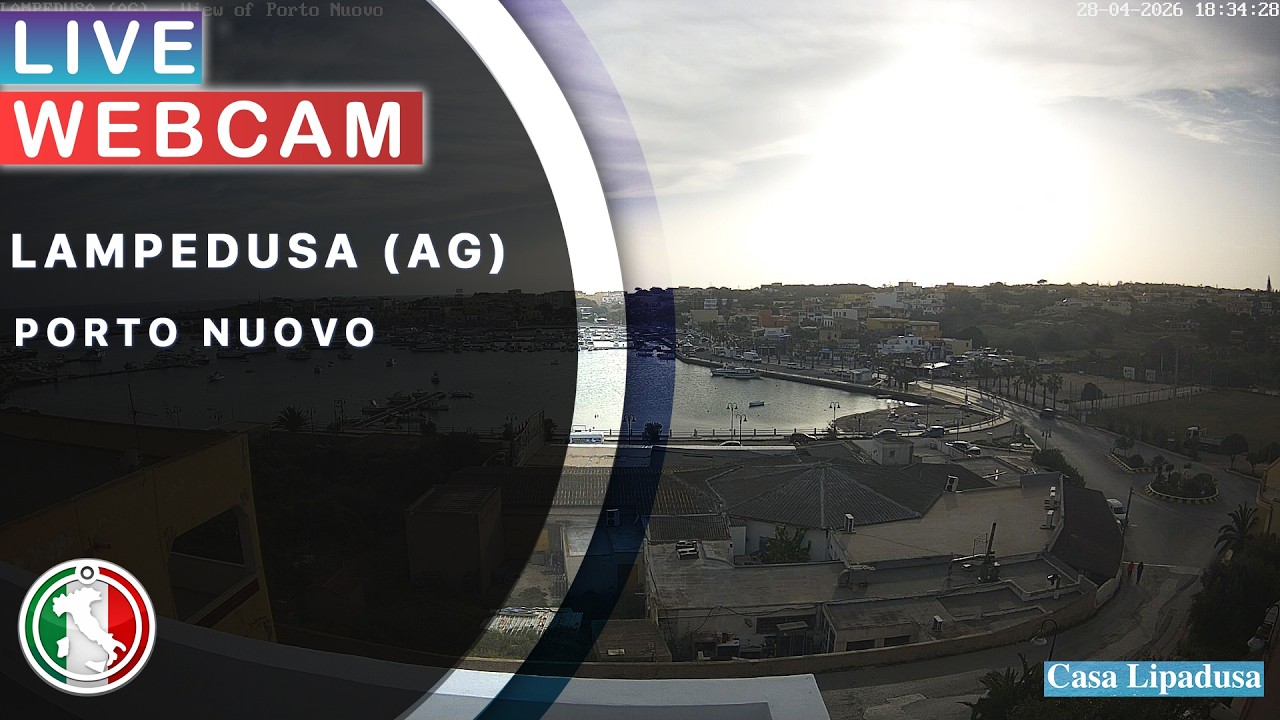
A piece of land in the middle of the Mediterranean Sea
If you look at a map of Europe, the southernmost point on Italian territory is Lampedusa: a rocky island in the Strait of Sicily, lying closer to Tunisia than to Sicily. Together with Linosa and the islet of Lampione, it forms the Pelagie Archipelago — a chain of islands whose name comes from the Greek "pelagos," meaning open sea. There are no grand monuments or gloomy cathedrals here — just emerald water, white sand, windy cliffs, and a small town living to the rhythm of the sea. That's why Lampedusa webcams online are one of the most atmospheric ways to experience the south of Italy: the live feed shows the turquoise expanse, boats in the harbor, and the scorching Mediterranean light.
Island history: from Greeks and Romans to the present day
Lampedusa was known to Phoenicians, Greeks, and Romans as a stopover on sea routes between the East and Africa. The island's name is associated with the Greek word "labedosa" — the name given to the resin extracted from local algae. A permanent settlement appeared late: the island was populated in waves from the 18th century, and its history can still be read in the architecture — low white houses that look more North African than Sicilian. Archaeological excavations here have been conducted since the early 20th century: traces of settlements dating back to the Bronze Age have been found — the island was inhabited long before its current name appeared on maps.
Rabbit Beach — Lampedusa's calling card
If you've ever seen the famous photos of "Mediterranean Maldives," it was almost certainly the bay of Spiaggia dei Conigli. The beach lies on the southwest coast, opposite the tiny islet of Isola dei Conigli — Rabbit Island, which gave its name to the entire bay. This is a protected natural area within the Riserva naturale orientata di Lampedusa, operating since 1995 — Rabbit Beach is a nesting site for loggerhead sea turtles Caretta caretta, for which access is restricted here. White coral sand, shallow transparent sea, and a strip of azure of a shade rarely found in the Mediterranean have made this place a constant star of world beach rankings — Spiaggia dei Conigli regularly appears on lists of the world's most beautiful beaches. The webcam on Lampedusa's beach is probably the most popular spot on the island for online viewing: the live picture lets you check if there's a queue, whether the sea is rough, and what that famous "turquoise" color actually looks like.
Capo Grecale Lighthouse and the northern cliffs
On the northeastern tip of the island, on the edge of a cliff, stands the Faro di Capo Grecale — a lighthouse built in 1855. An octagonal tower 19 meters high with a lantern and balcony rises above the two-story keeper's house — a classic 19th-century maritime silhouette. From the lighthouse observation deck, there is a 360-degree panorama of Lampedusa and the Strait of Sicily, and the place is famous for its shell trail and magnificent sunsets — travelers note the view from Capo Grecale as one of the island's main highlights. The northern cliffs are the opposite of the "Maldivian" south: jagged limestone rocks, crashing surf, and crystal-clear depths stretching all the way to Tunisia.
The town, the waterfront, and the memory of the sea
The island's only settlement bears the same name as the island itself — Lampedusa. It's a compact town with flat roofs, narrow streets, and surprisingly lively activity around the main street of Via Vittorio Emanuele III. Here too is the port, from which boats depart to remote coves, and the waterfront, where locals and travelers gather in the evening. On the waterfront stands the Memorial to Deceased Migrants with the inscription "In memory of those who died at sea seeking a better life" — a simple monument recalls the dramatic role of Lampedusa in recent history. For decades, the island was the first European land on the path of migration boats, and this theme has forever become part of the small town's identity — along with fishing, tourism, and turtle sanctuaries.
What else to do: coves, dunes, and the underwater world
A boat trip around the island is a must: boat captains show Cala Creta, Cala Pulcinella, a grotto, and a sunken ship, and in the transparent shallow water, schools of fish are visible. Guittitia Beach near the town is the most convenient for swimming — sandy and shallow — while Cala Creta is famous for its rocky "pools" and underwater life — an ideal spot for snorkeling. You can get there by bus too: the island's only public route departs from the city center — schedules and beach access should be checked in advance, because protected zones close earlier than the rest of the coast for the sake of the turtles. Diving centers, windsurfing, bird watching during migration season — the island operates as a large nature park where the main entertainment is the Mediterranean Sea itself.
Lampedusa in numbers and facts
The island's area is about 20 km², its length is just over 10 kilometers, and the terrain is almost flat: the highest point barely exceeds 100 meters. Lampedusa Airport (IATA: LMP) is the only airport on the island, and it's located practically within the city limits, just 2.6 km from the center — you can get from the plane to the hotel in just a few minutes. The Pelagie Archipelago is administratively part of Sicily, but geographically and climatically closer to Africa: summers here are long and hot, winters are mild, and the wind is a permanent resident of the island, earning it the nickname "windy Lampedusa." Part of the island's territory is included in the system of protected natural areas, and the island of Lampedusa as a municipality belongs to the province of Agrigento — geographical information about the island is available on maps.
What sea will the online camera show
The color of the water here is a separate attraction. The shade of the sea surface changes from deep blue on the outer cliffs to almost white-green over the sandy bottom of Rabbit Beach, and the live broadcast captures these changes better than any photograph: in a couple of hours, the sky, wind, and sea surface manage to change several times. That's why watching Lampedusa via webcam is not only a way to "preview" a vacation, but also a small ritual: turn on the live feed, hear (in your mind) the cries of seagulls, and see that the island still stands in its place in the middle of the strait.
What the cameras show
This page features Lampedusa webcams operating in real time and for free. The main observation points are Guittitia Beach with a view of the city coastline, Capo Ponente with a panorama of the western lighthouse, and Cala Creta Bay in the north of the island. Street cams on the waterfront and at the beaches allow you to assess the weather and sea in HD quality live, and the online broadcast from the town shows the measured life of the main street. Choose a camera on the map or in the list — and Lampedusa will open to you in real time: turquoise sea, white roofs, and the Strait of Sicily on the horizon.