

🏙️ Webcams Gallipoli online — watch the Italian city in real time
1 cameras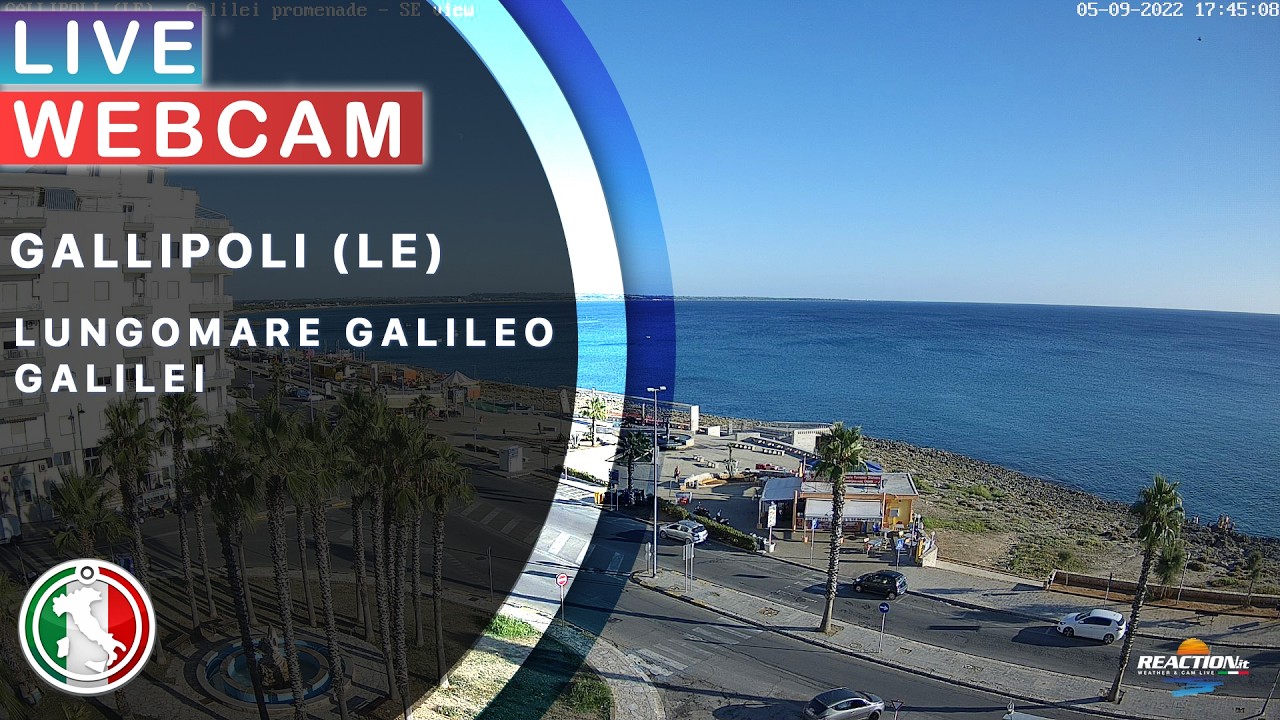
Historic center — a city on an island in the Ionian Sea
Gallipoli is one of those Italian cities that amaze you at first glance. Its old center sits on a small island connected to the mainland by the 16th-century Ponte Antico bridge. That is why locals still call the historic part of the city a peninsula — water laps at the walls from all sides, creating the sensation that the city is floating above the sea. The name Gallipoli comes from the ancient Greek Kallípolis — "beautiful city", and it has proudly borne this name for over two and a half thousand years. The Greek heritage is felt here in every stone — from the layout of the alleys to the names of the squares.
Narrow borgo alleyways wind between palazzi and churches, opening onto waterfronts where fishing boats bob at the docks alongside yachts. In the evening the city transforms — golden sunset light floods the facades, and the aroma of fresh fish and olive oil drifts from the open doors of trattorias. It is in such moments that you want to stop time — or at least have the chance to return here mentally through a webcam, to feel this atmosphere once again.
The Greek Fountain — a monument of the Hellenistic era
One of Gallipoli's most mysterious landmarks is the Greek Fountain (Fontana Greca), considered one of the oldest fountains in Italy. It was originally built in the 3rd century BC near ancient thermal baths, then moved in 1548 to the church of San Nicola, and by 1560 it had taken its current location by the Ponte Antico. The fountain is adorned with bas-reliefs depicting mythological scenes based on Ovid's "Metamorphoses" — here you can make out the transformations of Daphne, Diana, and Actaeon. Each bas-relief tells its own story, turning an ordinary fountain into a true open-air museum.
Legends say that it was at this fountain that lovers exchanged vows of fidelity, and sailors tossed coins before long voyages, asking the ancient gods for a safe journey. Today the Greek Fountain is a magnet for tourists and locals alike, who fill bottles with its water, believing in its healing properties.
Underground oil presses — heritage of the olive oil capital of Europe
Few people know that Gallipoli in the 17th–18th centuries was considered the "European capital of olive oil". From the port of this small town, ships laden with olio lampante set sail for London, Paris, Vienna, and Berlin — it was this oil that lit the European capitals before the advent of gas lamps. The oil was not used for cooking but as fuel for street lighting, making Gallipoli a key player in the energy market of its time.
In the historic center of the city, about 35 underground oil presses (Frantoi Ipogei) have been preserved, carved entirely into the limestone rock of carparo below street level. Some date back to the 16th–17th centuries and are entire underground labyrinths with pressing rooms, oil settling tanks, and workers' quarters. Descending a steep staircase, you enter another world — cool, dark, saturated with the scent of olives and stone. These oil presses are a unique monument to the history of olive oil production, with no equivalent anywhere else in Europe.
Architecture and religious shrines of Gallipoli
The Cathedral of Saint Agatha dominates the skyline of the old city. It was built in the 17th century in Baroque style on the foundation of an ancient pagan temple — and this is not a metaphor but literally true: excavations here uncovered fragments of Roman columns and an altar. The facade is adorned with inlays of local carparo limestone, and inside is kept a relic — the Mammella di Sant'Agata, venerated by the faithful for centuries. Next to the cathedral rises the bell tower, offering a view of the entire Ionian coast.
Equally significant for the townspeople is the Church of Santa Maria della Purità, which houses a statue of the Madonna of Mercy, known locally as La Desolata. On Holy Saturday morning, it is carried in procession alongside the statue of the Dead Christ — this is one of the city's most important religious traditions, drawing thousands of believers. Spanish rule, which lasted in Gallipoli through the 1500s, left its mark on palace facades — unique decorative details characteristic of Spanish influence can still be seen if you look closely at the stonework above doorways.
Nature and the Sant'Andrea Park
Beyond the historic center, Gallipoli reveals a different landscape — rocky shores, pine groves, and azure bays. The municipality is home to the regional nature park "Isola di Sant'Andrea and Punta Pizzo Coast", established by regional law No. 20 of July 10, 2006. The park encompasses not only the island of the same name but also a stretch of coastline with dunes where rare bird species nest. The crystal-clear waters around Sant'Andrea Island attract divers and snorkelers — the underwater world here rivals tropical resorts.
The coast between Gallipoli and Porto Cesareo is a succession of sandy beaches and rocky headlands, where everyone will find a spot to their liking. The beaches of Lido San Giovanni, Baia della Verdura, and Punta Pizzo are famous for their pristine water and well-developed infrastructure. And if you venture a little further, you can discover hidden coves untouched by mass tourism — only locals and those seeking solitude with nature.
What the cameras show
Gallipoli's webcams let you see the city in real time — from the waterfront with fishing boats to panoramic views of the old center from above. Cameras installed at key points show traffic on the Ponte Antico bridge, the life of the squares, and the state of the sea. It is a convenient way to plan a trip, check the weather on the coast, or simply enjoy the view of the Ionian Sea without leaving home. Choose a stream and head to Gallipoli — even if just for a few minutes.