

🏙️ Cape Town Webcams — Watch the City Live Online
4 cameras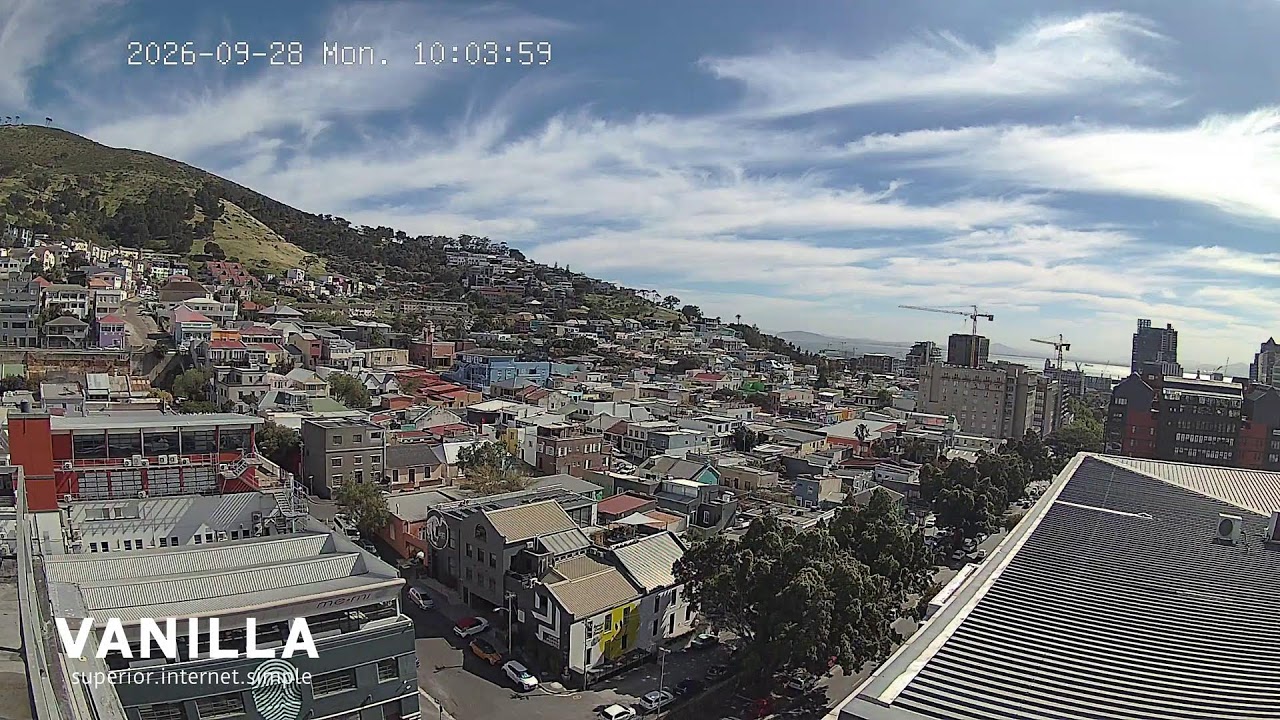


Cape Town — the city where oceans meet
Cape Town stretches at the foot of Table Mountain in the southwest of South Africa. It is the country's second-largest city with a population of about 4.8 million people and one of the most picturesque cities in the world. Here, South Africa's parliament sits in a building visible from the waterfront, while the business center neighbors historic quarters where time seems to have stood still.
The city was founded on April 6, 1652 by Jan van Riebeeck as the first European colony on the southern tip of Africa. The Dutch East India Company needed a waystation for ships heading to India, and the Cape of Good Hope was ideal for this purpose. For almost 200 years, Cape Town remained the most important port on the route between Europe and Asia until the Suez Canal opened in 1869.
Table Mountain — the symbol of the city
It is hard to imagine Cape Town without its main calling card. Table Mountain rises 1,086 meters above sea level, and its flat summit has served as a landmark for sailors since the 16th century. Portuguese admiral António de Saldanha named it Taboa do Cabo — "table of the cape" — in 1503. The indigenous Khoisan people called the mountain Hoerikwaggo, which translates to "mountain in the sea."
The age of Table Mountain's rock is about 600 million years, making it one of the oldest mountains on the planet. For comparison: the Alps are only about 40 million years old. Today, you to the summit via a cableway built back in 1929 and modernized to carry up to 60 people per ride. The view from above is such that you realize — for the sake of this one shot alone, it is worth flying halfway around the globe.
Bo-Kaap: the colorful heart of Cape Town
At the foot of Signal Hill, above the business center, lies the Bo-Kaap neighborhood — the Malay Quarter. Its history began in the 18th century when the Dutch brought slaves here from Asian colonies: India, Sri Lanka, Malaysia, Indonesia. They were the ones who founded the Muslim community that still exists here.
The district covers an area of less than 2 kilometers in length and 0.5 kilometers in width, but this compactness holds a unique culture. Here stands South Africa's oldest mosque, Auwal Mosque, built in 1793 or 1794. The colorful facades of the houses appeared after the end of apartheid — residents began painting the walls in rich colors, and this tradition became the neighborhood's calling card. Neighbors still coordinate with each other on shades to keep the area harmonious.
Robben Island: the place where freedom was born
In Table Bay, 6–9 kilometers from the shore, lies Robben Island — a place that is impossible to forget. Since the 17th century, it served as a prison: first Dutch, then British. From 1846 to 1931, it housed a leper colony, and from the mid-1960s to 1991 — South Africa's strictest prison for political prisoners.
Nelson Mandela spent 18 of his 27 years of imprisonment on the island — from 1964 to 1982. His cell in section B measured just 2 by 2 meters. Prisoners were forbidden to talk, forced to work in a limestone quarry, and made to wear only shorts even in winter. Today, the island is a UNESCO World Heritage Site since 1999 and a museum that can be reached by ferry from the Victoria & Albert Waterfront.
Penguins on Boulders Beach
One of Cape Town's most unexpected contrasts is a colony of African penguins in the middle of a beach. In 1982, only two pairs of birds came here, but according to the 2026 census data, about 790 pairs now nest on Boulders Beach — roughly 2,530 individuals. The colony accounts for 8–9% of the entire African penguin population in South Africa.
The beach is named after huge granite boulders, which are about 540 million years old. These stones create sheltered coves where the penguins feel safe. Visitors can observe them from wooden walkways without disturbing the birds. The African penguin is listed in the Red Book, and the colony in Cape Town is one of the few showing steady growth.
Two oceans and one aquarium
Cape Town is often called the city of two oceans, although formally the boundary between the Atlantic and Indian Oceans runs along Cape Agulhas — the southernmost point of Africa, located about 150 kilometers southeast of the city. It is here that the warm Agulhas Current turns back into the Indian Ocean, forming huge eddies that influence global heat circulation on the planet.
Cape Town itself is home to the Two Oceans Aquarium — the largest in the Southern Hemisphere. It showcases the inhabitants of both oceans: from white sharks and southern right whales to vibrant tropical fish. This is a place where you can see with your own eyes how different the underwater worlds separated by a single continent can be.
Neighborhoods and atmosphere of the city
Cape Town is a city of contrasts. The business center with skyscrapers neighbors historic quarters, the beaches of Clifton and Camps Bay — the industrial zones of Table Bay. The southern suburbs of Claremont and Wynberg are growing the fastest, while the slopes of Table Mountain and Signal Hill remain the most prestigious residential areas.
The Victoria & Albert Waterfront is the tourist heart of the city. Ferries to Robben depart from here, restaurants and shops operate here, and in the evenings musicians and artists gather. The Woodstock area has transformed into a creative cluster with galleries and workshops, and District Six, once razed to the ground during the apartheid era, is gradually being revived as a symbol of restorative justice.
Climate and best time for observation
Cape Town lies in a Mediterranean climate zone: dry hot summer from November to March and mild rainy winter from June to August. In summer, temperatures rise to 25–30°C, and the city fills with tourists. In winter, the mountains are often wrapped in clouds, creating the famous "tablecloth" on Table Mountain — a natural phenomenon where cloud cascades down the slopes of the flat summit.
For observing the city via webcams, morning hours are best: at this time, the lighting accentuates the relief of the mountains, and the ocean is not yet covered in haze. In the evening, you can watch Signal Hill catch the sunset and the lights of the waterfront come on.
What the cameras show
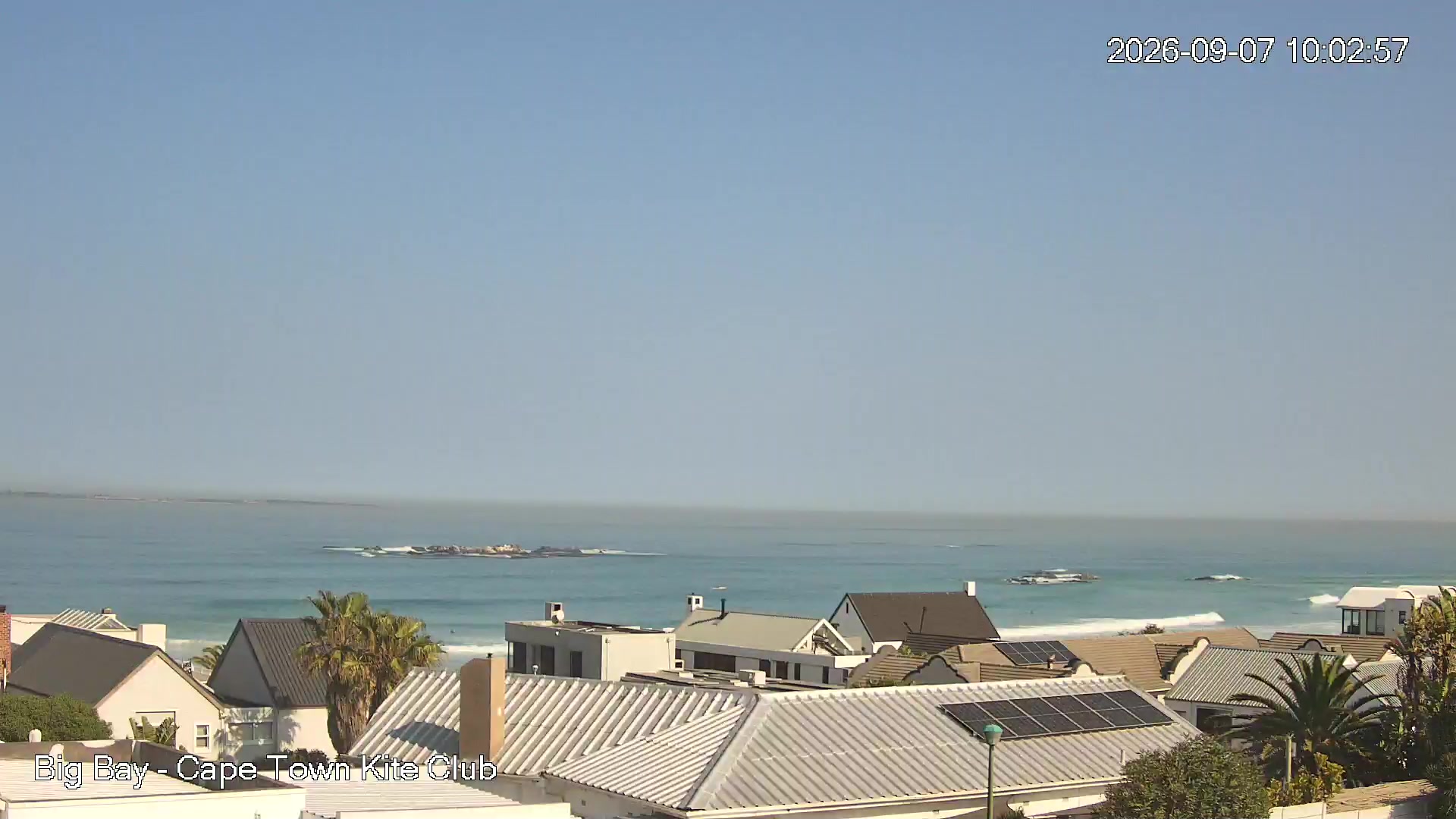
Cape Town's webcams are located at key points in the city: on Table Mountain, the Victoria & Albert Waterfront, the beaches of Clifton and Camps Bay, as well as in the Bo-Kaap neighborhood. They allow you to observe the city in real time — from the movement of ships in the harbor to the penguin walks on Boulders Beach.
When choosing a camera, pay attention to the angle: panoramic cameras on Table Mountain show the entire city and Table Bay, while cameras on the waterfront show the everyday life of Cape Town, its rhythm and atmosphere. Whether you are planning a trip or simply want to see a city on the other side of the world, live streams reveal Cape Town as it is right now.