

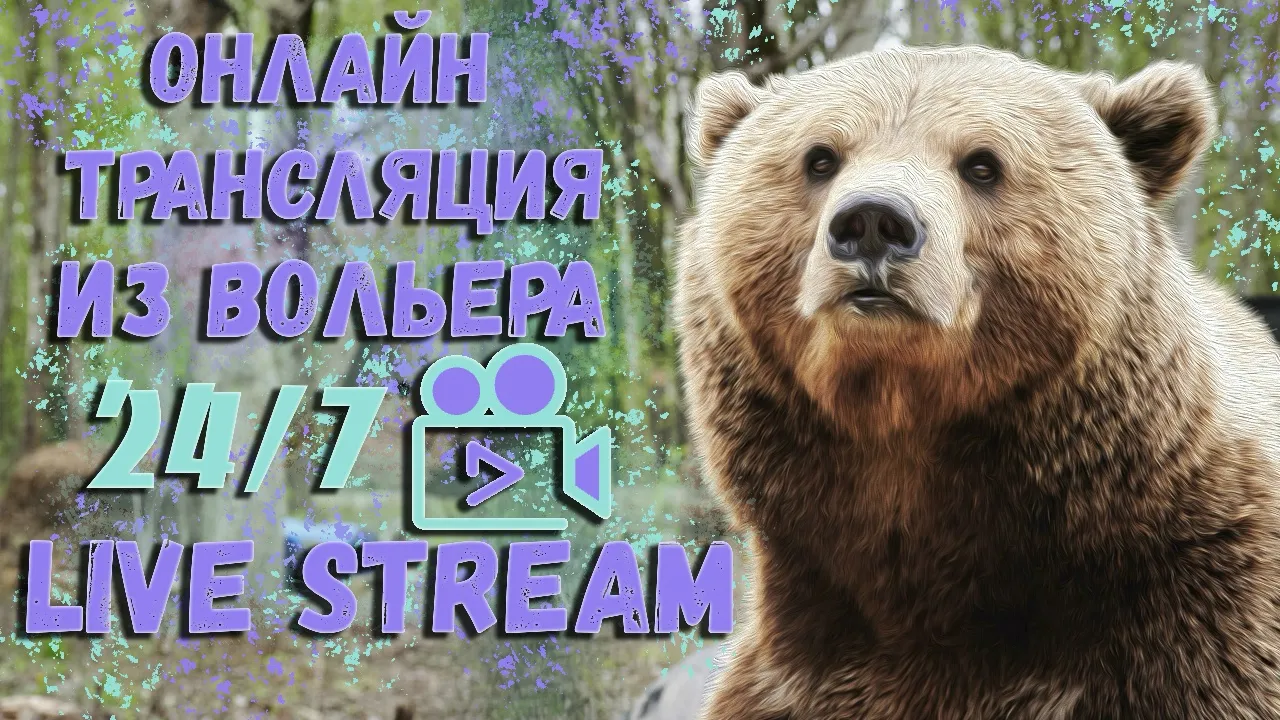
Mansur the Bear in Vorytynsk — Live Webcam Online
How the bear cub became an aviation bear
In the spring of 2016, pilots found a tiny bear cub on the runway of the Orlovka airfield in Tver Oblast. He sat alone, without his mother, completely bewildered. The pilots decided to keep the little one, and pilot Andrei Ivanov took care of him, now known as Mansur's "father." The bear cub grew up among airplanes, got used to the roar of engines, and became a real attraction at the aviation sports club.
The name Mansur was chosen for a reason — in the Altai dialect it means "bear." The owners of the Orlovka airfield were originally from Altai, so the choice of name was obvious. In the spring of 2018, when the "Albatros Aero" club moved to the Oreshkovo airfield in Kaluga Oblast, the bear followed. That's how Mansur ended up in the village of Vorytynsk, where a spacious enclosure was built for him in the forest.
Vorytynsk and Oreshkovo Airfield
The village of Vorytynsk is located in the Babyninsky District of Kaluga Oblast, about 20 kilometers from Kaluga. It's a quiet place where the Oreshkovo airfield is situated among the forests — the base of the aviation sports club. It is here, on the airfield territory, that the famous brown bear lives. The Mansur the Bear webcam allows you to observe him in his natural habitat — among trees and shrubs, in an open forest area.
Vorytynsk is known not only for its airfield. Nearby is the "Phoenix" wildlife rescue center, which specializes in bear rehabilitation. Mansur helped Masha, a bear brought from Kamchatka whose mother was killed after approaching humans, to adapt to her new environment. Although they live in different enclosures — about half an hour's drive apart — their stories are closely connected through the Kaluga animal rescue center.
1743 Square Meter Enclosure
A spacious enclosure with a total area of 1743 m² was built for Mansur. It consists of two parts: a large "forest" enclosure and a small "play" enclosure. The construction took into account the physiological characteristics of bears — brown bears need plenty of space for moving, digging, and climbing. The enclosure is located right in the forest, creating the most natural conditions for the animal.
The camera is positioned to cover a significant portion of the territory. It's a PTZ webcam that allows you to watch the bear in real time from different angles. The enclosure is fenced, but visually the boundary is imperceptible — the bear looks as if he's in the wild.
Brown Bear Diet
Mansur's diet is varied and balanced. The staple food is buckwheat, rich in vitamins and minerals. The bear receives boiled chicken eggs, seasonal vegetables, and fruits daily. Interestingly, meat is not included in the diet — Mansur prefers plant-based food, which corresponds to the natural behavior of brown bears, whose diet in the wild consists of 80% plants.
The bear's favorite treats are grapes, honey, pears, and watermelons. He takes particular pleasure in fish, especially roach, and fish soup. On the camera, you can often observe Mansur enthusiastically searching for food — this is natural behavior that indicates the animal's good health.
Mansur's Character and Habits
Mansur grew up among people, so his behavior differs from wild counterparts. He is accustomed to human presence, shows no aggression, and often approaches the fence out of curiosity. However, this is not a tame bear — he is a large predator with his own character. In 2019, an unpleasant incident occurred when a 16-year-old teenager broke into the enclosure and spat in the bear's face. After this incident, access to the enclosure was strictly limited — visits are only possible during organized cleanup days.
The bear is active at different times of the day. Like most brown bears, he can be active in the morning and evening, and rest in the shade of trees during hot weather. On the camera, you can see him digging the ground, playing with objects, resting on the grass, or simply surveying his territory. He is a calm, balanced animal that feels safe.
"Phoenix" Wildlife Rescue Center
Mansur's story is inseparable from the Kaluga "Phoenix" wildlife rescue center. It was here that Masha the bear from Kamchatka ended up — her mother was killed after approaching a village. Masha arrived at the center in critical condition, and it was Mansur's example that helped her adapt. The center's director Veronika and her team rehabilitate bears that, for various reasons, cannot return to the wild.
Attempts to transfer Mansur to a zoo or nature reserve were unsuccessful — a bear raised among people would not be able to survive in the wild. After one tragic story involving an attempt to transfer Mansur to another owner, a final decision was made: the bear will not be given to anyone else. He will remain in Vorytynsk, in his forest enclosure, where he feels at home.
Why You Should Watch the Stream
The Mansur the Bear webcam is a rare opportunity to observe a brown bear in near-natural conditions. Unlike zoo enclosures, here the animal is in the forest, among trees and shrubs. The camera operates around the clock, so you can see the bear during different periods of his activity.
This is not just entertainment — it's an opportunity to better understand the behavior of a large predator. Watching Mansur shows how the bear interacts with his environment, how he searches for food, rests, and explores his territory. For children and adults, this is an educational experience that is rarely available in urban settings.
What You Can See on the Camera
The stream from the enclosure in Vorytynsk shows a large brown bear against a forest landscape. The enclosure is located in an open area with natural vegetation — trees, shrubs, grass. The bear moves around the enclosure, sometimes approaching the camera, sometimes retreating deeper into the forest. Depending on the time of day and weather, he may be active or resting in the shade.
The camera is PTZ, so the view periodically changes, showing different parts of the enclosure. You can see the bear digging the ground, playing with objects, eating, or simply lying on the grass. The forest setting creates the impression that you're watching a bear in the wild, although it's actually a safe enclosure on the territory of the Oreshkovo airfield. The stream is broadcast in real time, without delays or recordings.


