

🏙️ South Padre Island Webcams Online — Watch Live in Real Time
4 cameras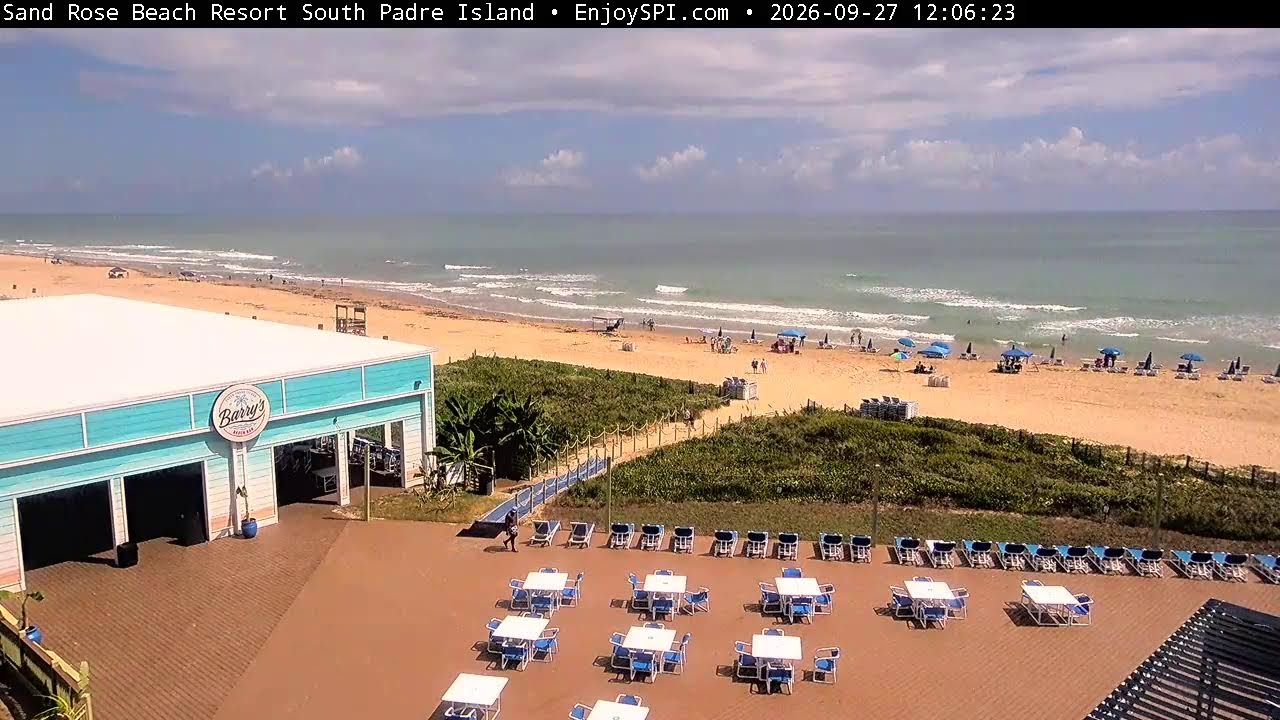


A Strip of Land That Made World Records
If you open a map of the Texas Gulf Coast, your eye is immediately drawn to a long sandy thread separating the shallow Laguna Madre from the open sea. This is Padre Island — the longest barrier island on the planet, about 182 kilometers with a width of up to five kilometers in places. South Padre Island is its southern, resort part, also administratively separated: here the strait opens a shipping channel to the port, and the island is split by the canal. On one side is the Gulf of Mexico with white quartz sand and salty breeze, on the other is the lagoon, whose water warms up earlier than the sea and is therefore always calmer. The second largest island in the continental states after Long Island, South Padre Island is cut off from the mainland by both the lagoon and the gulf — there is no connection to the big land except for a single bridge. At first glance, there is little "urban" here: the population of the resort town in Cameron County is just 2,066 people according to the 2020 census. But in high season, this number increases tenfold, and the narrow strip along the gulf turns into a continuous ribbon of hotels, fishing piers, surf schools, and bars with Mexico just beyond the horizon.
Galleons, Disasters, and the Birth of a Resort
The history of this shore began long before the first motels. In 1554, a storm raged off Padre Island, sending three Spanish galleons to the bottom — Santa Maria de Yciar, Espiritu Santo, and San Estebán. One of them was accidentally found in the late 1950s during dredging operations near the Port Mansfield channel, and the discovery reminded us that beneath the smooth bottom of the lagoon lie layers of maritime history. In total, historians count more than 2,000 shipwrecks over five centuries in the Gulf of Mexico — from galleons to twentieth-century steamships. For a long time, the island itself remained nearly uninhabited: cattle pastures, fishing huts, fine sand. Everything changed when a permanent crossing was built across the gulf, followed by road magnates and the construction boom of the seventies. Today it is the number one resort on the Texas Gulf Coast — a place where all of South Texas gathers on weekends: from Brownsville, Harlingen, McAllen, and Houston.
Queen Isabella Causeway: The Only Way Home
The resort life of this place rests on one engineering structure — the Queen Isabella Causeway, connecting the island with the town of Port Isabel. The first crossing opened in 1954, and the current one was built by 1974: the modern Queen Isabella Causeway was opened in 1974. The bridge length is 2.37 miles, or 3.81 kilometers, making it the second longest bridge in Texas after the Fred Hartman Bridge. A tragic episode occurred in 2001: a barge crashed into the supports, part of the span collapsed, killing eight people. The collapsed sections of the old crossing were later disposed of on the gulf bottom as the foundation of an artificial reef — so the disposal measure became a gift to fish and divers. Everyone who has ever crossed this bridge at sunset will remember the moment when the lagoon flashes beneath the wheels and a strip of beaches opens ahead. That is why the view from the bridge is one of the island's most recognizable "postcards," and this is where street cameras most often point their lenses.
Why the Snow-White Sand
Many come to the Texas shore expecting gray sand and cannot believe their eyes. It's a matter of geology: the island's beaches consist primarily of quartz, thoroughly ground by waves over millennia — white quartz sand gives the coast its characteristic light color. The beach width changes with the tides, and during periods of strong northern winds, waves stretch bands of foam along the entire edge. Special attention deserves the Laguna Madre — a hypersaline shallow body of water, one of the windiest places in North America. It is no coincidence that the island has long been considered a hub for gliding and kitesurfing: professional riders from around the world come here to race across the mirror surface of the lagoon while the gulf churns behind the dunes. For ordinary guests, swimming on one side of the island and calm water on the other is enough — a rare luxury for a seaside resort.
Kemp's Ridley Turtles: The Island's Main Signature
The rarest sea turtle on the planet — Kemp's ridley — nests off the South Texas coast. And South Padre Island has become one of its main outposts: the Sea Turtle Inc. center operates here, founded by veteran fisherman Ila Miller, who spent decades rescuing turtles trapped in nets and struck by motor propellers. Today the center combines rehabilitation pools with an educational platform: Sea Turtle Inc. on the island rescues and rehabilitates sea turtles, and the most touching events of the season are public releases of recovered individuals back into the ocean, when hundreds of spectators line the beach to let a plate-sized shell pass to the water. Special mention goes to the turtle camera — a live broadcast from the center's pools, where a recovering Kemp's ridley often pokes its head into the frame. And along the northern section of the island stretches Padre Island National Seashore — the largest national seashore in the USA: wild dunes, no roads, and sea turtle nesting sites where volunteers check every movement on the sand at night.
Dolphins, Fish, and Wind
Laguna Madre is home to a pod of Atlantic spotted dolphins. They can be spotted on a boat tour from the piers, or at the marine life observation center in neighboring Port Isabel: dolphins are shown here both on boat tours and at the Dolphin Research & Sea Life Nature Center. Dolphins swim almost right up to the bridge, and the chance of seeing a fin from the side of a pleasure boat here is much higher than at most seaside resorts. Fishing is the island's second religion: from the state's second longest fishing pier, from the jetties, from a jeep right on the firm sand of the national seashore. Tarpon, Spanish mackerel, speckled trout, and the famous redfish — seasons here don't stop year-round, only the gear changes. Add windsurfing and kiting on the lagoon, dunes for sunset walks, and the parade lighting of hotels — and you get an accurate portrait of this resort.
Districts, Parks, and Where Nightlife Lives
South Padre Island is small, but it has its own district logic. The northern part of the island is the quietest: private condominiums, sandy dunes, access to Island Paseo and lagoon piers. The center, around the interchange on Padre Boulevard, is the heart of nightlife: restaurants with live music, souvenir shops, sidewalk cafes. The southern tip is Isla Blanca Park, a green cape at the entrance to the shipping channel, with jetties, large piers, and the best spots for watching ships entering the port. Nearby is Andy Bowie Park with dunes and calm access to the lagoon. With its easily recognizable water park tower, go-kart tracks, and mirrored glass of high-rise hotels, the island looks even from satellite images like a strip of continuous resort life squeezed between two bodies of water.
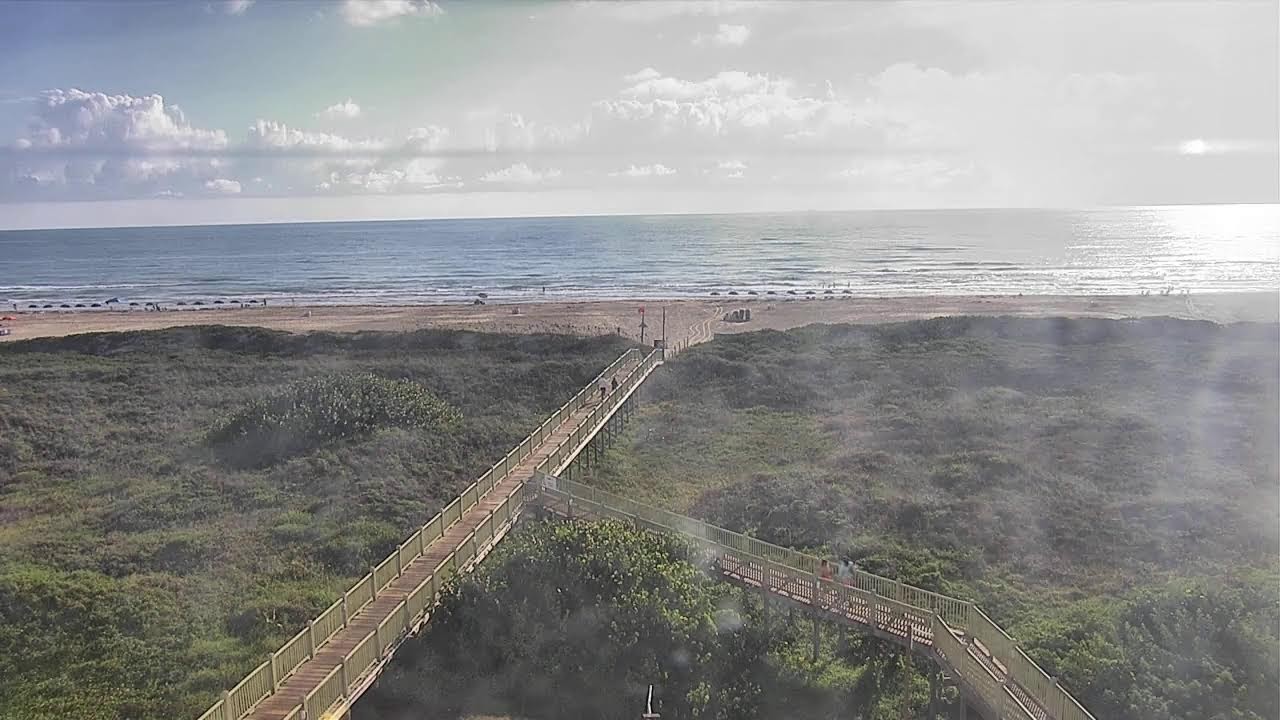
What the Cameras Show
Online broadcasts here begin where the land ends — at the coast. Beach cameras look at the open gulf from the main beaches, capturing wave height, water color, and the density of beachgoers. Cameras on Padre Boulevard and around the piers broadcast the street life of the resort: people walking along the colonnades, advertising signs of sunset cafes. Lenses on the Queen Isabella Causeway show the endless stream of cars connecting the island to the mainland, as well as the lagoon with passing boats and fishing vessels. There are broadcasts from the water park and from the jetties of Isla Blanca Park, where you can see a ship entering the channel. A separate category is "marine" cameras: views of the dock, the masts of fishing vessels, and even the turtle center pool where Kemp's ridleys swim live. Choose the angle by mood: bridge movement, lagoon calm, the fury of waves at sunset, or a quiet sunrise over the dunes — each camera has its own character, just like South Padre Island itself.