

🏙️ Webcams Crestone online — watch Colorado mountain town in real time
3 cameras
History and Unique Character of Crestone
Crestone is a tiny mountain town in the state of Colorado that has managed to become an internationally renowned destination despite having a population of just 141 people according to the 2020 census. Located in Saguache County in the northern part of the San Luis Valley, this town attracts travelers from all over the world with its unique atmosphere and spiritual energy. Unlike typical Colorado mountain settlements, Crestone owes its fame not to ski resorts or gold mines — here everything revolves around spirituality and unity with nature.
The town takes its name from the majestic peaks standing at about 14,000 feet, located to the east of the settlement in the Sangre de Cristo mountain range. These peaks are known as Crestone Peak and Crestone Needle — they gave the town its name and became its calling card. Crestone has become internationally known as a hub for various religious and spiritual traditions, and the main industry is hosting spiritual pilgrims and ecotourists. This creates a unique cultural environment in the town where Buddhist stupas, Christian monasteries, meditation centers, and Native American communities coexist.
The main street of Crestone is Galena Avenue, home to Cloud Station — a coffee shop in a former general store building that serves as the main gathering place for the community. It is here that locals, pilgrims, and tourists intersect, creating that very atmosphere of openness and spiritual seeking that made Crestone famous. The street is lined with wooden boardwalks, and on both sides are small buildings housing galleries, bookstores, and alternative medicine centers.
Geographic Location and Mountain Surroundings
Crestone is situated at the base of the western slope of the Sangre de Cristo range, one of the most scenic mountain ranges in the Rocky Mountains. This range stretches across southern Colorado and northern New Mexico, creating a dramatic backdrop for the town. The high-altitude location and proximity to mountain peaks make Crestone an ideal base for hiking and spiritual practices in nature. The town sits at an elevation of about 2,400 meters above sea level, providing clean mountain air and stunning views of the surrounding peaks.
The San Luis Valley, where Crestone is located, is one of the largest high-altitude valleys in the world. It is an expansive desert basin surrounded by mountains on all sides, creating a unique microclimate. The western slope of the Sangre de Cristo range, where the town is situated, receives more precipitation than the eastern part of the valley, ensuring lusher vegetation and numerous streams cascading down from the mountains. It was these streams that historically attracted the first settlers here, and today they are an important element of the local ecosystem.
The Sangre de Cristo mountain range, which translates from Spanish as "Blood of Christ," got its name from the distinctive red hue its peaks take on at sunset. This range is part of the Southern Rocky Mountains and includes several peaks over 14,000 feet known as "fourteeners." Crestone Peak, after which the town is named, is the seventh-highest peak in the Rocky Mountains and one of the most technically challenging to climb.
Spiritual Capital of Colorado
Crestone is often called the spiritual capital of Colorado, and for good reason. The town and its surroundings are home to more than a dozen different spiritual centers representing a wide variety of traditions — from Buddhist stupas to Christian monasteries and meditation centers. This place attracts people seeking solitude and spiritual growth, creating a special atmosphere of calm and mindfulness in the town. Here you can meet Tibetan lamas, Christian monks, Hindu swamis, and representatives of Native American shamanic traditions.
Hosting spiritual pilgrims and ecotourists is the main industry of Crestone's economy. Many travelers come here not only for the mountain landscapes but also to participate in retreats, meditations, and spiritual practices. The town hosts numerous seminars, workshops, and retreats dedicated to various spiritual traditions. This makes Crestone a place of constant cultural exchange, where people from different countries and cultures meet to practice together and share experiences.
A distinctive feature of Crestone is that the spiritual centers here do not compete with each other but coexist in an atmosphere of mutual respect. The Karma Kagyu Buddhist center neighbors a Catholic monastery, and a Hindu temple sits alongside a Kabbalah study center. Such diversity of spiritual traditions in one small town is unique not only for Colorado but for all of North America. Many pilgrims come here precisely for this opportunity to explore different spiritual paths in one place.
Natural Attractions Around Crestone
The surroundings of Crestone offer many natural attractions that draw tourists from all over the world. One of the main ones is the Baca National Wildlife Refuge — a wildlife sanctuary covering about 92,500 acres, located near Crestone in southern Colorado. The refuge is 54 miles from the town and is managed by the U.S. Fish and Wildlife Service. It is home to many species of wild animals and birds, including migratory birds that use the refuge's wetlands as a stopover during their flights.
The Baca Refuge is located in the northeastern part of the San Luis Valley and is part of the Sangre de Cristo National Heritage Area. This heritage area was created to preserve the unique natural and cultural history of the region, including the traditions of Native Americans, Spanish colonists, and American settlers. In the refuge, you can observe deer, elk, coyotes, and many bird species, as well as enjoy the silence and tranquility of untouched nature.
Another gem of the region is Great Sand Dunes National Park, located 54 miles from Crestone. This unusual park features towering sand dunes surrounded by mountains, where you can watch sunsets and participate in ranger-led programs. Two creeks — Medano and Sand Creek — carry sand from the mountains and deposit it in the dune area, creating this unique landscape. Some dunes reach heights of 230 meters, making them the tallest sand dunes in North America.
For hiking enthusiasts, the North Crestone Creek Trail is available — a 16.4 km loop trail starting and ending in Crestone, leading to the base of Crestone Peak, which is the 7th highest peak in the Rocky Mountains. This trail is considered one of the most challenging in the region and requires good physical conditioning and mountain climbing experience. However, even without reaching the summit, hikers can enjoy stunning views of the San Luis Valley and surrounding mountain ranges.
Beyond these main attractions, the surroundings of Crestone offer many lesser-known but equally beautiful places. Streams cascading down from the mountains create picturesque waterfalls and pools where you can swim in the summer months. Mountain trails of varying difficulty levels allow you to explore diverse landscapes — from alpine meadows to coniferous forests and rocky talus slopes. Many tourists come to Crestone precisely for the opportunity to combine spiritual practices with outdoor recreation.
Climate and Natural Features
Crestone's climate is typical of high-altitude Colorado settlements. Located at significant elevation, the town experiences large temperature swings between day and night, as well as pronounced seasonal changes. In winter, snow falls, transforming the mountain landscapes into picturesque winter scenes, while in summer warm days give way to cool nights. The average temperature in July is around 18°C, and in January it drops to -5°C, though more extreme values are possible.
Thanks to its location in the San Luis Valley, Crestone is sheltered from the strong winds characteristic of more open areas of Colorado. This creates comfortable conditions for living and tourism, making the town attractive to visit at any time of year. However, the high-altitude location means that solar radiation is significantly stronger here than in the lowlands, so tourists are advised to use sunscreen and wear hats even on cloudy days.
Precipitation in Crestone is unevenly distributed throughout the year. The majority of moisture falls in the summer months in the form of thunderstorms, which usually occur in the afternoon. Winter precipitation falls mainly as snow, which can lie on the ground from November through April. In spring and fall, the weather is most changeable — sunny days can give way to snowfall even in May or September. This variability is one of the characteristic features of Colorado's high-altitude climate.
The flora and fauna of the Crestone area are highly diverse. Lower mountain slopes are covered with juniper and pine forests, which at higher elevations give way to spruce and fir groves. In summer, alpine meadows bloom with numerous species of wildflowers, creating colorful carpets against the backdrop of snow-capped peaks. Among the animals found here are black bears, mountain lions, deer, elk, coyotes, and many bird species. To observe wildlife, many tourists use binoculars and cameras, while some prefer watching Crestone webcams to see animals in their natural habitat.
What the Cameras Show
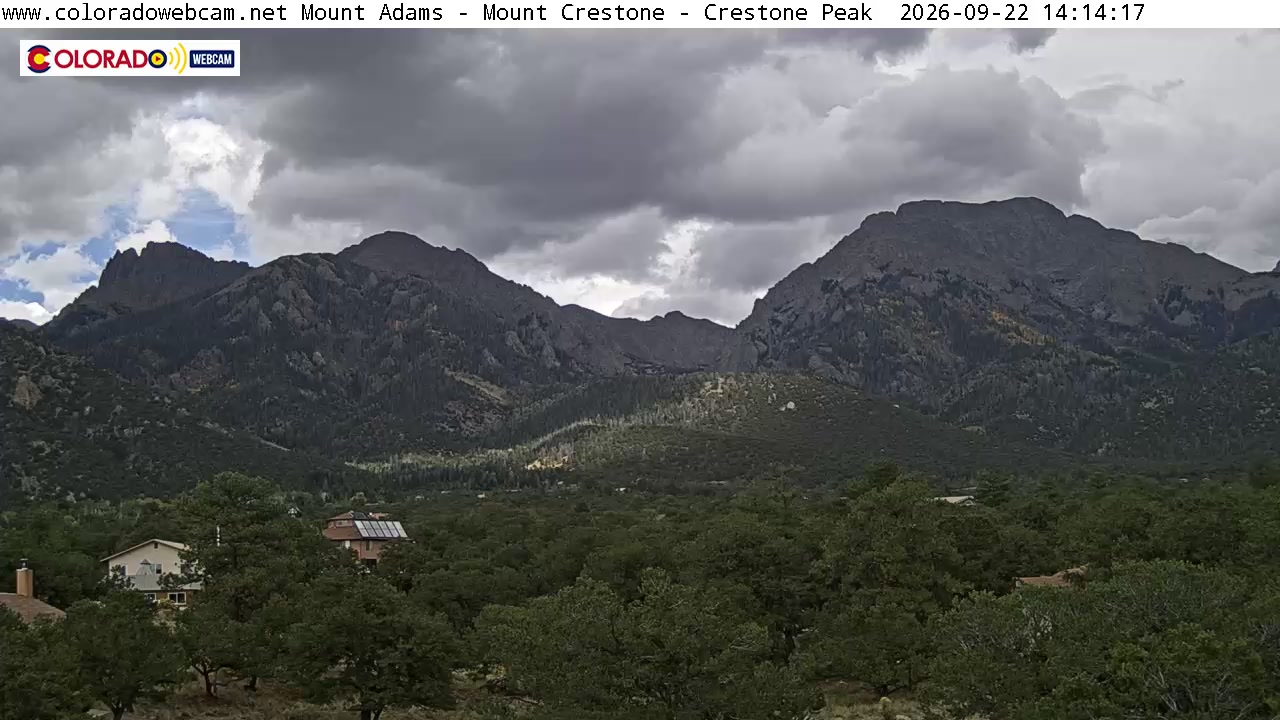
Crestone webcams online provide the opportunity to observe the life of this unique mountain settlement in real time. The cameras are positioned to cover key points of the town and its surroundings. You can see the main street Galena Avenue, where the primary establishments are located, as well as the mountain landscapes surrounding Crestone. The broadcasts are in HD quality, allowing you to examine the details of the mountain landscapes and the town's architecture.
Crestone webcams allow you to assess weather conditions in the region, monitor traffic on mountain roads, and enjoy views of the Sangre de Cristo range. This is especially valuable for travelers planning a trip to these places, as well as for those interested in the life of small Colorado mountain settlements. Live streaming from the webcams is available around the clock, allowing you to see Crestone at any time of day — from the first rays of dawn on the mountain peaks to the evening tranquility of the mountain town.
Watching Crestone webcams is not only a way to plan a trip but also an opportunity to connect with the atmosphere of this amazing place while being thousands of kilometers away. You can see how the lighting on the mountain slopes changes throughout the day, how clouds move over the peaks, and how the main street comes alive with the arrival of tourists. This is a unique opportunity for those who dream of visiting the spiritual capital of Colorado but cannot yet make the journey there.