

🏙️ Webcams Caernarfon online — watch in real time
2 cameras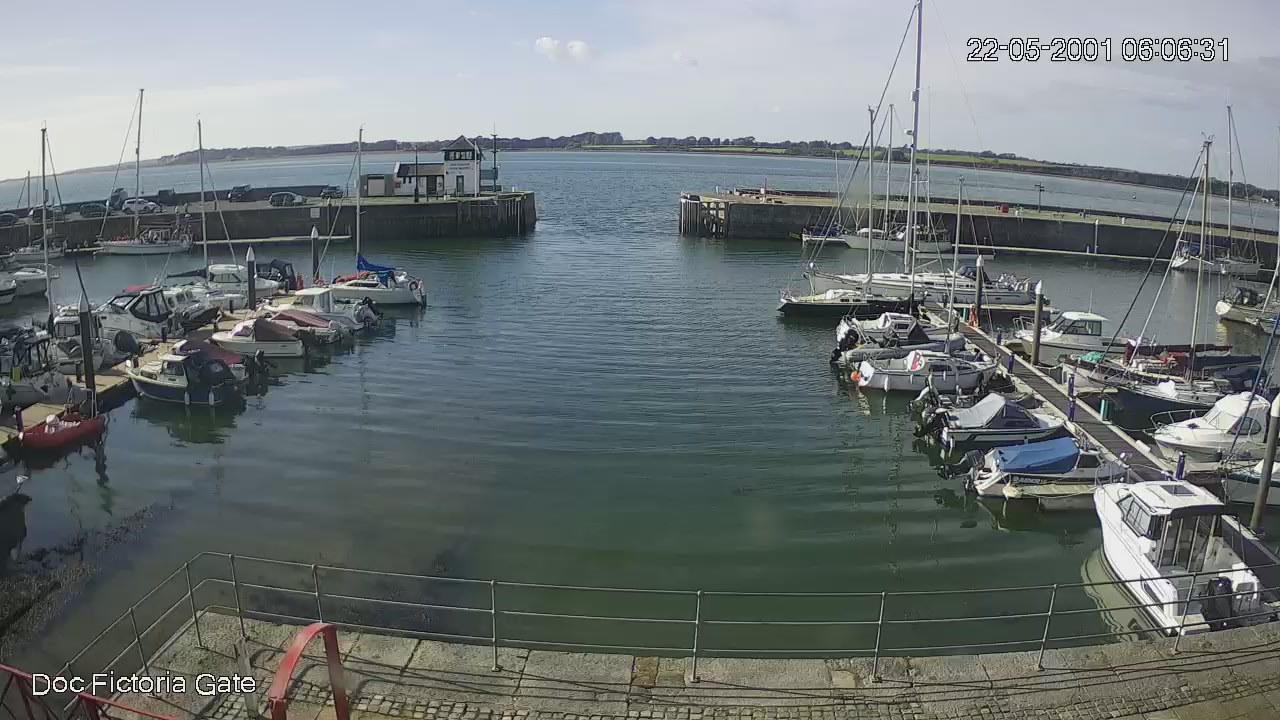

Caernarfon — ancient stronghold of Wales
On the eastern shore of the Menai Strait, where the River Seiont meets the warm waters, lies Caernarfon — a town whose history stretches back to Roman times. This is a place where every stone breathes the Middle Ages, and the silhouette of a mighty castle dominates the surrounding landscape. Caernarfon holds the status of a royal city — an honorary title granted by Elizabeth II in 1963 as a royal borough, and converted to "royal city" status in 1974. Today it is one of the most important cultural centres of North Wales, with the highest percentage of Welsh speakers among all towns in the region.
Caernarfon Castle: the octagonal might of Edward I
The heart of the town is its legendary castle, founded in 1283 by order of the English king Edward I. The site was chosen deliberately: a Norman motte-and-bailey castle had previously stood here, and even earlier — the Roman fort of Segontium. The project was led by Master James of Saint George, the king's chief military architect, whose name is forever linked to the castles of North Wales.
The first phase of construction was completed in 1292, costing the treasury £12,000 — an astronomical sum for that era. The second phase stretched from 1295 to 1323, with final additions completed by 1330. The castle is striking not only in scale but also in form: eight octagonal towers were deliberately modelled on the walls of Constantinople to impress the Welsh and elevate the authority of the English crown. The Eagle Tower — the tallest and most majestic — became a symbol of the power Edward I intended to establish in the conquered land.
Roman heritage: Segontium Fort
Long before Edward I laid the first stone of the castle, this site was already a strategic point of the Roman Empire. The fort of Segontium was founded in 77–78 AD by General Agricola after the conquest of the Ordovices — a warlike tribe of northern Wales. Situated on elevated ground at the mouth of the River Seiont, the fort controlled the Menai Strait and the approaches to Anglesey.
Initially the fortifications consisted of wooden walls and earthen ramparts, but by the first half of the 2nd century they had been replaced with stone. Inside the fort stood a large palace house with its own bath block — likely the residence of a local Roman official. The garrison numbered around a thousand auxiliary soldiers, although by 120 AD its strength had diminished. An inscription on the aqueduct from the era of Septimius Severus indicates the presence of the cohors I Sunicorum here in the 3rd century. The fort remained occupied until the end of the 4th century, after which the Romans left Britain and Segontium fell into obscurity for centuries.
Medieval walls and architectural features
Caernarfon's town walls are one of the best-preserved examples of medieval fortification in Britain. The stone rampart, approximately 750 metres long and up to 6 metres high, forms an almost octagonal inner ward divided into two parts: the upper eastern and lower western sections. Nine polygonal towers are fitted with narrow arrow slits, and the massive King's and Queen's Gateways are protected by barbicans and underground passages.
The designers paid particular attention to gate defence. Attackers faced numerous traps, murder holes, and portcullises. In plan, the fortress follows the lines of the rocks on which it stands, giving it a unique silhouette. In 1986, the castle and town walls were inscribed on the UNESCO World Heritage List as part of the "Castles and Town Walls of King Edward in Gwynedd".
Slate industry: the roofing of Britain
The area around Caernarfon was for centuries a centre of slate extraction — an industry that fed the region and supplied roofing material to the whole of Britain. Even the Romans used local slate for the roofs of Segontium Fort. But the real boom came in the 19th century: after the abolition of the slate tax in 1831 and the construction of narrow-gauge railways, the industry began to grow rapidly.
In 1898, a workforce of 17,000 people extracted half a million tonnes of slate. The two largest slate quarries in the world — Penrhyn near Bethesda and Dinorwig near Llanberis — were located in this very region. However, after the strike at the Penrhyn quarry (1900–1903) and the outbreak of the First World War, the industry went into decline. By the 1970s, most quarries had been closed due to the emergence of alternative roofing materials.
Investiture ceremony of the Prince of Wales
In 1301, the title "Prince of Wales" was first conferred at Caernarfon Castle — it was granted to the son of Edward I, the future Edward II, who was born within these walls in 1284. Since 1911, the solemn investiture ceremony has been held here, becoming a major event in the life of the British monarchy. In 1911, the title was granted to the future Edward VIII, and in 1969 — to Prince Charles, now King Charles III.
The ceremony transforms the castle into a theatre of medieval splendour: jousting tournaments, historical re-enactments, and cultural festivals attract thousands of spectators. For those unable to attend in person, Caernarfon webcams allow you to observe the life of the town in real time — from its measured everyday rhythm to grand celebrations.
Town atmosphere: Welsh spirit and modernity
Caernarfon is not an open-air museum, but a living town where the Welsh language is heard at every turn, and the locals are called "Cofis". The town's name in Welsh — "y gaer yn Arfon" — means "the stronghold in Arfon", referring to its strategic position by the Menai Strait. The narrow streets of the old town, the market square, and the waterfront create an atmosphere unlike any other town in Wales.
After the end of Roman rule around 410 AD, the settlement continued to exist as part of the Kingdom of Gwynedd, known as Caer Segeynt (Fort of Seiont) and Caer Gysteynt (Fort of Constantine). Today, Caernarfon is a blend of ancient and modern, where cosy pubs, galleries, and shops sit alongside medieval walls.
What the cameras show
Caernarfon webcams online offer views of the town's key locations: the square in front of the castle, the waterfront by the Menai Strait, and the central streets of the old town. Real-time broadcasts allow you to assess the weather, tourist footfall, and the atmosphere of this unique place. Whether you are planning a trip to North Wales or simply want to touch history — the Caernarfon live stream will be your window into a world where the past meets the present.