

🏙️ Salinas webcams online — watch the beach and promenade in real time
1 cameras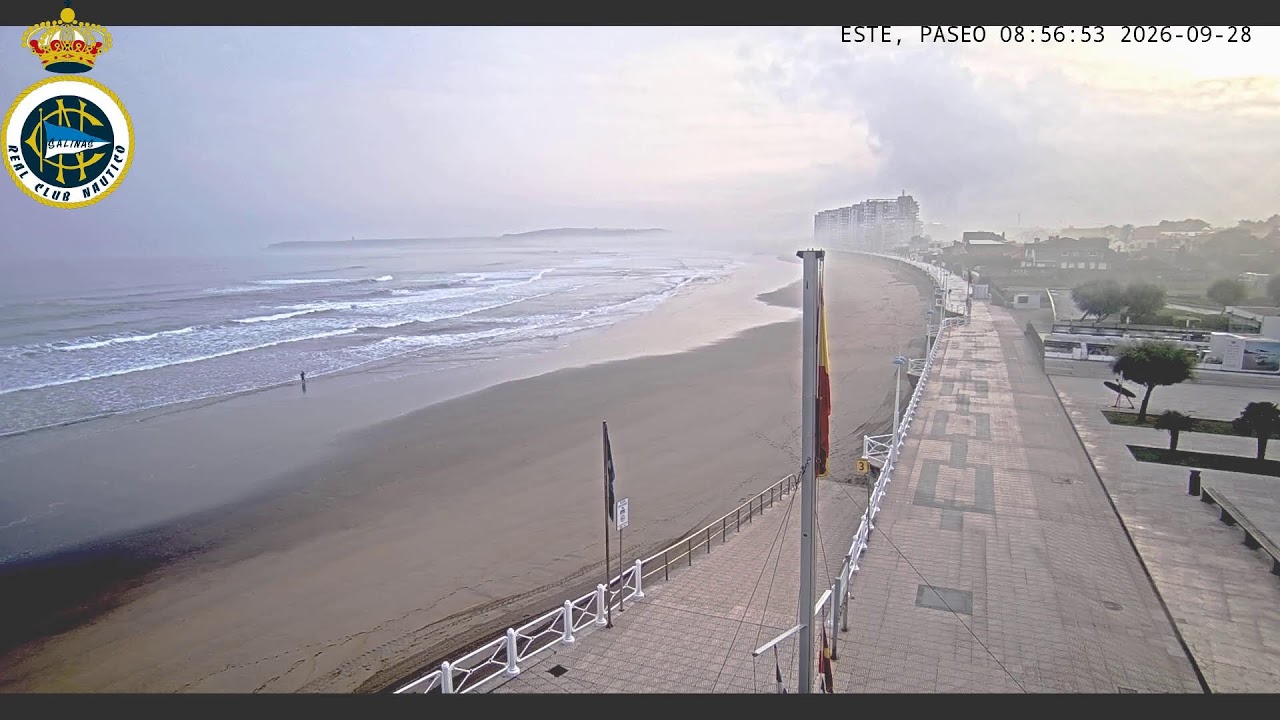
Salinas — the pearl of the Asturian coast
In northern Spain, where the Cantabrian Sea meets the green hills of Asturias, lies a small but remarkably picturesque resort town — Salinas. This place has long been a magnet for those who value not noisy crowds of tourists, but genuine sea romance, fresh breezes, and endless beaches with golden sand. If you haven't been here yet, Salinas webcams will let you immerse yourself in this atmosphere right now — just open the stream and hear the sound of the waves.
Salinas is not just a dot on the map. It's an entire parish (district) in the municipality of Castrillón, the second most populous after Piedras Blancas. According to 2006 data, 4,635 people lived here, but since then the flow of tourists and new residents has only grown. The town is located just a few kilometers from Avilés — a major industrial and cultural center of the region, making it a convenient base for exploring all of western Asturias.
Where did the name "Salinas" come from?
The city's name clearly points to salt — from the Spanish sal. For a long time, it was believed that historical salt works operated here, and the toponym is directly connected to salt extraction. However, it's not so straightforward. There is an article «Salinas, un nombre en entredicho» ("Salinas, a name in question") that explores the origin of the toponym and casts doubt on this version. So the exact etymology remains a subject of scientific debate — perhaps the name is connected not to salt works, but to some geographical feature or historical event.
Salinas Beach — a strip of gold on the Cantabrian coast
The city's main treasure is, without a doubt, the beach. The length of Salinas beach is about 2500 meters, and together with neighboring beaches El Espartal and San Juan, this figure reaches 3 kilometers. This is one of the longest beaches on the entire Asturian coast, divided into three parts: Salinas proper, El Espartal, and San Juan de Nieva.
The beach is characterized by golden sand, dunes, and constant waves — ideal conditions for surfing. It was here that Felix Cueto first rode a board on the waves, laying the foundation for the local surf culture. Today Salinas is considered one of the most popular surfing spots in Asturias, and surf schools and equipment rentals operate on the promenade.
If you want to see the beach in real time, Salinas webcams will show the waves, the surfers, and just people relaxing — the stream works live around the clock.
Philippe Cousteau Anchor Museum — a tribute to the sea
At one end of the beach, on the cape La Punta del Espinal, there is a unique open-air museum — the Philippe Cousteau Anchor Museum. It is named after the son of the legendary Jacques-Yves Cousteau — Philippe, who tragically died at the age of 38 near Lisbon.
The museum's exhibition is a collection of anchors from various eras and vessels. One of the most impressive exhibits is the anchor from the bulk carrier Castillo de Salas, which ran aground off the coast of Asturias. In addition to anchors, you can see sails, deck equipment, and a large ceramic mural. The bust of Philippe Cousteau is the work of sculptor Vicente Menéndez-Santarua Prendes.
The museum is free and open year-round, and the views from the cape over the Cantabrian Sea and the Asturian coast are simply breathtaking. This is a must-visit place, and Salinas webcams often show this part of the coast.
Surfing and water adventures
Salinas is not just a beach resort, it's a true surfing capital of Asturias. Constant waves, blowing winds, and a relatively small number of people in the water make it an ideal place for both beginners and experienced surfers. Several surf schools operate on the promenade where you can take a lesson or rent a board.
But surfing is not the only entertainment. Kitesurfing, windsurfing, swimming, and simply walking along the shore are popular here. And if you prefer to watch from the sidelines, Salinas webcams will show all this water diversity in real time — from lone surfers at dawn to whole groups in the middle of the day.
Gastronomy and festivals — the taste of Asturias
Asturias is famous for its cuisine, and Salinas is no exception. The main gastronomic event of the year is the «Hot Fabada» (fabada) festival, which turns the traditional Asturian bean stew into a culinary hit right on the beach. Imagine: huge pots, the aroma of fabada, the sound of waves, and hundreds of people enjoying food in the open air.
The city's main holiday is dedicated to the patroness of Salinas — the Virgin of the Rosary (Virgen del Rosario). Its modern history began in 1972, and since then it has become an important event in the life of the local community. During these days, the promenade is transformed: fairs, concerts, fireworks, and, of course, plenty of food and cider — the famous Asturian cider, which is poured from a height here, saturating the drink with carbon dioxide.
Arcos de las Salinas — another Salinas in Aragon
An interesting fact: there is another Salinas in Spain — Arcos de las Salinas in the province of Teruel, autonomous community of Aragon. This is a tiny municipality with a population of just 105 people (as of 2018) and an area of 112.99 km², part of the Gúdar-Javalambre district.
Despite its modest size, Arcos de las Salinas attracts tourists with its nature and the GALÁCTICA observatory — a center for astronomy popularization, located in an area with minimal light pollution. Star observations, workshops, and educational programs are held here. For mountain biking and hiking enthusiasts, routes have been laid through the picturesque landscapes of Aragon.
Although webcams of Arcos de las Salinas are less common than those of the Asturian resort, they also exist and allow you to see a completely different Spain — not coastal, but mountainous, with harsh landscapes and starry skies.
Weather and climate — when is the best time to watch
The Cantabrian Sea shapes a mild oceanic climate: winters here are warm (rarely below +10°C), and summers are comfortable (about +22-25°C) without sweltering heat. However, the weather is changeable — the sun can give way to rain in a matter of minutes, and vice versa. That's why Salinas webcams are so popular: they allow you to assess current conditions before a trip or simply observe the weather change in real time.
The best time for surfing is autumn and spring, when the waves are most stable. For beach holidays — July and August, when the water warms up the most. But even in winter, Salinas is beautiful: an empty beach, gray sky, and the endless sound of the surf create a special, almost meditative atmosphere.
What the cameras show
This page collects all available Salinas webcams — both the Asturian resort and the Aragonese municipality. You can watch live streams from the beach, promenade, La Punta del Espinal cape with views of the Anchor Museum, as well as from other coastal points. For Arcos de las Salinas, cameras are available showing the landscapes of Gúdar-Javalambre and the surroundings of the GALÁCTICA observatory.
All Salinas webcams work for free and without registration — just choose the stream you're interested in and enjoy the view. Image quality depends on the specific camera, but most of them broadcast in HD format. Watch the waves, follow the surfers, check the weather, or simply meditate on the endless horizon line — Salinas webcams open a window to this amazing corner of Spain for anyone with internet access.