

🏙️ Playa del Inglés webcams online — watch in real time
1 cameras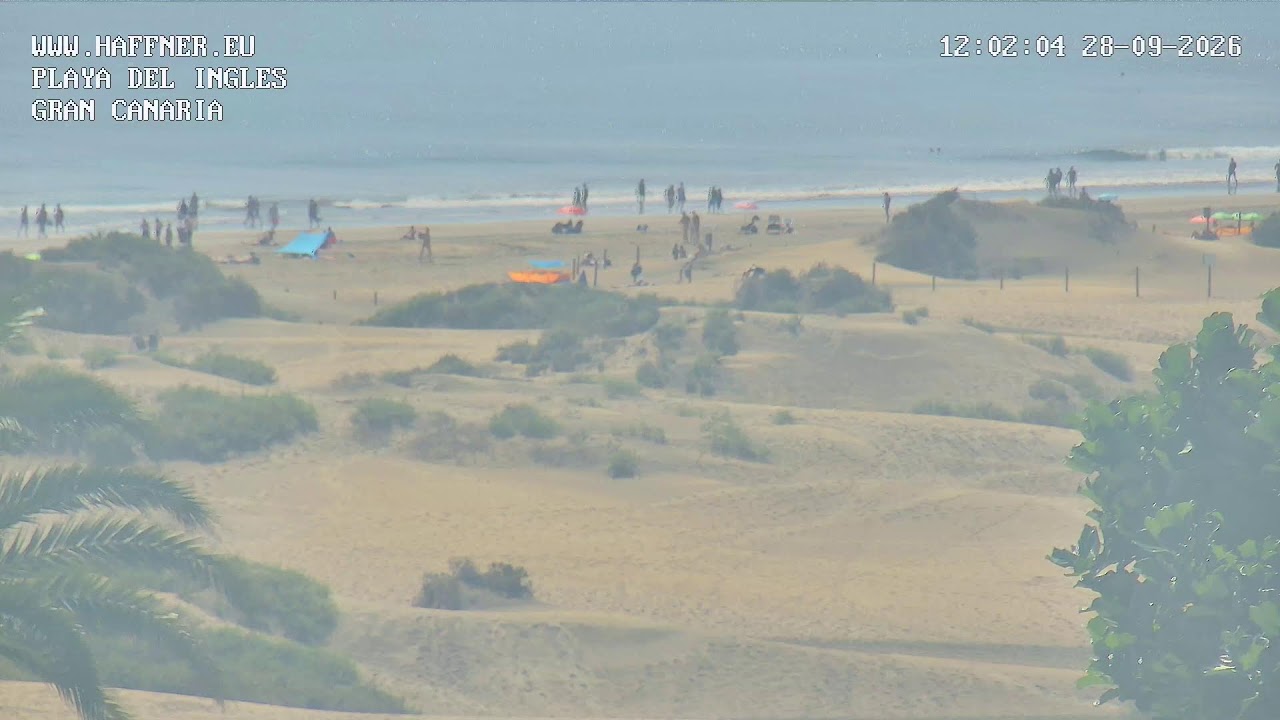
History and origin of the name
The name of this resort translates from Spanish as "Englishman's beach" — and behind this simple phrase lies a whole story. In the early 20th century, this area was completely wild and undeveloped, but already attracted the first holidaymakers. According to one version, French bohemians came here, but for some reason the local population assigned an English name to the beach. Today Playa del Inglés is one of the busiest resorts in the south of Gran Canaria, where millions of tourists from all over Europe come every year. The resort is part of the municipality of San Bartolomé de Tirajana and together with Maspalomas and San Agustín forms a single resort area on the south coast of the island. Everything here is dedicated to relaxation: endless beaches with golden sand, numerous hotels and apartments, restaurants for every taste and shopping centers. But the main wealth of this place is its nature and unique climate, which allows you to enjoy the sun all year round. Playa del Inglés has become a symbol of mass tourism in the Canary Islands, a place where cultures and languages from all over the world meet.
Maspalomas Dunes — a living nature reserve
The heart of Playa del Inglés is, without a doubt, the Maspalomas dunes, covering an area of about 400 hectares. These are not just sand hills, but a real living organism that constantly changes under the influence of the wind. The dunes were declared a nature reserve, and since 2015 local authorities have introduced restrictions on access to some areas due to the threat of destruction of the dune massif caused by mass tourism and erosion. The nature reserve stretches from the Maspalomas lighthouse to the Playa del Inglés beach itself, creating a landscape reminiscent of the Sahara Desert in miniature. Here you can find rare species of plants and animals adapted to life in sandy environments. Special paths have been laid for tourists to observe this fragile ecosystem balance without harming it. Webcams installed in this area allow you to see the scale of the dune massif and how the sand ridges slowly move under the pressure of the Atlantic wind. Watching the dunes in real time means becoming a witness to how nature creates and destroys these sand mountains.
Maspalomas Lighthouse — a landmark for sailors
At the edge of the dunes rises the Maspalomas lighthouse, whose construction was completed in 1890 after 30 years of work. It was designed by the famous Canarian engineer Juan León y Castillo. The height of the structure is 56 meters (according to some sources — 68 meters), and at the time of completion it was the tallest lighthouse in Spain. It still operates today, helping ships navigate at night off the south coast of Gran Canaria. The lighthouse has become a symbol of Playa del Inglés and one of the main attractions of the south of the island. Next to it is a busy promenade where you can always see tourists strolling along the ocean. In the evening, photographers and artists gather here to capture the sunset — the sun sets directly into the Atlantic Ocean, painting the sky in orange and pink tones. Online broadcasts from this area show not only the lighthouse itself, but also the panorama of the coast, where sand, water and stone ridges meet. The lighthouse remains an active navigation aid, and its light still guides ships sailing along the west coast of Africa.
Beaches and promenade of the resort
Playa del Inglés is famous for its long beaches with golden sand, which stretch for several kilometers along the coast. This is one of the largest and busiest holiday destinations in Gran Canaria, where life is always bustling. The beach here is gently sloping, with fine sand, and the entry into the water is convenient even for families with children. The Atlantic Ocean off the south coast of the island warms up enough for comfortable swimming for most of the year. The Playa del Inglés promenade is a pedestrian area paved with tiles, along which there are cafes, shops and entertainment venues. Here you can meet tourists from different countries — Germans, English, Scandinavians, Spaniards. Many come here for several weeks or even months to wait out the European winter in the warm climate. Webcams on the promenade show the rhythm of resort life: morning runs, the midday heat when the beach fills with holidaymakers, and evening walks to the sounds of street musicians. The promenade stretches from Playa del Inglés to neighboring San Agustín, forming a continuous walking area along the ocean.
Yumbo Shopping Center — a shopping labyrinth
In the center of the resort area is the Yumbo Centrum — a shopping center opened in October 1982. This is not just a store, but a whole complex of more than 200 shops and restaurants with international cuisine, located in open courtyards and terraces on several floors. The layout of Yumbo is so confusing that it is very difficult to navigate — it is a kind of labyrinth where every turn reveals something new. Yumbo is known not only for shopping but also for its special atmosphere. Thematic parties, festivals and cultural events are held here. In the evening, the shopping center turns into the center of nightlife, attracting tourists from all over the south of Gran Canaria. Cameras installed in the Yumbo area allow you to see how the mood of this place changes throughout the day — from calm daytime shopping to bustling nightlife. This is a place where you can find literally everything: from souvenirs and clothes to electronics and jewelry.
Gran Canaria climate — the island of eternal spring
Gran Canaria is often called the "island of eternal spring" — and this is not an exaggeration. There is no winter in the usual sense here, no rainy season or period of bad weather. The change of seasons here is relative: summer is slightly hotter, winter is slightly cooler, but overall the temperature stays in a comfortable range all year round. On the island are the extinct volcano Pico de las Nieves and subtropical forests on the mountain slopes, creating different climatic zones. Gran Canaria is an island of contrasts: dunes give way to forests, beaches with volcanic sand coexist with colonial architecture. The mountains in the middle of the island create different climatic zones, so in one day you can visit both a snowy peak and a hot beach. Every year the island is visited by 4 million travelers, and many of them choose the south coast with its resorts of Playa del Inglés, Maspalomas and San Agustín. Online cameras allow you to see what the resort looks like at any time of the year — and make sure that there is always something to enjoy here. The climate of the south coast is particularly mild: the ocean softens the heat in summer, and in winter does not let the temperature drop below comfortable values.
What the cameras show
Playa del Inglés webcams are installed at key points of the resort and show the city in real time. Broadcasts are conducted from the beaches, promenade, Maspalomas dunes and central areas. You can observe the situation on the coast, monitor weather conditions or simply enjoy the view of the Atlantic Ocean. Live broadcasts are available around the clock and allow you to see the resort at any time of the day — from morning freshness to evening lights. When choosing a camera for viewing, you should pay attention to the angle: some show a wide panorama of the coast, others — details of city life. Playa del Inglés webcams online is an opportunity to see the resort through the eyes of an eyewitness, without leaving home. Watching the city in real time helps to plan a trip, assess the crowdedness of the beaches or simply lift your mood with a view of the sunny coast of the Canary Islands. Cameras in Playa del Inglés are a window into the world of eternal summer, where the sun always shines and the waves of the Atlantic roar.