

🏙️ Albentosa Webcams Online — Watch the City in Real Time
1 cameras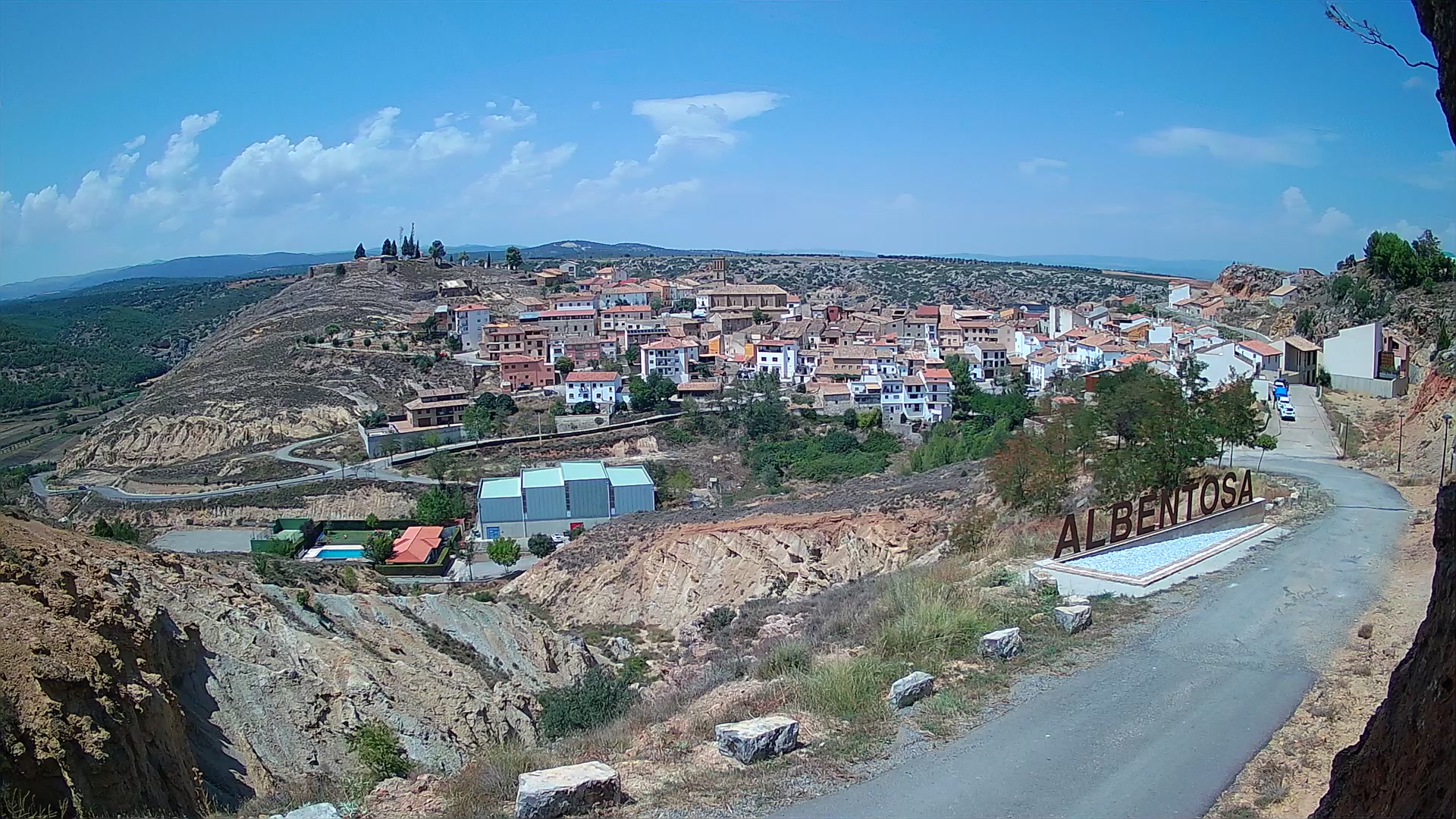
Geographical Location and Nature of Albentosa
Albentosa is a small municipality in the province of Teruel, autonomous community of Aragon, part of the district (comarca) Gúdar-Javalambre. The municipality covers an area of 68 km², making it a compact yet geographically diverse settlement. The distance to Teruel is 46 km, and the population of Albentosa is 310 people. These figures speak for themselves: this is a typical Aragonese backcountry where life flows at a rhythm that has changed little over the past centuries.
The city is located in the Maestrazgo region — a natural and historical mountain area in the eastern part of the Sistema Ibérico. This mountain range forms the unique landscape of eastern Spain, and Albentosa occupies a special place within it. The Guadalope River and its tributaries carve deep valleys into the geological structures of the Maestrazgo region, shaping the local terrain. The waterways not only add picturesque beauty to the landscape but historically determined human settlement — communities arose along river valleys where water and fertile land were available.
The climate here is typically Mediterranean with continental features, intensified by the mountain terrain. Winters are cool, summers are warm but not exhaustingly hot thanks to the altitude. The natural surroundings of Albentosa are a combination of mountain slopes, forested massifs, and river valleys creating the distinctive landscape characteristic of Aragon's interior. For those who want to see these places with their own eyes, Albentosa webcams online offer a chance to experience the beauty of the region from anywhere in the world.
History of the City from the Reconquista to the Present Day
The history of Albentosa is inextricably linked to the Reconquista — the centuries-long process of Christian kingdoms reclaiming territories of the Iberian Peninsula from the Moors. During the Reconquista, Alfonso II granted the church of Albentosa to the Knights Templar (1182-1187). This event became a turning point in the settlement's history, determining its further development as a strategic point in the mountainous terrain of Aragon.
The Knights Templar — one of the most powerful and enigmatic knightly orders of the Middle Ages — did not merely own the church. They turned Albentosa into a stronghold of their network in the Maestrazgo region, controlling trade routes and ensuring the security of settlements. After the dissolution of the order in the early 14th century, the lands passed to other military-religious organizations, but the Templar trace in local toponymy and architecture is still felt today.
Over the following centuries, Albentosa remained a small but important settlement in the system of mountain communications of Aragon. Its inhabitants engaged in traditional local trades — livestock farming, agriculture, forestry. The isolation of the mountain valleys contributed to the preservation of distinctive culture, dialectal features, and architectural traditions that make Albentosa particularly interesting to study today.
Architectural Monuments and Landmarks
The architectural appearance of Albentosa is a layered history in stone. Here one can trace how styles and construction technologies changed over the centuries, from medieval fortifications to Renaissance civic buildings.
The central element of the urban fabric is the Iglesia parroquial de Nuestra Señora de los Ángeles — the parish church of Our Lady of the Angels. This temple impresses not so much with its exterior decoration as with its interior decor: a painted ceiling comparable in quality to the best monuments of the Teruel region. The frescoes represent a valuable example of pictorial art preserved in a relatively small mountain settlement — a fact that speaks to the significance of Albentosa in the medieval settlement system of Aragon.
Albentosa is home to a Renaissance town hall (Ayuntamiento renacentista) — a building reflecting the era of flourishing civic architecture in the region. Renaissance elements in the town hall's design testify to a period of economic and cultural upsurge that the settlement experienced in the 16th-17th centuries. Today the town hall remains the administrative center of the municipality and one of the symbols of Albentosa.
Particular attention deserves the viaduct "El viaducto de Albentosa" — an engineering structure spanning one of the mountain valleys. The bridge not only serves a practical function, connecting parts of the settlement, but also acts as a landmark completing the city's panorama against the mountain landscapes of Maestrazgo.
Ermita de la Cueva Santa — A Mountain Sanctuary
In the Mas de Albentosa area, near the main settlement, is the Ermita de la Cueva Santa — a modest rectangular structure with a single nave of three sections. The hermitage, or chapel-refuge, is typical of Spain's mountain regions: such structures served as places of prayer and shelter for travelers, shepherds, and merchants crossing mountain passes.
The simplicity of the hermitage's architecture is deceptive. Behind the unassuming facade lies a centuries-old history of the region's spiritual life. Such sanctuaries often arose at sites of apparitions of saints or miraculous icons, becoming centers of local pilgrimage. The Ermita de la Cueva Santa is no exception: it remains a place where residents of surrounding villages come on religious feast days.
The surroundings of the hermitage represent a typical mountain landscape of Maestrazgo: rocky outcrops, Mediterranean shrub thickets, views of winding valleys. For hiking enthusiasts, this place is a starting point for routes along surrounding trails where one can feel the scale and grandeur of the mountain nature of eastern Spain.
The Maestrazgo Region — Mountain Heritage of Aragon
Albentosa is located in the Maestrazgo region — a natural and historical mountain area in the eastern part of the Sistema Ibérico. It is one of the most picturesque and least tourist-developed regions of Spain, preserving an authentic character and untouched landscapes. Maestrazgo is not just a geographical name but an entire world with its own history, culture, and identity.
The Guadalope River and its tributaries carve deep valleys into the geological structures of the Maestrazgo region, shaping the local terrain. Water erosion over millions of years has created impressive canyons, narrow gorges, and wide terraces where settlements are spread. Albentosa occupies one such place — at the junction of mountain ranges and a river valley, which historically provided its inhabitants both protection and access to water resources.
Maestrazgo is known for its role in Spanish history. These lands were the scene of numerous conflicts — from the Reconquista to the Carlist Wars and the Civil War of 1936-1939. Traces of these events can still be found in the form of ruined castles, fortified churches, and abandoned military positions scattered across the mountain slopes. Albentosa, thanks to its strategic position, repeatedly found itself at the epicenter of historical storms.
Cultural Heritage and Traditions
Despite its modest size, Albentosa preserves the authentic spirit of the Aragonese backcountry. Local residents carefully keep the traditions of their ancestors, passing them down from generation to generation. The city's architecture reflects features typical of Aragon's mountain settlements — compact development, use of local stone, narrow streets descending the slopes.
The traditional way of life in Albentosa was formed over centuries in conditions of mountain isolation. Livestock farming, grain cultivation, forestry — these have been the foundation of the local economy for centuries. Even today, when globalization has reached the most remote corners, the inhabitants of Albentosa largely maintain their connection to the land and nature that determined the rhythm of life of their ancestors.
The city's cultural calendar is marked by religious holidays, many of which date back to the Middle Ages. Processions, fairs, traditional celebrations — all this is not just a tribute to memory but a living part of everyday life that unites the community. For an outside observer, these traditions offer a unique opportunity to glimpse a world that has changed little over the past centuries.
Infrastructure and Connection to the Outside World
Albentosa is located 46 km from Teruel — the administrative center of the province. This distance, covered by car in less than an hour, connects the mountain settlement with the region's largest city, where administrative, educational, and medical institutions are concentrated. The roads connecting Albentosa with Teruel and other settlements of Maestrazgo pass through picturesque mountain passes, offering views of valleys and ridges.
Despite its small population, Albentosa has the necessary infrastructure for daily life. There are administrative buildings, shops, and a medical center. The Renaissance town hall still performs its functions, remaining the center of municipal life. The school, if operational, often accepts children from surrounding hamlets — a typical picture of the Spanish backcountry where small settlements cluster around a larger center.
Modern technology is gradually penetrating this mountain corner as well. Mobile communication, the internet — all this brings Albentosa closer to the rest of the world without destroying its identity. Albentosa webcams are an example of how modern technology allows the world to look into this remote corner of Aragon.
Natural Surroundings and Landscapes
The nature of Albentosa is the region's calling card. Mountain slopes covered with pine and oak forests alternate with open meadows and rocky outcrops. The Guadalope River and its tributaries create green corridors in an otherwise harsh landscape, attracting diverse fauna — from birds of prey to small mammals.
For outdoor enthusiasts, the surroundings of Albentosa offer hiking trails of varying difficulty. The paths lead to viewpoints offering panoramas of the valleys and ridges of Maestrazgo, to abandoned settlements preserving the memory of the past, to natural sites — springs, caves, geological formations. The Ermita de la Cueva Santa is one such point attracting both pilgrims and tourists.
The biodiversity of the region is impressive. The mountains of Maestrazgo serve as a refuge for species disappearing in more developed parts of Spain. Ornithologists come here to observe birds of prey — eagles, vultures, falcons. Botanists study endemic plants adapted to the harsh conditions of high mountains. For the ordinary traveler, walks around Albentosa are an opportunity to disconnect from the hustle and bustle and feel the scale of nature.
What the Cameras Show
Albentosa webcams open a window into the life of this mountain settlement of Aragon. Live streams from streets and squares allow you to see the historic center of the city, appreciate the architectural appearance of the Renaissance town hall, and feel the atmosphere of measured life in the mountains of Maestrazgo. The online broadcast is available for free and without registration — just select the camera you're interested in and start watching.
Watching Albentosa webcam is an opportunity to observe how the lighting changes on the mountain slopes, how rare pedestrians move along narrow streets, how the city lives in real time. Cameras installed in the central part capture the key architectural landmarks — the church with its painted ceiling, the town hall, the bridge over the mountain river. For those planning a trip to the region, Albentosa webcams online are a way to assess the situation and weather conditions in advance.
Albentosa webcam center watch online — a query that brings travelers, researchers, and simply curious people here. Each camera is a separate angle on the city, its streets, buildings, and natural surroundings. Choose the broadcast that interests you and enjoy the view of one of the most authentic corners of the province of Teruel.