

🏙️ Făgăraș Webcams Online — Watch the City in Real Time
1 cameras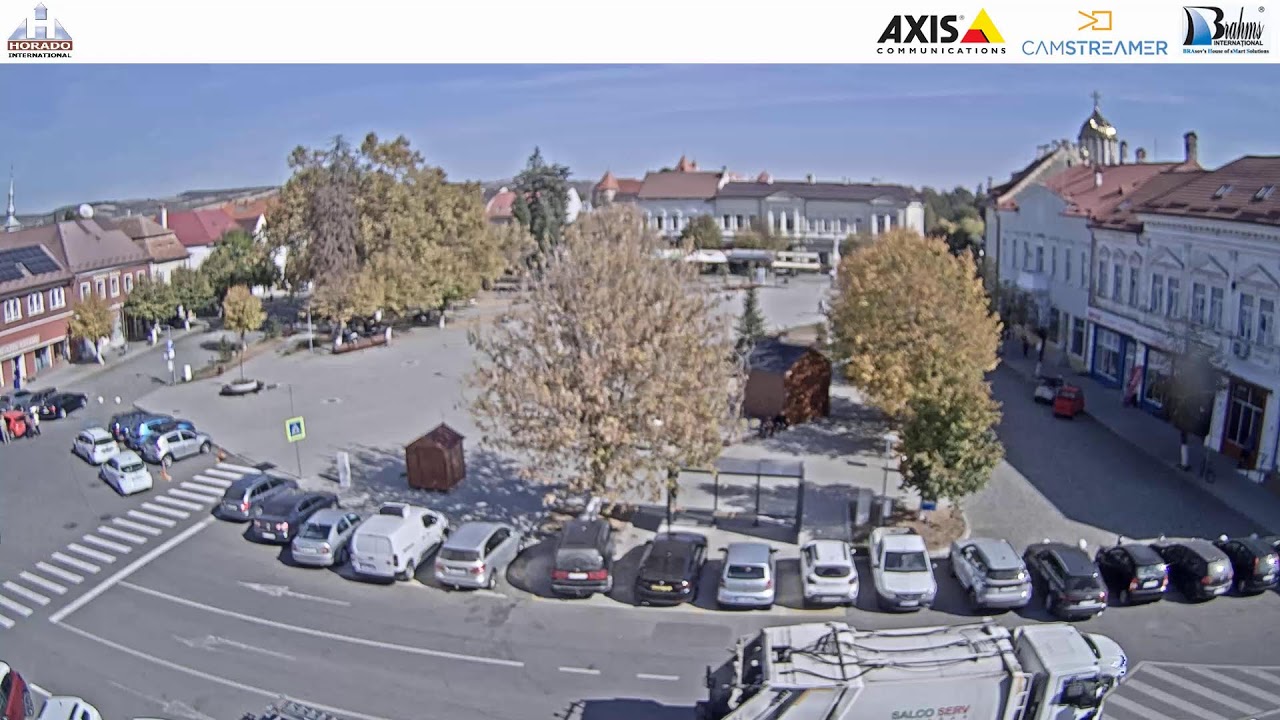
Historical Făgăraș: From the Middle Ages to the Present Day
Făgăraș is a city whose fate is inextricably linked with the history of Transylvania. Founded in 1291, it is located in Brașov County on the banks of the Olt River, in the very heart of this historical region. Today, 26,284 people live here according to the 2021 census, but the significance of this place is measured not in numbers, but in layers of history visible at every turn — from medieval towers to Austro-Hungarian facades.
The city became the main center of the Țara Făgărașului subregion — an area that, together with Amlaș, represented a traditional Vlach enclave in Transylvania during the Middle Ages. The first written document mentioning Romanians in these lands referred specifically to the Vlach territories in the Făgăraș region. This is a place where the destinies of different peoples intertwined, where each era left its mark in stone and in the memory of local residents. The narrow streets of the old town preserve the atmosphere of trade routes that passed through these lands for centuries.
Făgăraș Fortress: Citadel of Nobles and Legends
The city's dominant feature is the majestic fortress, towering over the surroundings and visible for many kilometers. Its history began around 1310, when a new citadel was built on the site of old fortifications destroyed in the mid-13th century during the Mongol invasion of 1241. The fortress survived the Ottoman invasion of 1541, when the invaders captured the stronghold, and its owner died in captivity at the Yedikule Fortress in Istanbul. These events forever inscribed Făgăraș into the military history of Eastern Europe.
Between 1567 and 1573, Gáspár Bekes, the new owner of the citadel, built a moat around the fortress that has survived to this day and is now filled with water, creating a picturesque frame for the ancient walls. However, by the early 20th century, the citadel was in a deplorable state — historian Nicolae Iorga described it as practically ruined in 1903. In the mid-20th century, the fortress gained notoriety as a political prison of the communist period, operating until approximately the 1960s. The walls that once protected against external enemies now confined those whom the regime considered internal threats.
Today, the fortress operates as the Făgăraș Citadel Museum, displaying artifacts from Roman times to medieval weapons, as well as a collection of folk crafts. According to local legend, it was from the central fortress of Făgăraș that Negru Vodă set out southward past the Transylvanian Alps to become the founder of the Principality of Wallachia. The city and fortress are known as the "fortress of nobles and legends," with stories of nobility, knights, and medieval mysteries that continue to attract researchers and history enthusiasts.
Făgăraș Mountains: The Transylvanian Alps
Făgăraș lies at the foot of a majestic mountain range often called the "Transylvanian Alps". The Făgăraș Mountains are the highest in the Southern Carpathians, covering an area of 3,000 square kilometers. Their main peak, Moldoveanu, reaches 2,544 meters and is the highest point in all of Romania. The summits offer breathtaking panoramic views — Wallachia stretches to the south, Transylvania to the north, and on clear days, the distant ridges of the Eastern Carpathians can be seen.
This mountain range is one of the most impressive and extensive in the country, attracting tourists from all over Europe. Alpine meadows, crystal-clear lakes, jagged peaks — nature here remains pristine, and the air is so clean it seems almost weightless. The Făgăraș Mountains are home to brown bears, lynx, wolves, and many bird species listed in the Red Book. For local residents, these mountains are not just a backdrop, but a part of everyday life, a source of inspiration and sustenance.
Transfăgărășan: The Road Through the Clouds
The legendary Transfăgărășan road was built in the 1970s under Nicolae Ceaușescu primarily to improve military mobility across the Carpathians. Today it connects the regions of Wallachia and Transylvania and is known worldwide thanks to the Top Gear show, where Jeremy Clarkson called it the best road in the world. The route climbs to an altitude of 2,042 meters, making it the second-highest mountain pass in Romania after Transalpina.
Along the road there are four recommended stops for tourists, and one of the main attractions is Balea Lake — a glacial lake lying at an altitude of over two thousand meters. In winter, a ski resort operates here, and in summer it serves as a starting point for hiking to the peaks. Transfăgărășan is not just a road, but an engineering marvel carved into the rock at the cost of enormous effort and human lives. Every kilometer of this route tells the story of the struggle between man and nature.
The Olt River and the Nature of the Surroundings
The Olt River, one of Romania's main waterways, flows through Făgăraș, dividing the city into two parts. Its waters originate in the Hăghimaș Mountains, cross the Southern Carpathians, and carry their waters through Transylvania to Wallachia. In the vicinity of the city, the river forms picturesque meanders, and its banks are overgrown with willows and poplars. In the past, the Olt was used for timber rafting and as an energy source for numerous mills — their remains can still be seen along the river's course.
The nature around Făgăraș is remarkably diverse: from floodplain meadows to mountain forests, from alpine pastures to deep valleys. Here you can encounter brown bears, lynx, wolves, and many bird species listed in the Red Book. The forests are rich in mushrooms and berries, and the mountain streams are famous for their crystal-clear water. For the residents of Făgăraș, nature is not an abstract concept, but an everyday reality that determines the rhythm of life and seasonal activities.
Architecture and Attractions of the City
Besides the fortress, Făgăraș boasts several notable buildings reflecting the city's multi-layered history. The city hall is an example of Austro-Hungarian period architecture, with the characteristic severity and elegance of that era. The city's churches — both Orthodox and Reformed — preserve traces of various eras and denominations, demonstrating the religious diversity of Transylvania.
The streets of the central part of the city are paved with cobblestones, and the facades of the houses retain a colonial charm — here you can see both medieval foundations and Renaissance details, Baroque decorations and modernist touches. A walk through the historic center allows you to feel the atmosphere of old Transylvania — unhurried, solid, with a touch of mysticism. Every building here has its own story, every alley leads to a small discovery.
Cultural Heritage of Țara Făgărașului
The Țara Făgărașului region is famous for its folk craft traditions, which are preserved and passed down from generation to generation. Here, carpets are still woven according to ancient patterns, wood is carved, and ceramics with characteristic ornaments are made. Local fairs and festivals attract lovers of authentic culture — you can see the process of creating items live and purchase unique souvenirs carrying the warmth of the craftsman's hands.
The region's cuisine is a blend of Transylvanian and Wallachian traditions: goulash with polenta, mititei (grilled sausages), tocitura (meat stew), and local wines. In Făgăraș restaurants, you can taste dishes whose recipes are passed down from generation to generation. Local desserts are especially famous — cheese pies, apple strudels, and rosehip jam. Cultural heritage here is not a museum exhibit, but a living tradition woven into everyday life.
What the Cameras Show
For those who want to see Făgăraș in real time, there are online cameras broadcasting the life of the city. They allow you to observe traffic on central streets, see the fortress in different lighting, and monitor weather conditions in Transylvania. The live broadcast from Făgăraș is an opportunity to experience the atmosphere of this place without leaving home, to see how the city changes depending on the time of day and season.
Online cameras in Făgăraș are a convenient way to plan a trip or simply enjoy the views of Transylvania. The live broadcast shows the city as it is: with its narrow streets, ancient buildings, and majestic mountains on the horizon. Observing Făgăraș through a webcam reveals the city from an unexpected side — calm, measured, authentic.