

🏙️ Webcams Szczecin online — watch in real time
5 cameras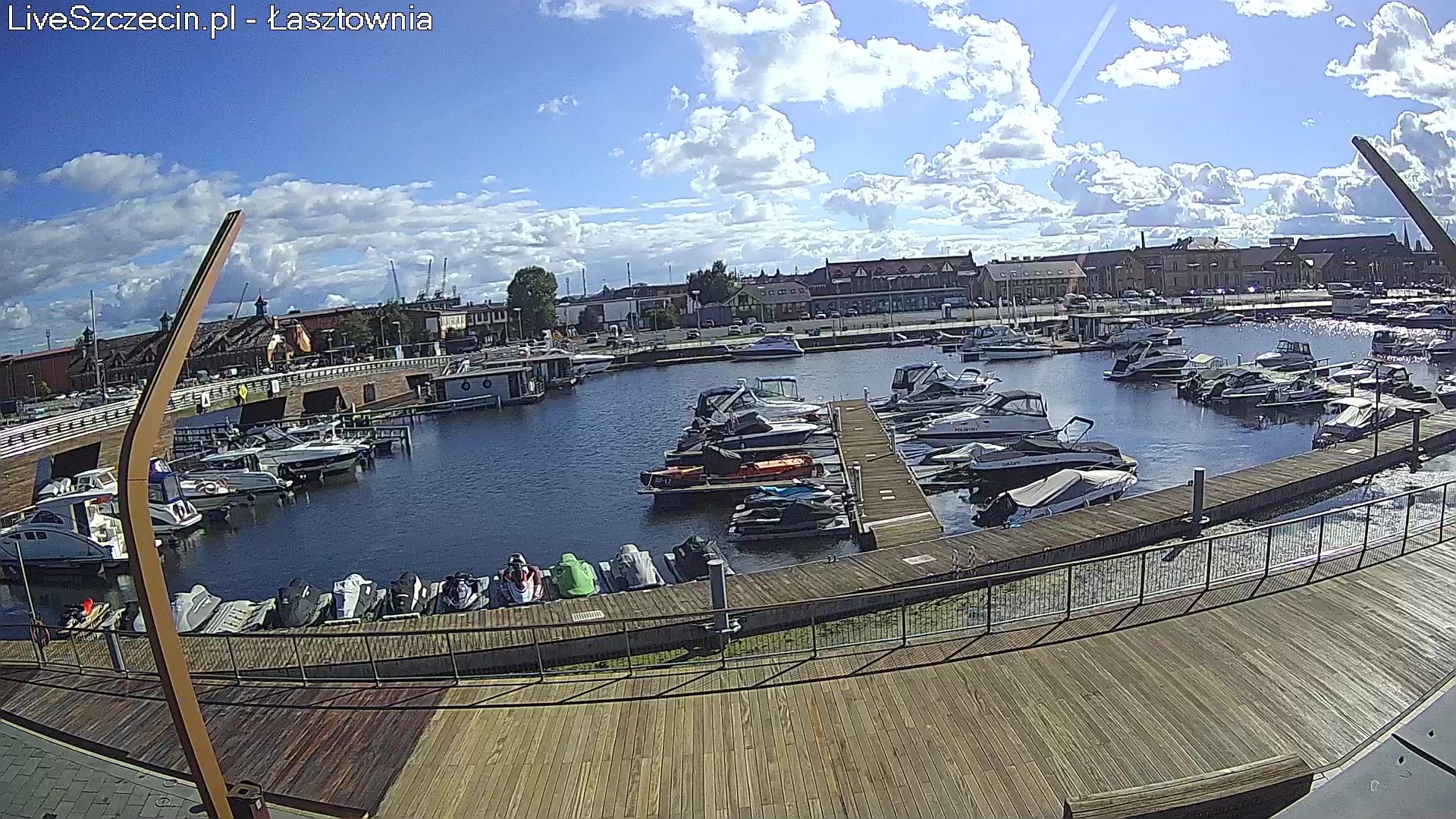

A port city with a Hanseatic character
Szczecin lies in western Poland, where the Oder flows into the Baltic. It is a city with a complex fate — German Stettin, destroyed by war, rebuilt by Poles, and today transformed into one of the greenest and most unexpectedly stylish cities in the country. Szczecin webcams online allow you to see its contrasts: medieval brick facades sit alongside an avant-garde philharmonic, while port cranes stand beside baroque domes.
The city joined the Hanseatic League in 1278, becoming a key Baltic transshipment point. Grain, timber, and herring were shipped from here across Europe. This trading legacy shaped Szczecin's appearance — wide embankments, spacious markets, and brick Gothic architecture that can be explored for hours.
Pomeranian Dukes' Castle and the Curse of Sidonia
The city's dominant landmark is the Pomeranian Dukes' Castle, towering above the Oder. Its history began in 1346, when Duke Barnim III laid the foundation for the so-called "Stone House." By the 16th century, under Duke John Frederick, Italian architect Wilhelm Zacharias transformed the modest residence into a Renaissance palace with five wings, the last of which — the museum wing — was completed in 1619.
The castle is linked to a dark legend about Sidonia von Borck. The noblewoman fell hopelessly in love with the son of Duke Philip I, but the groom chose another. The spurned Sidonia allegedly placed a curse on the Griffin dynasty — the line was to be cut short. A few years later she was accused of witchcraft, tortured, and executed in 1620. The Pomeranian dukes indeed failed to leave direct heirs.
Underground Szczecin: Cold War bunkers
Beneath the city streets lies an entire world. Podziemne Trasy Szczecina offers three themed routes through underground passages and bunkers. You can choose "World War II," "Cold War," or "The Communist Era." The temperature inside stays around 14°C, so the free blankets at the entrance are not a luxury but a necessity.
A self-guided visit costs 50 PLN for a full ticket and 40 PLN for concessions. The complex operates Thursday through Monday, from 12:00 to 16:00, with the last entry at 15:00. Photography is allowed, but video recording is prohibited. For those who want to go deeper, there is a three-hour guided tour at a depth of about 20 meters — it passes through abandoned World War II shelters.
Brick Gothic and Hanseatic heritage
Szczecin's architectural profile was shaped by the Hanseatic League. Three medieval brick churches are included in the European Route of Brick Gothic. St. James' Cathedral was founded as early as 1187 and remains one of the most impressive examples of this style in the region. The Town Hall is a Gothic monument that survived wars and reconstructions.
After 1873, when fortress restrictions were lifted, urban planner Conrad Kruhl redesigned Szczecin with a radial street network. Eclectic apartment buildings with Berlin-scale ambition appeared — rich facades, sculptural decoration, stucco work. Today these neighborhoods are among the most atmospheric parts of the city, where Szczecin webcams show the measured pace of local life.
Philharmonic: a white iceberg on the Oder bank
In 2014, Szczecin received a building that instantly became its calling card. The Mieczysław Karłowicz Philharmonic, designed by the Spanish firm Barozzi Veiga, is a structure of opaque white glass resembling an iceberg or a frozen sail. Inside is a 1,000-seat symphony hall covered in gold leaf and a 200-seat chamber hall.
The acoustics here meet the standards of Vienna's Musikverein, allowing for studio recordings. In 2015, the philharmonic received the Mies van der Rohe Award — the first Polish building to earn this honor. The white hall is divided by just two staircases, and the gold decor of the auditorium follows local craft traditions using irregular triangular plates whose fragmentation increases with distance from the stage — this is not just decoration but acoustic calculation.
Triglav: the three-headed god
Before Christianity, the main deity of the Pomeranians was Triglav — a three-headed idol worshipped in Szczecin, Wolin, and probably in Brenna. Artifacts of the cult included a gilded and silver saddle and a black horse. When an epidemic struck the city, priests declared it divine punishment for abandoning the faith. Pagan sacrifices resumed, and Christian churches fell into decline.
In 1127, Bishop Otto of Bamberg returned to Pomerania and continued Christianization, destroying pagan shrines. The cult of Triglav was suppressed, but memory of it survived in legends and archaeological finds — another layer in Szczecin's centuries-old history.
Pomeranian cuisine: from shandar to rukhanki
Szczecin is a fishing city, and this is felt in the menu. Fish soup is a must as a starter. Halibut, cod, and herring in the Kashubian version with a sweet-and-sour onion and tomato sauce are classics of local taverns. Smoked mackerel, eel, and pike-perch from the lake are all served with young potatoes in herb oil and sauerkraut.
Among meat dishes, ferkazé stands out — poultry in a white sauce with raisins, a sweet-and-sour dish that surprises tourists. Gołąbki — cabbage leaves with rice and pork in tomato sauce — is home cooking at its finest. For dessert, people eat rukhanki — yeast pancakes with apple, kuch — a pie with streusel, and cheesecake made from local cottage cheese. And on the streets of Szczecin, you must try pasztetik — a crispy fried pie with beetroot soup, a cult snack of Polish Pomerania.
What the cameras show
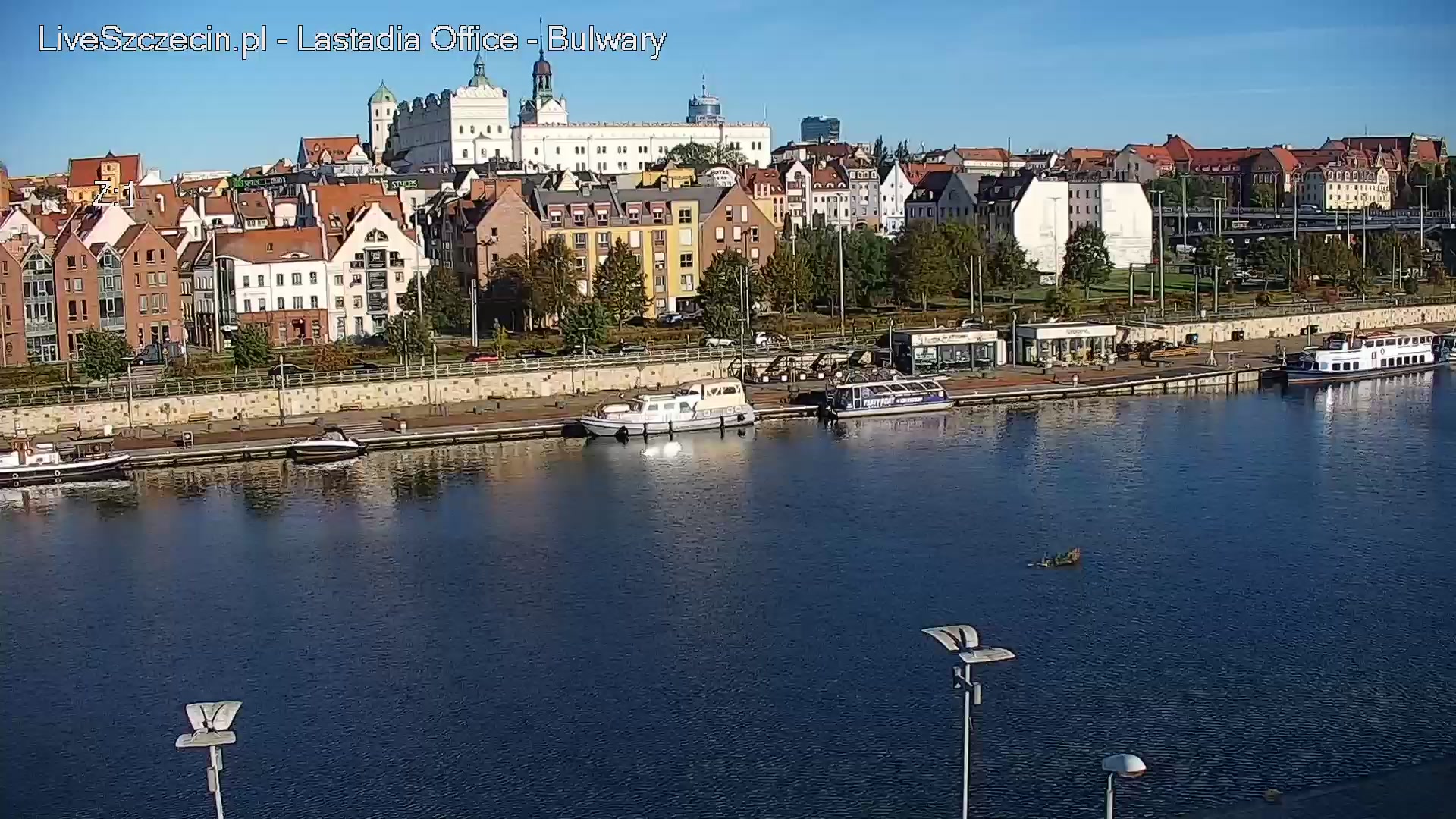
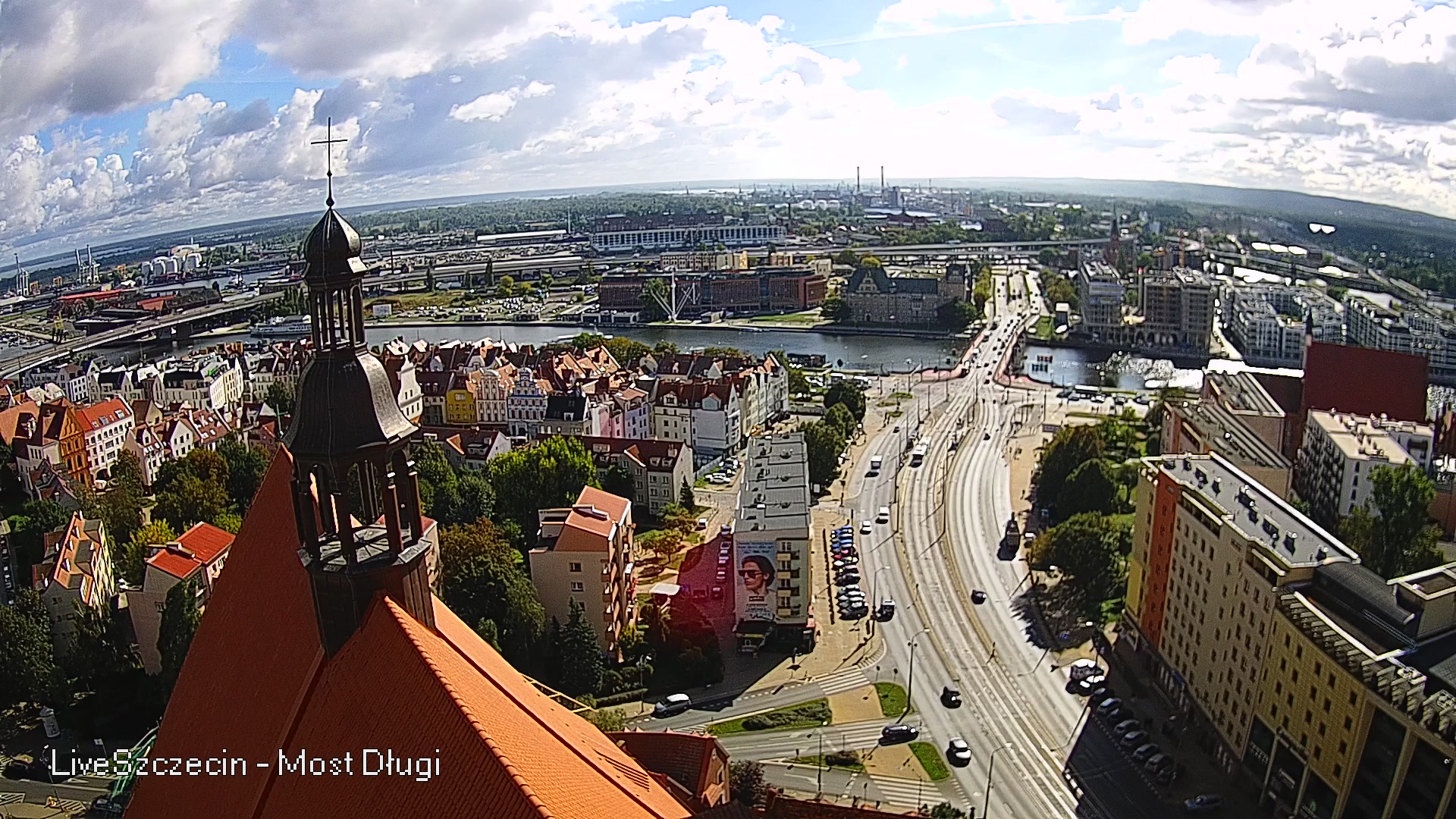
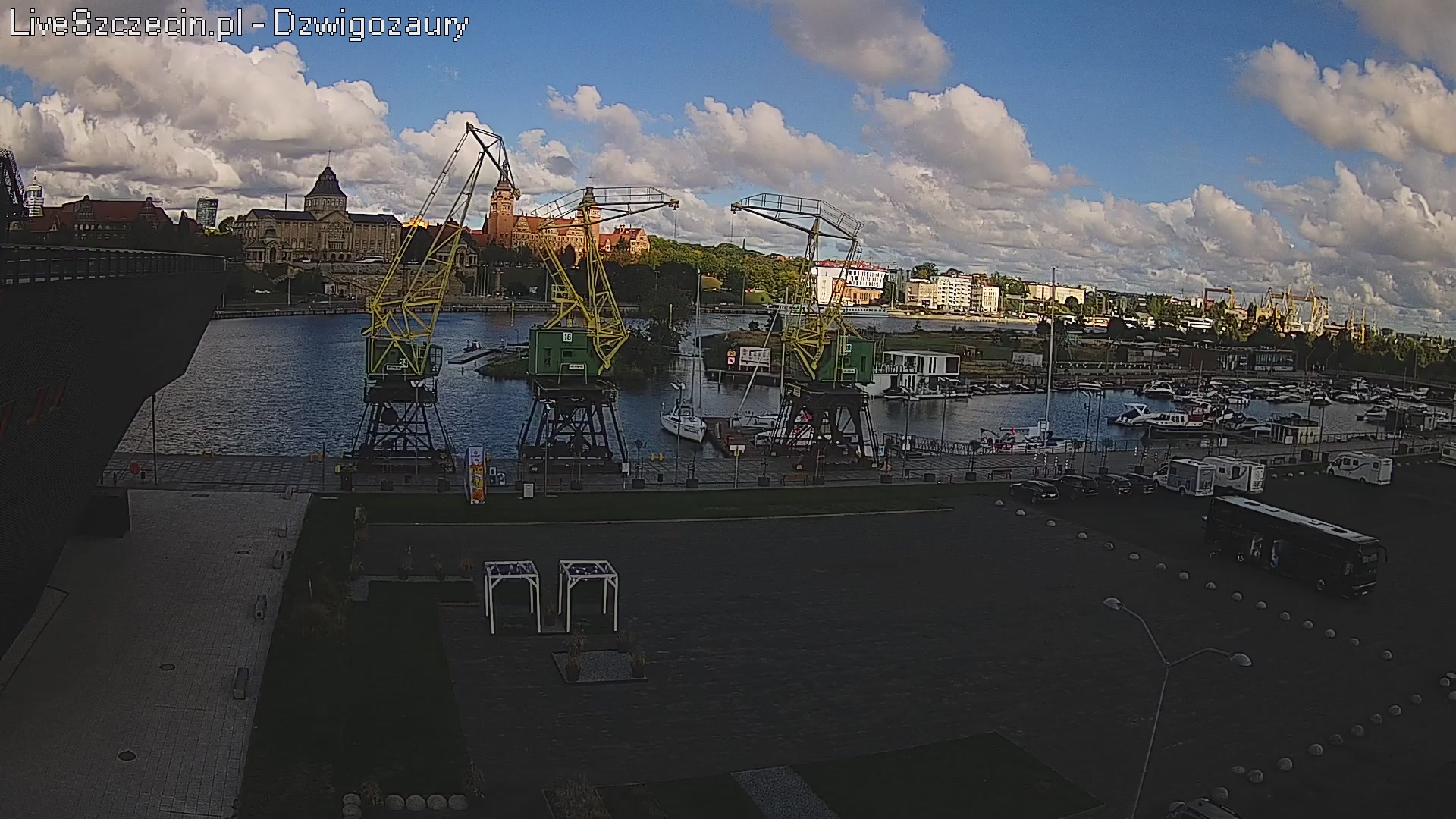
Szczecin webcams online are positioned to cover the city's key points. Broadcasts from the Oder waterfront show the Pomeranian Dukes' Castle against port landscapes — a contrast of medieval and modern commerce. Cameras in the center capture the Gothic facades of brick churches and the town hall, as well as the busy intersections of the radial street planned by Kruhl.
Separate broadcasts come from the square in front of the philharmonic — you can watch how Barozzi Veiga's white iceberg changes color depending on the time of day. Szczecin webcams in real time are a way to see the city as it is: port, Hanseatic, with underground bunkers beneath your feet and a golden hall above your head.