

🏙️ Holwert Webcams Online — Watch the Frisian Village in Real Time
1 cameras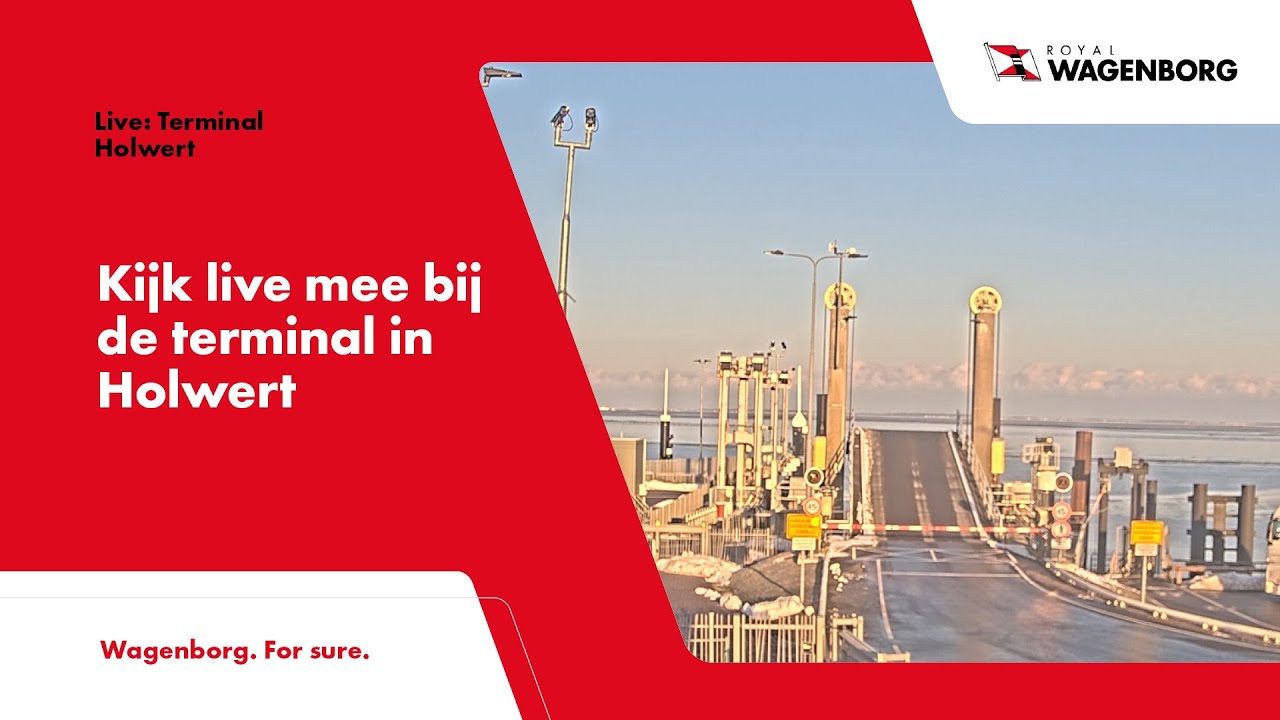
Holwert — a trading outpost on the Wadden Sea coast
In the north of the Netherlands, where land meets the endless muddy flats of the Wadden Sea, stands a village with a complex fate. Holwert is a settlement with approximately 1,607 inhabitants, which for centuries has maintained its position as one of the key coastal points of Friesland. There is no capital city noise here, but there is something that cannot be bought for any money — a tide that twice a day turns sea into land, and a horizon behind which the Frisian Islands hide.
The village stretches along a dike separating farmland from the mudflats. On one side — neat farms and canals, on the other — an endless strip of mud, along which locals have walked to neighboring islands since time immemorial. It is this duality that defines Holwert's character: it is simultaneously peasant and maritime, quiet and open to all winds.
Village history: from terps to ferry hub
The first settlers did not appear here by choice. In the 8th century, people built terps — artificial mounds to save themselves from floods. On these elevations they built houses, stored grain, and prayed to their gods. Over time, the terps grew, merged, and by the Middle Ages Holwert had become a full-fledged settlement with its own harbor.
Already in 1348, the village is mentioned as a trading place. The sea fed and provided opportunities to earn — grain, cattle, and wool were exported from here. Holwert's flag still bears the caduceus — a symbol of trade, while the yellow and blue colors remind of the land and sea that are inseparable here. The village maintained its status as a trading center for centuries, even when larger ports of Friesland overshadowed it in cargo volume.
Architectural heritage and national monuments
Holwert boasts an impressive collection of historic buildings. 14 structures are registered as national monuments (rijksmonumenten) — residential houses, churches, and farms whose age is measured in centuries. This makes the village the settlement with the largest number of protected buildings in the Dongeradeel municipality.
Among them stands out the Sint-Willibrorduskerk church — a stone testament to Holwert's former wealth and influence. Its walls have survived more than one war, more than one storm, and still serve as a landmark for sailors. A walk through the village is a journey through eras: from medieval foundations to neat Frisian houses with tiled roofs.
Windmills and coastal landscape
Friesland is unthinkable without windmills, and Holwert is no exception. Two windmills stand in the village: Miedenmolen, built in 1855 and restored to working condition, as well as De Hoop. Miedenmolen has national monument status under number 38696 — it is not just a museum piece, but a working mechanism that turns its sails on windy days, just as it did a century and a half ago.
The windmills here are not decoration. They remind how the Frisians fought water for centuries, pumping it from the fields back to the sea. Around the windmills stretch pastures, canals, and dikes — a typical landscape of the Dutch north, where every patch of land is conquered from the elements.
Wadden Sea and the unique mudflat ecosystem
Holwert's main treasure is not the buildings or windmills, but what stretches beyond the dike. The Wadden Sea is the world's largest continuous system of tidal flats, a UNESCO World Heritage Site. Twice a day the water recedes, exposing kilometers of mud that can be walked on.
Holwert is home to the Wadloopcentrum Fryslân — a training center for mudflat hiking guides. Here they teach how to safely navigate the muddy bottom, read tide charts, and understand the sea's behavior. Mudflat hiking is not just a tourist attraction, but part of Frisian identity, a way to feel connected to ancestors who walked these same mudflats thousands of years ago.
The Wadden Experience Centre offers tourists an immersion into the Wadden Sea ecosystem: learn about birds nesting on the mudflats, seals coming ashore, and how the food chain of this unique place works. It is a place where science meets the poetry of coastal life.
Ferry to Ameland: gateway to the Frisian Islands
Holwert is not the end of the journey, but the beginning. Since 1920, a ferry to Ameland Island has departed from here — one of the five inhabited Frisian Islands. This makes the village an important transport hub through which thousands of tourists pass annually.
The ferry terminal is the heart of modern Holwert. There is always movement here: cars line up, cyclists wait for boarding, children press against the railing watching the ship's maneuvers. From here there is a view of the fairway, used not only by passenger ferries but also by fishing boats and yachts.
For those not ready for a sea voyage, the village itself is worth a visit. Narrow streets, canals with bridges, the smell of salt and hay — Holwert has preserved that atmosphere of the Frisian province that disappears in large cities.
What the cameras show
Holwert webcams online offer views of key points in the village: the dike with a panorama of the Wadden Sea, the ferry terminal, central streets, and surroundings. Watching Holwert in real time allows you to see how the landscape changes depending on the tide, how the ferry crossing operates, and what the weather is like in the north of Friesland right now.
Broadcasts from Holwert are especially interesting during tide hours — you can watch the water recede, exposing the muddy flats, or conversely, cover the mudflats. Windmills in the background create that unmistakable Dutch landscape. A live broadcast from this Frisian settlement is an opportunity to touch life on the edge of Europe without leaving home.