

🏙️ Rome Webcams Online — Watch the Italian Capital in Real Time
6 cameras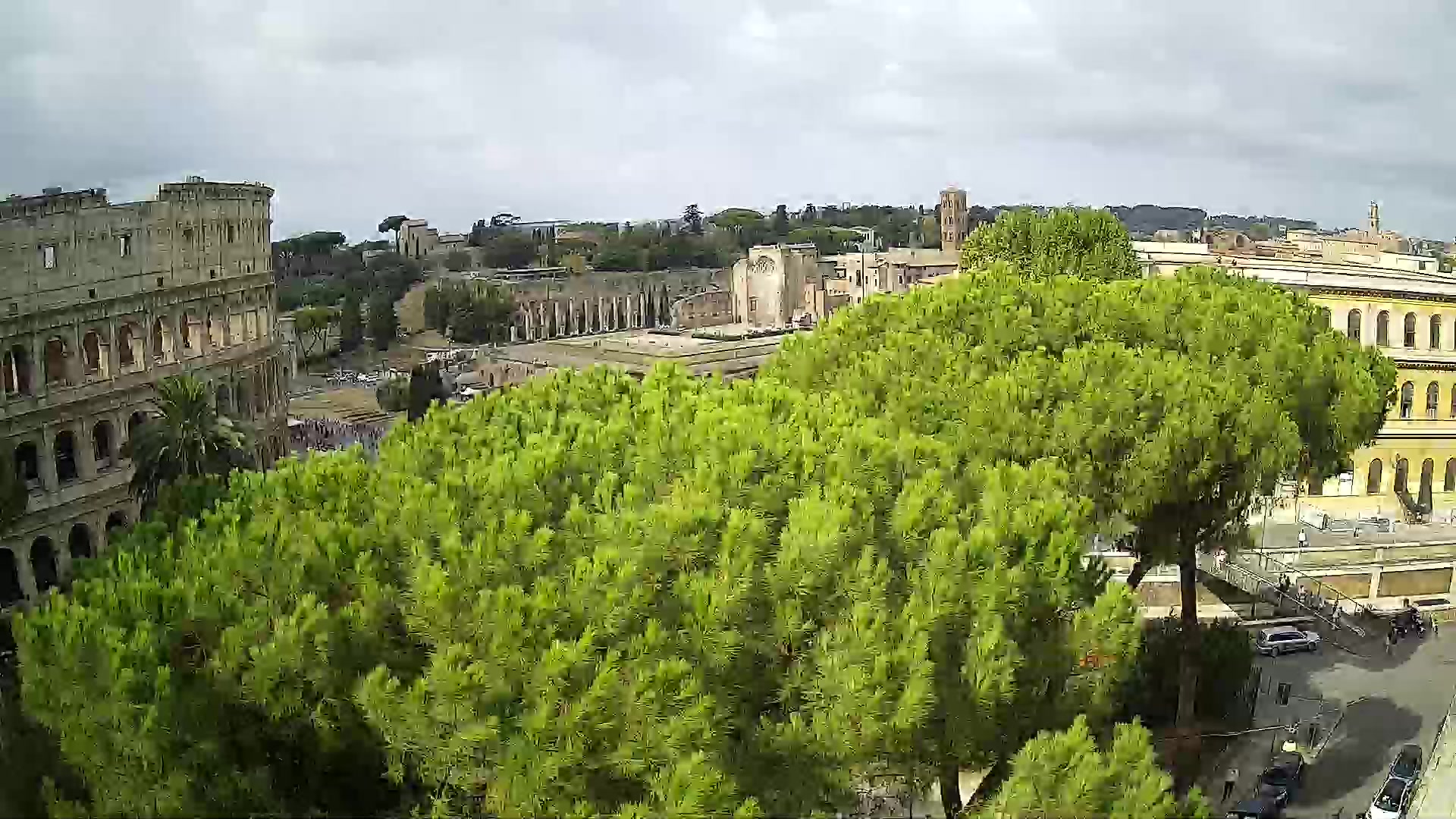
The Eternal City: History and Modernity
Rome is a place where time flows differently. Here ancient ruins stand alongside baroque facades, and modern life thrives in the shadow of two-thousand-year-old columns. The capital of Italy boasts over 2700 years of continuous history, and every stone here holds the memory of the past. A stroll through the streets of Trastevere or a view of St. Peter's Square allow you to feel this unique atmosphere where past and present merge into one.
The city lives at its own pace — unhurried yet filled with energy. Morning coffee on the Spanish Steps, shopping on Via Corso, an evening aperitivo in the Testaccio district — all of this creates the unmistakable Roman character. You can observe this rhythm not only while traveling but also through webcams that convey the atmosphere of the Eternal City in real time.
The Colosseum: The Grandeur of Ancient Rome
The Flavian Amphitheatre, known as the Colosseum, remains the primary symbol of ancient grandeur. Built in 70–80 AD, it accommodated up to 50,000 spectators and had 80 numbered entrances. Few people know that in the early years the arena could be filled with water to stage naval battles — naumachiae. Today the Colosseum is recognized as a UNESCO World Heritage Site and one of the New Seven Wonders of the World.
The underground tunnels of the hypogeum — a complex system of corridors, elevators, and cages for animals and gladiators — remained hidden from visitors' eyes for a long time. In 2025, the secret passage of Emperor Commodus, through which the ruler descended to the arena, was opened to the public. Animals for the spectacles were brought from across the empire: lions, elephants, rhinoceroses, giraffes, and even polar bears.
The Pantheon: Secrets of the Ancient Dome
The Temple of all gods, built under Emperor Hadrian around 126 AD, is a marvel of engineering perfection. Its dome with a diameter of 43.3 meters remains the largest unreinforced concrete dome in the world. The sole source of light — the oculus with a diameter of 8.2 meters — creates a magical play of light and shadow. Rain penetrates inside, but a hidden drainage system channels water through holes in the floor.
The secret of Roman concrete is still being studied by engineers. To lighten the upper layers of the dome, pumice and tuff were used, but the exact recipe remains a mystery. From the 7th century, the Pantheon became the Christian church of Santa Maria ad Martyres, which saved it from destruction and preserved it for future generations.
The Trevi Fountain: The Tradition of Throwing Coins
The baroque fountain, created by Nicola Salvi in 1762, has become a pilgrimage site for tourists from around the world. According to tradition, one coin thrown with the right hand over the left shoulder guarantees a return to Rome, two — to love, three — to divorce. Every year, around 1.5 million euros are retrieved from the fountain, which since 2007 have been donated to the charity Caritas.
The Trevi Fountain is not just an architectural monument but a living symbol of Roman identity. Its baroque sculptures and frothy jets of water create a sense of celebration that attracts thousands of people every day. Evening illumination transforms the fountain into a theatrical stage where every tourist becomes a participant in an ancient ritual.
Rome's Cats: Free Inhabitants of the Eternal City
Rome has Law No. 28 of 1991, which protects the right of stray cats to freedom. The ruins of the ancient temples at Torre Argentina have become home to about 200 cats, cared for by volunteers. If five or more cats live in an area, they are recognized as a "colony" and cannot be removed.
Rome's cats are descendants of those that lived in Ancient Rome, where they were considered sacred animals associated with the goddess Libertas. Today they have become an integral part of the urban landscape: they can be found on the steps of the Pantheon, among the ruins of the Forum, and on the cozy streets of Trastevere. For many tourists, a photo with a Roman cat is a must-do activity.
Aventine Hill: The View Through the Keyhole
On the Square of the Knights of Malta stands the famous keyhole of the Priory of the Knights of Malta. Through it, a perfectly framed perspective is revealed: at the end of a cypress-lined avenue, the dome of St. Peter's in the Vatican appears. This view was designed by architect François Duval in the 18th century and remains one of Rome's most unusual "hidden" vistas.
The Aventine Hill is one of the seven hills on which the city was founded. Today it is a quiet residential district with orange tree gardens and medieval churches. The view through the keyhole creates the illusion that the dome lies just beyond the gate, although the distance to it is several kilometers. A line of tourists often forms before the keyhole, eager to see this optical illusion.
The Legend of Romulus and Remus
According to legend, Rome was founded on April 21, 753 BC by twin brothers nursed by a she-wolf. Archaeological discoveries on the Palatine Hill confirm the existence of settlements from the 8th century BC, which coincides with the legendary date. Today the she-wolf remains the symbol of the city, and the founding day is celebrated as a holiday.
The legend tells of the grandchildren of King Numitor of Alba Longa, whom their uncle Amulus ordered to be thrown into the Tiber River. The basket with the infants washed ashore at the Palatine Hill, where they were found by a she-wolf. The shepherd Faustulus raised the brothers, and upon reaching adulthood, they decided to found a new city. A dispute over the choice of location led to the death of Remus at the hands of Romulus, who became the first king of Rome.
What the Cameras Show
Rome's webcams allow you to see the main attractions without being there in person. Broadcasts from panoramic viewpoints reveal views of the Colosseum, the Pantheon, and St. Peter's Square. Watching the Eternal City online is an opportunity to feel its rhythm, explore routes before a trip, or simply enjoy the beauty of the Italian capital from anywhere in the world.
Online broadcasts cover key areas: from the historic center with its baroque squares to modern neighborhoods with bustling streets. Rome webcams online are a window into a city where antiquity meets modernity and every day brings new discoveries.