

🏙️ Webcams Naples Online — Watch in Real Time
2 cameras
Ancient Roots: The Greek Foundation of Modern Naples
Naples is one of the few European cities where antiquity is not hidden behind museum displays but literally beneath your feet. The streets of the historic center still follow the geometric grid laid out by Greek colonists in the 8th century BC. It was then that the settlement of Neapolis — "New City" arose on the shores of the Bay of Naples, becoming an extension of earlier Greek colonies on the island of Ischia and in Cumae.
Walking through Piazza Bellini, you can see fragments of the Greek wall — the very one that separated the residential quarters of the ancient polis. And beneath the medieval church of San Lorenzo, archaeologists have unearthed the ancient agora — the marketplace where Greek merchants once traded. The historic center of Naples is one of the few in the world that has preserved a layout over 2,000 years old almost intact. This is not an open-air museum but a living city where palazzos, churches, and narrow alleys of Spaccanapoli have risen above ancient foundations.
Of particular interest is the Crystallini Hypogeum — a Greek necropolis from the late 4th century BC, opened to visitors in 2023. The burial chambers resemble Macedonian tombs, and the walls bear the inscription "χαῖρε" — an ancient "hello," equivalent to the modern Neapolitan "ciao." The Greek theater, where Nero once performed, is still visible on Via Anticaglia — a reminder that Naples maintained its Hellenic cultural identity even after joining Rome.
The Underground City: Labyrinths Beneath Naples
If the historic center is the face of Naples, then its underground is the hidden soul. The multi-layered labyrinth originated as early as the 4th century BC, when Greeks began excavating porous tuff for construction. The Romans turned these quarries into a system of aqueducts and cisterns that supplied the city with water. In the Middle Ages, the underground passages served as warehouses, and during World War II as bomb shelters for thousands of Neapolitans.
Today, Underground Naples comprises 400 kilometers of tunnels, cisterns, and caverns located at depths of 10 to 40 meters. The unique acoustics of the underground create the sensation that the city is breathing somewhere below. Tours are conducted by lantern light — among tuff vaults, stalactites, and ancient water pipes.
Special attention deserves the catacombs. The Catacombs of San Gennaro house the relics of Naples' patron saint and unique frescoes with biblical scenes. There is also an ancient baptistery resembling a sandbox — a place where early Christians performed the sacrament of baptism. The Catacombs of San Gaudioso in the Rione Sanità district were founded in the 4th-5th centuries and are decorated with 9th-century frescoes, including a mosaic with a peacock — a symbol of immortality. In the 17th century, the Dominicans expanded these catacombs, adding side altars consecrated in 1628.
The Miracle of San Gennaro: Blood That Liquefies
In the Cathedral of Naples, two ampoules are kept containing a dried substance that believers consider the blood of San Gennaro — the Bishop of Benevento who suffered martyrdom on September 19, 305 AD during the Diocletianic Persecution. Three times a year — December 16, September 19, and the first Saturday of May — a miracle occurs: the dark substance liquefies and sometimes even boils before the eyes of the gathered crowd.
The first documented mention of the miracle dates to August 17, 1389 — recorded in the Chronicon Siculum chronicle. Since 1667, the ampoules have been kept behind the altar of the Treasure Chapel in a niche closed by two massive silver doors — a gift from Charles II of Spain.
History knows remarkable episodes. In 1799, the French army of General Championnet captured Naples and demanded an extraordinary miracle. Soldiers broke into the sacristy and threatened the clergy with execution — on January 24, 1799, liquefaction occurred. And in 1979, when a powerful earthquake claimed thousands of lives, popular rumor linked the tragedy to the fact that the miracle did not occur. On May 4, 2024, the miracle of liquefaction occurred during a Mass led by Archbishop Domenico Battaglia.
In 2005, Professor Margarita Hack put forward the hypothesis that the "blood" is an iron-oxide gel (FeO(OH)) that liquefies when shaken. The Church rejected this explanation. When the miracle occurs, priests wave a white cloth — a sign that the omen has taken place.
Pizza Margherita: From Naples Streets to the Whole World
June 1889. The Royal Palace of Capodimonte commissions pizzaiolo Raffaele Esposito to create a pizza for Queen Margherita of Savoy. Of the three options, the queen chooses the one colored in the Italian flag: red tomato, green basil, white mozzarella. The pizza takes the queen's name, and the official letter of recognition is still displayed at Pizzeria Brandi — Esposito's very establishment.
However, researchers have found mentions of similar toppings as early as 1796-1810, and in the 1830s, the book "Napoli, contorni e dintorni" describes a pizza with tomatoes, mozzarella, and basil. But it is the legend of Esposito that became the cultural myth, and Neapolitan pizza — the gastronomic symbol of Italy.
Authentic Neapolitan pizza is a strict ritual. The dough consists of four ingredients: flour, water, yeast, and salt — no fats. It is kneaded by hand, shaped without a rolling pin, no more than 3 mm thick. It bakes for 60-90 seconds in a wood-fired oven at 485°C. Tomatoes must be San Marzano or Piennolo del Vesuvio, cheese — Mozzarella di Bufala Campana or Fior di Latte. The art of the Neapolitan pizzaiolo is inscribed on UNESCO's Intangible Cultural Heritage list — recognition that pizza here is not fast food but a philosophy.
Coffee Rituals: Naples as a "Starbucks Under the Open Sky"
Coffee in Naples is not a beverage but a way of existence. The tradition arrived in 1768 when Maria Carolina of Austria, upon marrying King Ferdinand IV, brought the Viennese custom of coffee ceremonies. In 1819, the "cuccumella" was invented — a Neapolitan coffee maker with a double filter that alternated Turkish brewing with Venetian infusion. With it, coffee ceased to be exclusively a bar drink.
In Neapolitan bars, cups are kept in a container of hot water — the barista retrieves them with special tongs. Coffee is always served with a glass of water, which is drunk BEFORE the coffee to cleanse the taste receptors. And the tradition of "suspended coffee" (caffè sospeso) — when a person pays for two cups, drinks one themselves, and leaves the second for a stranger — has become a symbol of Neapolitan generosity.
The famous 4 "M" classification defines the perfect espresso: Macchina (coffee maker), Macinino (grinder), Miscela (blend), and Mano (the barista's hand). The roast here is slightly darker than in other regions of Italy, and the essential oils reveal themselves more vividly a couple of days after processing.
"'O Sole Mio": The Song That Conquered the World from Odesa
In 1898, Eduardo di Capua, while in Odesa, composed a melody that became one of the most recognizable musical works on the planet. The lyrics were written by Giovanni Capurro. The authors sold the rights for 25 lire and died in poverty — not even suspecting that they had created a hymn to the sun that would be sung by Elvis Presley, Enrico Caruso, and Luciano Pavarotti.
At the 1920 Olympic Games in Antwerp, the conductor lost the sheet music for the Italian national anthem — the orchestra performed "'O Sole Mio," which they knew by heart. In 1949, Tony Martin recorded the English version "There's No Tomorrow," and in 1960 Elvis Presley released "It's Now or Never" — the single topped the US and UK charts, with over 10 million copies sold. Thirteen-year-old Roberto Loretti, who sang this song in Italian cafes, became a world star after being noticed by a Danish producer.
Today, "'O Sole Mio" is not just a song but a cultural code of Naples, performed in the Neapolitan dialect and translated into dozens of languages.
Superstitions and Amulets: The Invisible Protection of Neapolitans
Neapolitans are one of the most superstitious peoples in Italy. Here, the "malocchio" — the evil eye — is feared, and protection comes from a red thread on the wrist, coral amulets, and small protective eyes. Children are hung with red threads (laccio rosso) around their necks, and at the first signs of illness, people slap the shoulder and hiss "tschur."
Friday the 17th is a day when Neapolitans prefer not to start important business. Unlike the rest of the Western world, which fears the number 13, here 17 is dreaded: the Roman inscription "VIXI" ("I lived," meaning "I am dead") adds up to this number. A hat is not placed on a bed — this is associated with a doctor's last visit to a dying person. One does not walk under a leaning ladder — the triangle symbolizes the Trinity, and to break it is a sin.
Broken mirrors, old dolls, and cracked ceramics are considered vessels of evil spirits. Such items are taken out of the house, buried under a cross, or thrown into the sea. Sometimes they are brought to a church, where a priest performs a cleansing ritual.
Neighborhoods of Naples: From Spaccanapoli to Posillipo
Naples is a city of contrasts, where each quarter has its own character. Spaccanapoli — the street that cuts through the historic center and gave the entire district its name — is the heart of Naples: noisy, colorful, smelling of pizza and bay leaf. Here are workshops where figurines for Christmas presepe are still made — a tradition dating back to the 18th century.
The Rione Sanità district — a former cemetery turned residential area — is a place where death and life are forever intertwined. This is where the Catacombs of San Gaudioso are located, and local residents have lived for centuries in houses built directly over ancient burials. The Posillipo district is the aristocratic opposite: villas with views of the bay, the Caracciolo promenade, and Villa Floridiana Park, which offers a panorama of the entire Bay of Naples with Vesuvius.
Vesuvius and the Bay: The Volcanic Landscape of Naples
Vesuvius is not just a volcano but an active participant in city life. The last eruption occurred in 1944, destroying the villages of San Sebastiano and Massa di Somma. Today the volcano is under constant surveillance, and its silhouette dominates the panorama of Naples. On the slopes of Vesuvius grow vineyards producing Lacrima Christi wine — "Tears of Christ," considered one of the best southern Italian wines.
The Bay of Naples is one of the most recognizable bodies of water in the Mediterranean. The islands of Capri, Ischia, and Procida are visible from the Mergellina waterfront, especially at sunset. The Port of Naples is one of the largest in Italy, connecting the city with the islands, Sardinia, and Sicily.
What the Cameras Show
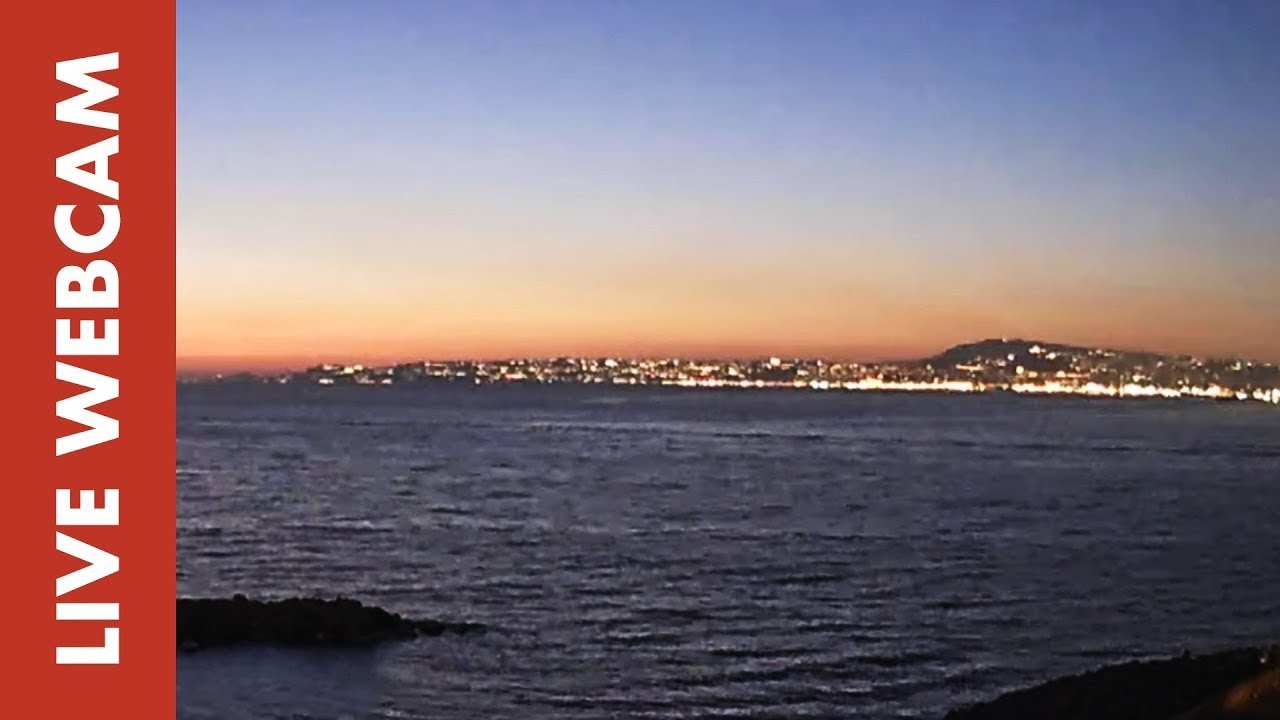
Naples webcams allow you to see the city as its residents do: noisy squares, narrow alleys of Spaccanapoli, the waterfront with views of Vesuvius and the bay. Cameras installed in the historic center show traffic on streets where Greek layout coexists with Baroque facades. Broadcasts from the waterfront reveal the panorama of the port and the island of Capri on the horizon.
Watching Naples in real time means feeling the rhythm of a city where antiquity and modernity exist in a single flow. Webcams capture not only architectural monuments but also everyday life: baristas preparing espresso, fishermen on the pier, tourists at the cathedral with the Treasure Chapel of San Gennaro. This is an opportunity to see Naples from the inside — without flights or visas, but with a full sense of presence.