

🏙️ Webcams Carrara Online — Watch the Marble City in Real Time
1 cameras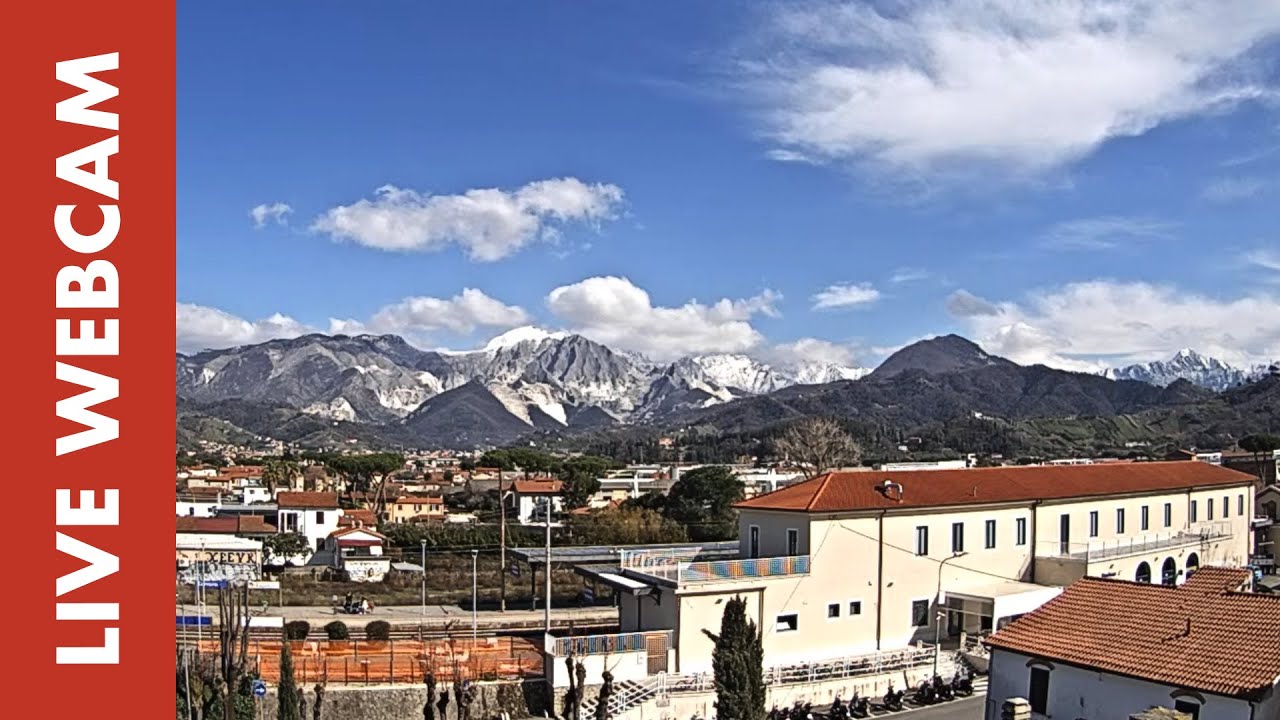
City History and Marble Quarries
Carrara is a city whose fate is inextricably linked to stone. Carrara's marble quarries have been worked since Roman times, and it is Carrara marble that was used in the construction of the Roman Pantheon and Trajan's Column. The city's name derives from the Celtic word "kair," meaning "stone" — this speaks to the ancient roots of the settlement, which existed long before the Roman conquest of these territories. The Celtic tribe of Ligurians, who inhabited these lands in prehistoric times, were the first to notice the deposits of white stone in the mountains.
In the 5th century, marble extraction in Carrara virtually ceased due to barbarian raids. Around the year 1000, the village of Carrara was founded, and by 1250 quarrying had resumed. Since then, the city has become a center of the marble industry, known far beyond Italy. Carrara marble was prized for its purity, whiteness, and ability to withstand the test of time — qualities that made it the material of choice for the world's greatest sculptors. In the Middle Ages, Carrara was an independent commune, and later became part of the Duchy of Massa and Carrara, ruled by the Cybo-Malaspina dynasty.
Today, Carrara's quarries are a breathtaking sight — white marble walls rise hundreds of meters high, creating a landscape unlike any other in the world. This is a place where history and nature have merged into one, creating a unique atmosphere that can be felt by watching the city through Carrara's online webcams. The Colonnata quarries and other areas are still actively worked, although extraction volumes have significantly decreased compared to past centuries.
Michelangelo and Carrara Marble
The great Michelangelo spent nearly a year in the Carrara quarries, personally selecting marble and building roads for its transport. He wanted to be simultaneously an engineer, a laborer, and a stonecutter — this approach allowed him to control the quality of the material from the moment of extraction to the creation of the sculpture. For the statue of David, an enormous block of marble was delivered to Florence from the Carrara quarries — Carrara marble was chosen for its ability to maintain structure in harsh weather. A sculpture made of poor-quality marble would have had its eyebrow or nose shift over time, but Carrara stone has preserved the perfection of form for centuries.
Carrara marble was used for Michelangelo's Pietà, the statue of George Washington, Jean-Antoine Houdon's works, and the massive Akshardham Temple in New Delhi. Some types of Carrara marble were even used in the cladding of the underground vestibules of Moscow Metro's Okhotny Ryad station — such is the far-reaching fame of Carrara stone. This marble has become a symbol of perfection and durability, a material chosen for their masterpieces by the greatest artists of different eras and cultures. From antiquity to the present day, Carrara marble remains the standard of quality in the world of natural stone.
Stonecutters' Life and the Anarchist Movement
By the end of the 19th century, Carrara had become the cradle of anarchism in Italy, especially among quarry workers. According to The New York Times in 1894, marble quarry workers were among the most neglected laborers in Italy. Harsh working conditions, low pay, and constant danger in the quarries led to the formation of a strong labor movement, which subsequently became an important part of Italian history. Carrara's stonecutters were renowned for their physical strength and endurance, yet they lived in poverty while the marble they extracted brought enormous profits to quarry owners.
On May 1st, an annual anarchist festival is held in Carrara, and marble monuments to fallen quarry workers have been erected in the city. The city's coat of arms features a cartwheel with the motto "Fortitudo mea in rotā" ("Our strength is in the wheel") — it was on such carts that marble slabs, which constituted the city's wealth, were hauled. This symbol serves as a reminder that Carrara's prosperity has always depended on the labor of ordinary workers who extracted and transported marble. The traditions of the anarchist movement in Carrara are alive to this day — the city remains a place where the workers' struggle for their rights is remembered and honored.
Gastronomic Traditions of Carrara
Lardo (cured pork fat) was originally the food of stonecutters working in Carrara's marble quarries — a high-calorie food that kept well and provided energy for heavy physical labor. Today, this dish has become a gastronomic symbol of the region, which can be tasted in the city's numerous restaurants and taverns. Lardo from Carrara is prepared using a special technique — the pork fat is aged in marble containers with the addition of herbs and spices, giving it a unique flavor. Marble containers are used for a reason — they maintain a constant temperature and do not react with the product.
In addition to lardo, Carrara's cuisine is renowned for other Tuscan traditional dishes: pasta with seafood, fresh fish from the Ligurian Sea, extra virgin olive oil, and local wines. The city's gastronomic traditions are closely linked to its geographical position — the proximity to the sea and mountains determines the diversity of local cuisine. In Carrara's restaurants, you can try traditional Tuscan soups such as ribollita and pappa al pomodoro, as well as dishes made with game and mushrooms gathered in the surrounding forests.
Attractions and Architecture
Carrara is not only about quarries — it is also a beautiful city with rich architecture. The Cathedral of Saint Andrew, built in the 12th-14th centuries, is one of the most impressive Romanesque-Gothic churches in Tuscany. Its facade is adorned with alternating white and gray marble — the traditional Pisan-Tuscan architectural style that can be seen in other buildings throughout the city. Inside the cathedral are works of art created by masters of different eras, and its bell tower is visible from many points in the city.
Renaissance palaces, medieval streets, squares adorned with marble fountains — all this creates the unique atmosphere of Carrara. The city is located at the foot of the Apuan Alps, creating a unique landscape: snow-white mountain peaks against the backdrop of Mediterranean vegetation and the blue of the Ligurian Sea in the distance. Carrara's webcams allow you to see this beauty in real time, watching how the lighting changes throughout the day. In the morning, the city is enveloped in a light mist; during the day, the marble buildings shimmer slightly in the sun; and in the evening, the sunset paints the mountains in pink and golden hues.
Among other attractions is the Palazzo Cybo-Malaspina, home to the Academy of Fine Arts founded in 1769, and the Marble Museum, which tells the history of the extraction and processing of this noble stone. A walk through the historic center of Carrara is a journey through centuries, where every building tells its own story. The narrow streets of the old city lead to squares where marble trade once thrived, and where cafes and shops are now located.
What the Cameras Show
Carrara's webcams allow you to see the city in real time. Streams from central squares, views of the marble quarries, and panoramas of the Apuan Alps are available. Choose the viewpoint that interests you and enjoy the atmosphere of this unique Italian city. The live stream from Carrara is an opportunity to touch history, feel the rhythm of life in the marble city, and see the places that inspired great masters to create their masterpieces. Watching Carrara via webcam means gaining access to a living portrait of the city, where past and present exist in harmony.