

🏙️ Aosta Webcams Online — Watch Roman Ruins and Alpine Landscapes in Real Time
1 cameras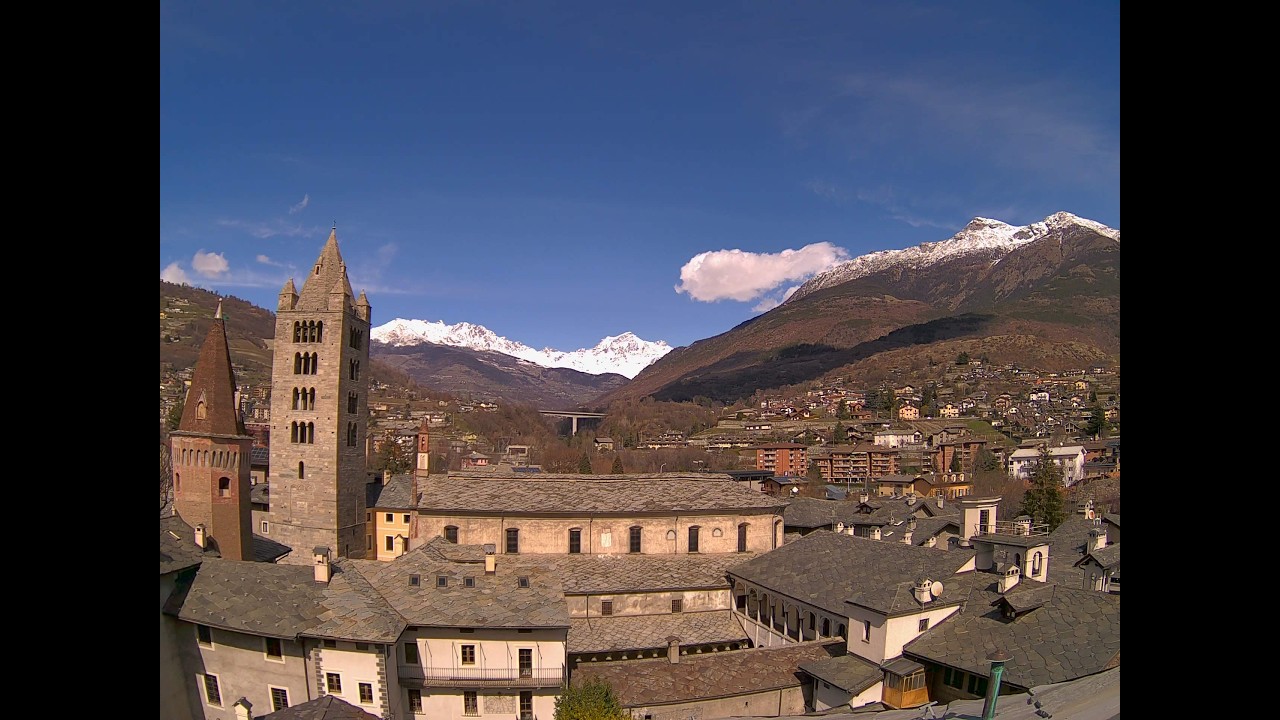
Two Millennia of History Around Every Corner
Aosta is a place where antiquity meets alpine silence. This city, founded as Augusta Praetoria Salassorum in 25 BC, still bears the marks of Roman engineering genius. Walking its streets, you literally step on layers of civilizations — from legionary foundations to medieval towers and Baroque facades. The Arch of Augustus still rises 11.4 meters, greeting travelers from the east just as it greeted Roman merchants two thousand years ago. Porta Praetoria — the eastern gate — retains three openings: the central one for carts, the side ones for pedestrians. And the city walls stretch for about 3 kilometers with twenty towers, spaced at equal distances from each other.
What makes Aosta unique is that it hasn't been frozen in a museum vacuum. People live here, shops operate, and fresh bread smells waft from bakeries on Via San Anselmo. The Roman Theatre, whose facade rises 22 meters, after its 2009 restoration once again hosts performances — imagine opera sounding open-air among ruins that are two thousand years old. The ancient capacity was between 3,500 and 4,000 spectators, and today the stands fill with audiences once more on summer evenings.
Three Languages on One Square
Aosta is Italy's linguistic paradox. It has two official languages: Italian and French. But there's a third — the Valdostan dialect, Franco-Provençal, spoken long before this land became part of the Italian state. According to the 2001 census, 77.29% of the population named Italian as their mother tongue, 17.91% Valdostan, and 1.25% French. At the same time, more than half of residents are fluent in all three languages.
A historical curiosity: in 1536, the Aosta Valley became the first government to adopt modern French as an official language — three years before France itself did. The fascist regime tried to eradicate French by closing schools and banning its teaching, but after the war the language returned. Today, schools have equal hours of Italian and French, and civil servants must demonstrate proficiency in both languages. On the streets, you can hear people smoothly switching from Italian to French mid-sentence — it sounds like the music of bilingualism honed over centuries.
Castles That Guard the Valley
The Aosta Valley is dotted with castles — over a hundred of them, from majestic ruins to restored residences. Each tells its own story of power, betrayal, and beauty. Fénis Castle became a masterpiece of defensive architecture in the 14th century, with frescoes depicting saints and coats of arms. Issogne Castle is famous for its "Pavillon" frescoes and the great hall where the Count of Savoy stayed. Verrès Castle is an austere 30-by-30-meter cube, built by the Challant family on a rocky outcrop: drawbridge, vaulted ceilings, arrow slits, boiling oil chutes — all part of a unified defense concept.
Fort Bard on the hill stopped Napoleon in the 19th century — its garrison withstood the siege, blocking the road to Italy. Today it houses a military museum, and the terraces offer a breathtaking panorama of the valley. And Graine Castle holds a legend of buried treasure: a shepherd heard a voice in a dream pointing to the treasure's location but warning him to leave before the third rooster's crow. He found the hatch, saw the gold, but lingered — and remained in the cave forever. Such stories are told to children here at bedtime, and you believe them looking at the stern walls.
The Roof of Italy: Four Giants
Aosta sits on the roof of Italy — here stands Mont Blanc at 4,810 meters, the country's highest point. But this is not the valley's only claim to fame. Four four-thousanders — Mont Blanc, Monte Rosa (4,634 m), Matterhorn (4,478 m), and Gran Paradiso (4,061 m) — stand as sentinels over the region. Gran Paradiso is unique: it is the only peak above 4,000 meters located entirely on Italian territory. Mont Blanc and Monte Rosa are shared with France and Switzerland, the Matterhorn is also on the border, while Gran Paradiso is entirely Italian.
On December 3, 1922, Gran Paradiso National Park was established — Italy's first national park. King Victor Emmanuel III donated 2,100 hectares of his hunting reserve to the state. Today the park covers 703 square kilometers, home to over 3,500 ibex, marmots, golden eagles, and stoats. Glaciers cover 9.5% of the territory, and elevations range from 800 to 4,061 meters. In summer, alpine meadows are carpeted with flowers; in winter, with snow — and at any time of year, this place feels like the edge of the world.
Cuisine That Warms in the Mountains
Valdostan cuisine is a story of survival in a harsh climate, transformed into art. You won't find the refined dishes of Tuscan tradition here — only hearty, caloric, honest food. Fontina is the region's main cheese, semi-hard with a nutty flavor that becomes creamy when heated. It's used in fondue, in polenta, or simply with bread and honey. Meat delicacies — bresaola, lard d'Arnad, jocolat (cured pork) — have been prepared for centuries to last through long winters.
A separate chapter is wine. The Aosta Valley is Europe's highest wine-growing region, with vines growing at altitudes up to 1,200 meters. Local varieties — Petit Rouge, Fumin, Cornay — produce light, mineral wines that pair perfectly with mountain cuisine. And for dessert — "Dolce Aosta" cake with cocoa, almonds, and cream, and local coffee sipped in small gulps while gazing at snow-capped peaks.
Festivals and Traditions: Cow Queens and Christmas Lights
Every October, the Aosta Valley transforms into an arena for an unusual spectacle — the Bataille de Reines, cow battles. This is not cruelty but a ritual: Alpine black-brown cows establish herd hierarchy by locking horns. The winner earns the title of "queen" and a place of honor on summer pastures. The tradition dates back to times when herds were a family's main wealth, and a cow's strength determined the community's prosperity.
In winter, central Aosta is transformed: on the square before the Roman Theatre and the Arch of Augustus, the Marché Vert Noël — Christmas market — lights up. Wooden chalets, the smell of mulled wine, local crafts and products against the backdrop of two-thousand-year-old ruins create an atmosphere that cannot be replicated anywhere else. And in spring, in March, the Foire de Saint-Ours takes place — a craft fair honoring Saint Ursus, the city's patron, with wood carvings, leather goods, and traditional dances.
Villages Not Found on Maps
Beyond Aosta lie places where time has stood still. Chamois is one of Italy's few car-free villages, accessible only on foot or by cable car. There are no cars here, only stone houses, morning fog, and the sound of bells from pastures. The village of Ru — abandoned, being reclaimed by nature: walls without roofs, vines climbing through window openings, and only a sign reminding that people once lived here.
In Etroubles, at 1,270 meters, the Free Sculpture Museum operates — contemporary artists' works displayed in the open air against alpine meadows. And in Pré-Saint-Didier, Roman baths still welcome guests: hot springs known since Augustus's time have been converted into a modern spa complex. The Chanusia Botanical Garden at 2,170 meters collects alpine plants from around the world — edelweiss, mountain roses, rare mosses.
Practical Tips: When to Go and What to Consider
The best time to visit Aosta depends on your goal. June through September — for hiking, cycling, and mountaineering. Gran Paradiso National Park opens its trails, mountain huts (rifugi) welcome guests, and the weather is stable. December through March — for skiing: Courmayeur, La Thuile, and Cervinia offer world-class slopes with views of Mont Blanc and the Matterhorn. November and May are unpredictable months: huts are closed, slopes are empty, and the weather changes its mind ten times a day.
October is a double-edged sword: beautiful autumn but unpredictable weather plus the Bataille de Reines festival, which draws crowds. Aosta is Italy's wealthiest and safest region, but prices here are above the Italian average. Budget travelers will appreciate agritourism in the smaller valleys — in Le Cour, Arvier, and Remd-en-Boss, where you can stay at family farms for reasonable prices and try authentic local cuisine.
What the Cameras Show
Aosta webcams online reveal views worth traveling to the Alps for. City center cameras broadcast Roman ruins in daylight and evening lamplight — the Arch of Augustus, the Roman Theatre facade, and Porta Praetoria appear in real time. Panoramic cameras on the outskirts show the valley from above: snow-capped peaks, green summer pastures, autumn larch colors. Some cameras are aimed at intersections and squares — you can observe the city's rhythm, how locals hurry about their business, how tourists photograph ruins, and how light changes on stone walls.
Watching Aosta webcams is a way to plan a trip or simply touch the atmosphere of a place while thousands of kilometers away. Morning broadcasts show the city in fog, daytime ones in bright sunlight, evening ones in the golden light of the setting day. If you're choosing when to go, observe the weather in real time: the Alps are capricious, and what was yesterday may change by the next morning. Aosta webcams are your window into a world where history and nature speak the same language.