

🏙️ Plattling webcams online — watch the city in real time
1 cameras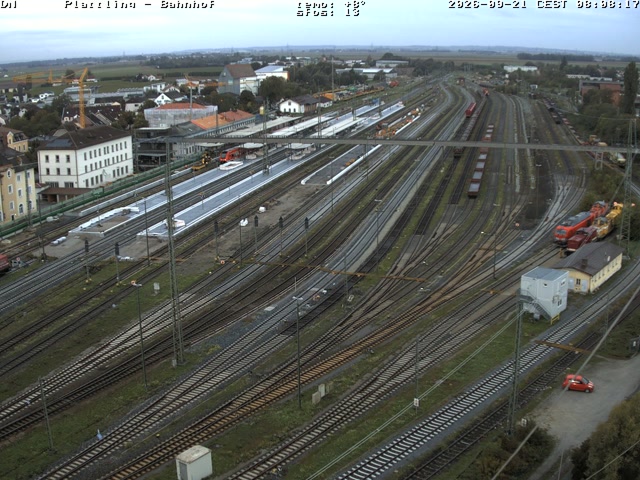
Plattling: the Nibelung city on the Danube
In the very heart of Lower Bavaria, where the Gäuboden plain stretches between the Danube and the foothills of the Bavarian Forest, lies Plattling — a city with over a thousand years of history and a truly unique character. It's a place where medieval traditions coexist with railway heritage, and Bavarian joie de vivre can be felt on every street. For those who want to experience the atmosphere of this corner of Germany, Plattling webcams online open a window into its daily life — from bustling squares to quiet embankments.
Plattling doesn't look like a typical Bavarian town with gingerbread houses. Its appearance was shaped by the railway, trade, and the river, making it truly authentic. There's no tourist hustle of Munich or Nuremberg here, but there's real Bavarian life, best observed live — through cameras installed at key points in the city.
History of Plattling: from a monastic settlement to a railway hub
Plattling's roots go deep into the Early Middle Ages. The first documented mention of Plattling dates back to 868, when King Ludwig donated the settlement to Metten Abbey. It was a small village on the banks of the Danube that gradually gained importance due to its position at the crossroads of trade routes.
The turning point came when the city was transferred to the Counts of Bogen. Around 1200, Plattling came into the possession of the Counts of Bogen; a bridge and a customs office already existed at that time. The bridge over the Danube and the customs house turned the settlement into a strategic point — duties were collected here from merchants traveling along the river. In the 19th century, Plattling became a true trading center: the city hosted nine goods and livestock markets, which at the time was an indicator of significant economic weight.
But the real transformation came with the arrival of the railway. The construction of railways in 1857–1880 turned Plattling into an important railway hub and a "railway workers' city". The station became one of the largest in Lower Bavaria, and the railway depot became the city-forming enterprise. Around 1900, about 2,000 people lived off the railway, and this spirit is still felt in the city — just look at the station and the surrounding neighborhoods.
Plattling attractions: what to see
The historic core of Plattling is compact and cozy. The main landmark is Bürgerspital — a historic building that now houses the city and parish library. It's one of those places where history is literally tangible: the walls remember the centuries, and inside there's a modern cultural space.
Churches and chapels are scattered throughout the city, each with its own history. A special place is occupied by the parish church of St. Jakob — the spiritual center of Plattling. A walk through the streets of the center allows you to see typical Bavarian architecture: half-timbered houses, painted facades, flower boxes on windows. Plattling webcams in the center show exactly this atmosphere — calm, measured, truly Bavarian.
The town hall also deserves attention — the building that serves as the administrative heart of Plattling. Life usually bustles around it: locals hurry about their business, tourists examine the signs, and small markets and events are often held in the square in front of the town hall.
Isarwelle: the world capital of water freestyle
One of Plattling's most unusual attractions is Isarwelle, a world-famous artificial wave on the Isar River for canoe freestyle. It's a place where sport meets nature: the engineering structure creates a perfect standing wave on which athletes from around the world practice tricks on kayaks and canoes.
The significance of Isarwelle is hard to overestimate. World Freestyle Kayaking Championships (2011, 2025) and World Cups (2010, 2024) have been held here. On competition days, tiny Plattling becomes the world capital of water freestyle: thousands of spectators, athletes from dozens of countries, a real sports festival. But even on regular days, you can see training sessions on the wave — a spectacle worth watching via webcam live.
The Isar River flows into the Danube 9 km northeast of the city center, and this confluence of two rivers is one of the natural gems of the region. Watching the emerald waters of the Isar meet the mighty Danube can go on for hours, and the camera on the embankment gives this opportunity to anyone with internet access.
Traditions and festivals: the Bavarian character of Plattling
Plattling is a city with a strong identity. Its unofficial name is "Nibelungenstadt," the City of the Nibelungs. This nickname is no coincidence: the city is closely associated with the legends of the Nibelungs, and every two years the Nibelungenmarkt (Nibelung Market) and Nibelungenfestspiele (Nibelung Festival) are held here. On these days, medieval costumes, jousting tournaments, and theatrical performances transport guests to the era of the heroic epic.
The annual Plattlinger Volksfest is another source of pride. Five days of music, Bavarian beer, traditional costumes, and general merriment. This is not a tourist show but a real folk festival that draws residents from all over the area. If you watch a broadcast from Plattling during the folk festival, you'll see Bavarian joie de vivre in its most authentic form.
Geography and location: gateway to the Bavarian Forest
Plattling is located in the Deggendorf district of Lower Bavaria, in the fertile Gäuboden plain along the Danube. It's one of the most picturesque regions of Germany: a wide river valley, green meadows, forests on the horizon. Plattling, together with Deggendorf, forms a regional center (Oberzentrum) — meaning it's a place where residents of surrounding villages come for services, education, and culture.
The Gäuboden plain is one of the most fertile areas of Bavaria. The rural landscapes around Plattling are fields of wheat, sugar beets, apple orchards, and vineyards. In spring everything blooms, in summer there's a thick green carpet, in autumn — the gold of the harvest. Cameras on the outskirts of the city show exactly this rural idyll that makes Lower Bavaria so attractive for living.
Population and modern life
As of 2024, the population of Plattling is about 13,160 people. It's a small city where everyone knows each other, but at the same time has everything necessary for a comfortable life: schools, shops, restaurants, sports facilities, cultural institutions. For comparison: in the 1950s, about 6,000 people lived here, and by the beginning of the 19th century — about 1,800 residents. Population growth is directly linked to the railway and industry.
Today, Plattling is a city that knows how to combine tradition and modernity. The railway heritage is still noticeable: the station remains an important hub, although the scale of railway activity has changed. If around 1900 about 2,000 people lived off the railway, today it's about 100. But the spirit of the "railway workers' city" hasn't gone anywhere — it's in the architecture of the station, in the names of streets, in the memories of old-timers.
How to get to Plattling
Plattling has excellent transport accessibility. Plattling railway station is on several key lines: from here you can travel to Munich, Regensburg, and Passau. The connection to Deggendorf takes about 10 minutes, tickets cost from €4 — convenient for those who want to explore both cities of the regional center.
The A3 autobahn passes in close proximity to the city, making Plattling accessible by car as well. Regional RE and RB trains connect the city with surrounding settlements. For those planning a trip, Plattling webcams online are a great way to assess road conditions, weather, and the general atmosphere before traveling.
What the cameras show
Plattling webcams are installed at key points in the city and allow you to observe life in real time. The camera at the railway station shows the arrival and departure of trains — the very railway hub that determined the city's fate. Cameras in the historic center broadcast squares, the town hall, the Bürgerspital — everything that makes up the architectural core of Plattling.
For nature and sports enthusiasts, the camera at Isarwelle — the artificial wave on the Isar — is of particular interest. Live, you can watch kayakers train or simply enjoy the view of the river. Cameras on the Danube embankment offer a panorama of one of Europe's great rivers — the very one that has fed and protected Plattling for a thousand years.
Watching Plattling webcams is an opportunity to get a glimpse of life in a real Bavarian city: not touristy, not staged, but alive, breathing, filled with history and modernity. Choose a camera and enjoy the view — Plattling is always happy to welcome guests, even virtual ones.