

🏙️ Webcams Munich online — watch in real time
3 cameras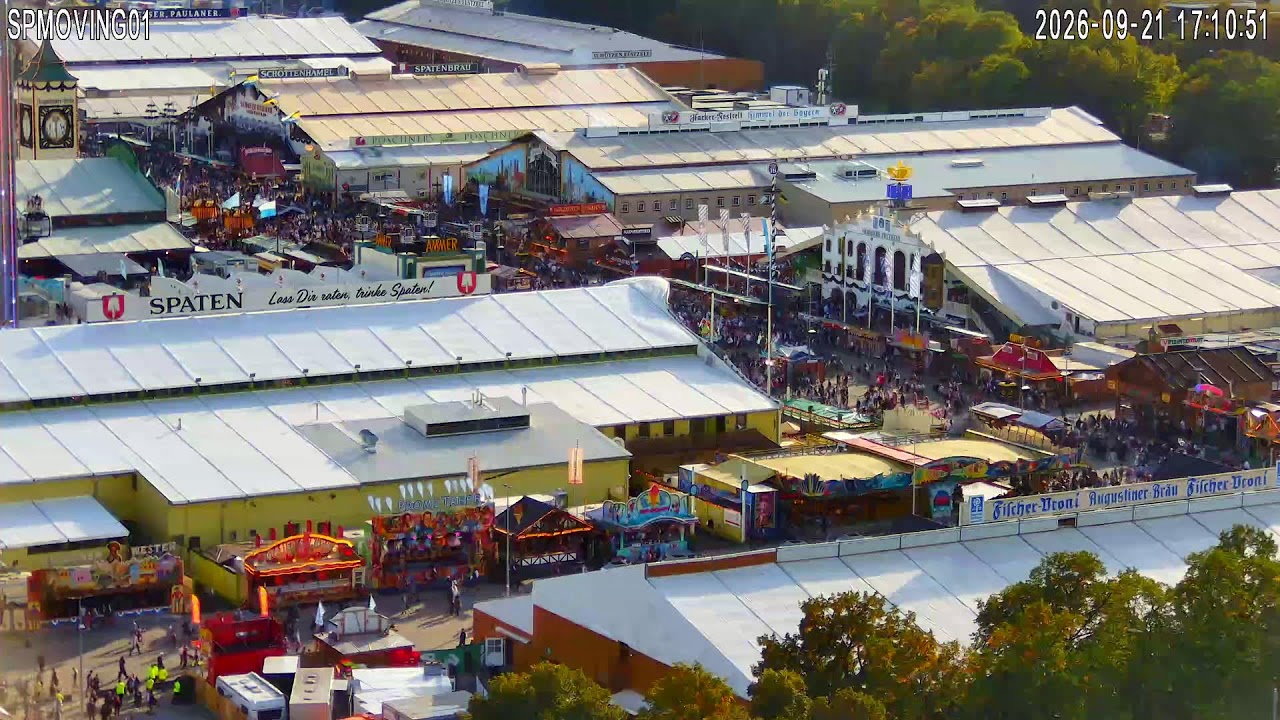
Munich — a city that remembers monks and devils
Bavaria's capital is a place where medieval legends coexist with high technology, and brewing traditions have been elevated to the rank of national heritage. Munich amazes with its contrasts: here Siemens skyscrapers neighbor Gothic cathedrals, and right in the city center surfers catch waves on an artificial stream. If you want to see this city in real time, Munich webcams online allow you to watch the life of the Bavarian capital from anywhere in the world.
The city grew from a small monastic settlement into one of Europe's largest cultural centers. Today Munich is home to 1.5 million residents, dozens of museums, world-famous breweries, and a unique atmosphere that cannot be confused with anything else. Every stone here holds history, and every courtyard can tell a legend.
The Devil's Footprint at Frauenkirche: a legend that became a landmark
Munich's main cathedral — Frauenkirche (Cathedral of Our Blessed Lady) — holds one of the city's most intriguing legends. According to the tale, architect Jörg von Halsbach made a deal with the devil: he would finance construction on the condition that the building would have no windows. When the cathedral was completed, the devil entered and initially did not notice the windows — massive columns blocked the view. But taking one more step, he discovered the deception and in fury stamped his foot on the stone tile, leaving a dark imprint — Teufelstritt, or the Devil's Footprint.
The black footprint is still visible in the entrance corridor of the cathedral, and next to it there is a faint gust of wind — as if the devil is still displeased. There is a version that the huge window at the far end of the nave was hidden by a massive altar from 1620 to 1858, and it was during this period that the legend may have arisen. Nevertheless, tourists from around the world come here to see the footprint with their own eyes.
Beer gardens: why Bavarians bring their own food since 1812
Munich's beer gardens (Biergarten) are not just places to drink beer, but genuine social institutions. The tradition of bringing your own food dates back to January 4, 1812, when King Maximilian I issued a compromise decree: he allowed beer cellar owners to serve beer in summer but strictly forbade selling food. Since then, every guest was forced to bring snacks from home.
This decree has long lost its force, but the tradition has survived and become part of Bavarian etiquette. In a true beer garden, self-service is customary, it is accepted to greet and introduce yourself by name at the table, and to address each other with the informal "du". The largest beer gardens in Munich accommodate thousands of guests: Hirschgarten — about 8000 seats, and the beer garden at the Chinese Tower in the English Garden — approximately 7000.
Surfing in the heart of the city: the Eisbach wave that conquered the world
In the very heart of the English Garden, one of the largest urban parks in the world, lies a unique surf spot — Eisbachwelle. The wave formed naturally due to landscape features: a fast flow of water drops through a small dam and flows around a rocky section of the riverbed, creating a steady standing wave. Since the 1970s, urban surfers began gathering here.
In the early 2000s, municipal services modified the riverbed and built a concrete ramp-projector that shapes a smooth surface and amplifies the wave. This made Eisbachwelle one of the most predictable urban waves in the world. Surfers from across the globe come here to demonstrate their skills before amazed tourists. Munich webcams online allow you to watch this spectacle in real time — especially on weekends when the most spectators gather.
Capital of the Movement and the White Rose: dark pages of history
Munich was the cradle of the Nazi party — it was here that the Beer Hall Putsch of 1923 took place, and the city received the nickname "Hauptstadt der Bewegung" (Capital of the Movement). During World War II, the city was subjected to 71-74 air raids over six years. About 50% of the entire territory was damaged, and 90% of the old part (Altstadt) was seriously destroyed due to carpet bombing policies.
The deadliest bombing occurred on July 16, 1944: 1,453 killed and 4,525 wounded. Civilian casualties amounted to 6,632 dead and 15,800 wounded. 81,500 houses were destroyed, leading to the displacement of about 300,000 residents. By May 1945, 337,000 people (41% of the population) had left the city.
But even in the darkest times, there were those who resisted. The student group "White Rose" (Weiße Rose) under the leadership of Hans and Sophie Scholl posted leaflets calling for the overthrow of Hitler. In 1943, they were arrested and executed. On the walls of the university at the corner of Ludwigstraße and Schellingstraße, bullet holes are still visible as a reminder of those events.
Traditions that defy explanation
Munich is a city of paradoxes and amazing customs. At Viktualienmarkt, the city's main food market, on Shrove Tuesday groups of vendors in colorful costumes perform a lively dance, tossing champagne glasses. This tradition has survived centuries and become so popular that it is broadcast on television.
On Ash Wednesday, residents throw wallets into the Fish Fountain, believing it will attract financial prosperity. And every day at 11:00 and 12:00 on the New Town Hall, puppet figurines come alive, acting out historical scenes — this mechanical performance draws crowds of tourists to Marienplatz.
On the western corner of the New Town Hall is a dragon sculpture — "Wurmeck". According to legend, in olden times a dragon appeared that infected people with plague, but a clever marksman slew the monster. And the coopers in 1517 supposedly saved Munich from the plague — their craft became a symbol of resilience in the face of calamity.
Munich Child: why the symbol of the city is a monk
Munich's coat of arms is adorned with "Münchner Kindl" (Munich Child) — a stylized depiction of a child in monastic clothing. The city's name comes from the Old German "Mönche" ("monks"). In the 8th century, monks from Schäftlarn monastery settled on Peter's Hill, and the settlement is first mentioned in documents from 1158 under the name Villa Munichen.
In the 12th century, the image of a monk appeared on official seals, symbolizing these roots. By the mid-15th century, this image became stylized and miniaturized into a child, often depicted in monastic robes and sometimes holding a beer mug or a radish. Since then, Münchner Kindl has served as the official coat of arms and recognizable symbol of the city.
Which cameras show the city
Munich webcams online open up views of key spots in the Bavarian capital. The broadcast from Marienplatz shows the New Town Hall in all its Gothic splendor — it is here that puppet figurines come alive every day. Cameras at Frauenkirche allow you to examine the cathedral's famous domes and even notice tourists searching for the devil's footprint.
The online broadcast from the English Garden opens up a view of the Chinese Tower and the famous Eisbachwelle wave, where surfbers catch a wave right in the city center. Cameras at Odeonsplatz show the Frauenkirche and the residence of the Bavarian electors. And if you want to see the famous beer gardens in real time, webcams at Odeonsplatz and in the Schwabing district open up views of the city's bustling streets.
Watching Munich webcams is an opportunity to feel the pulse of the Bavarian capital without leaving home. Whether it is morning mist over the Isar or the evening illumination of Frauenkirche — every moment reveals the city from a new side.