

🏙️ Webcams Millau — live streams from the viaduct city
1 cameras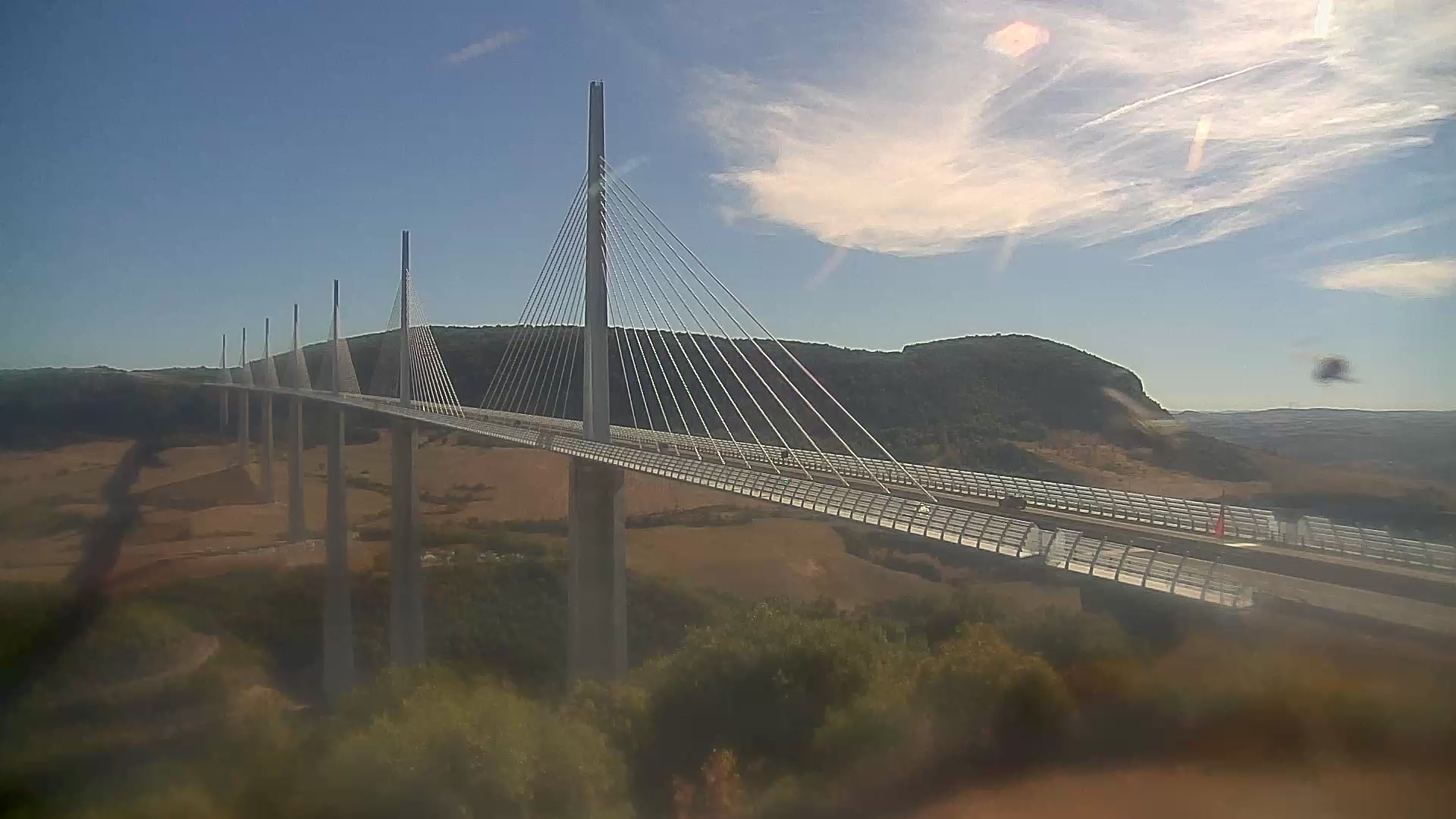
Millau — a city on the edge of the sky
In southern France, where the Tarn River cuts through limestone plateaus, lies a city that has become a symbol of engineering boldness. Millau is a commune in the Aveyron department, Occitanie region, with approximately 22,000 residents. But fame came to this city not because of its population, but thanks to a grandiose structure hovering above the valley at a height surpassing the Eiffel Tower.
Millau is situated at an altitude of 340 meters above sea level, at the junction of several landscapes — from the arid Larzac plateau to deep canyons. The climate here is one of the sunniest in France: over 2,600 hours of sunshine per year make the city an ideal subject for observation at any time of day. The air on the plateau is dry and clear, providing excellent visibility for tens of kilometers around.
Millau Viaduct: an engineering wonder above the clouds
The main attraction of Millau is the cable-stayed bridge spanning the Tarn Valley. Opened in December 2004, the viaduct became a record-breaker in several parameters simultaneously. The height of the tallest support — the P2 pylon — is 245 meters, and including the mast, the total height reaches 343 meters. That is higher than the Eiffel Tower.
The project was created by engineer Michel Virlogeux in collaboration with British architect Norman Foster. Construction took just three years — a record time for a structure of such complexity. The bridge is 2,460 meters long, and seven supports bear a steel structure that seems weightless against the backdrop of clouds. The project cost approximately 400 million euros.
The viaduct solved an acute transport problem: in summer, the A75 motorway, connecting Paris with Languedoc, turned into a multi-kilometer traffic jam due to tourists rushing to the Mediterranean. The bridge shortened the route by 35 kilometers and freed Millau from transit congestion. Today, the viaduct is not only a transport artery but also a tourist attraction: at its foot, there is an observation deck offering a panorama of the entire valley.
Capital of Gloves: a craft spanning six centuries
Long before the viaduct, Millau was famous for something else — leather gloves. The tradition of their manufacture spans over 600 years, dating back to the 14th century. The city became a center of glove production due to its proximity to pastures — the sheep and goats of the Larzac plateau provided soft leather, and the clean water of the Tarn was ideal for tanning.
In the 19th century, more than 30 workshops operated in Millau. Gloves from here were ordered by Hermès, Chanel, Dior — all of French fashion relied on the hands of Millau's leather workers. Today, the tradition is continued by several factories and ateliers, and the Glove Museum tells the story of the craft from the Middle Ages to the present day. Here you can see leather workers' tools, vintage models, and learn why exactly Millau became the world capital of this product.
Gateway to the Tarn Canyons and the Larzac Plateau
Millau is the natural entrance to the Causses valley, where the Tarn River carved limestone cliffs up to 500 meters deep. The canyons attract climbers, rafters, and lovers of panoramic views. The Larzac plateau to the south of the city is a different world: endless stone wastelands where flocks of sheep graze and the wind sculpts bizarre shapes from the rocks.
From the height of the viaduct or the viewpoints around Millau, views that are hard to forget open up. That is why webcams Millau online allow you to see this geological drama in real time — from the bends of the canyons to the road crossings on the plateau. The landscape here changes every few kilometers: from green valleys to rocky wastelands, from deep gorges to flat highlands.
Roquefort and Caves: the underground kingdom of cheese
30 kilometers southeast of Millau lies Roquefort-sur-Soulzon — the birthplace of the cheese that the French call the "king of cheeses". Roquefort received AOC protection as early as 1925, and since then its production has been strictly regulated: only milk from Lacaune breed sheep, only aging in the natural caves of the Combalou plateau.
The cave-ffiesses have unique ventilation through fissures called fleurines, creating a constant microclimate: temperature around +4°C and humidity of 95%. Millau is the nearest major city to Roquefort, and many tourists begin their acquaintance with the cheese right here, visiting local markets and museums. Tastings are held directly in the caves, where visitors can see how the cheese matures in natural conditions.
Larzac: the plateau that changed France
The Larzac plateau south of Millau became the stage for one of the most peaceful civil victories in French history. In 1971, the government announced plans to expand the military camp by 17,000 hectares, which meant the eviction of 107 farming families.
The Larzac shepherds responded with nonviolent resistance. The movement was led by Lanza del Vasto, a follower of Gandhi's teachings. The tactics were peaceful: hunger strikes, blockades, construction of illegal farm buildings. The protest gained nationwide support — from Jean-Marie Le Pen to Chomsky. In 1981, President François Mitterrand canceled the camp expansion. The farmers' victory became a symbol of the alter-globalization movement, and in 2003, a large-scale forum against the World Economic Forum took place on the plateau.
Old Town: medieval mysteries of Millau
The center of Millau is a labyrinth of narrow streets, half-timbered houses, and squares where time slows down. The 12th-century Gothic Notre-Dame Cathedral rises above the rooftops, and the Belfry Tower — the only surviving tower of the medieval fortifications — recalls the city's former greatness.
The legend of the Beautiful Maiden — a young woman whose beauty attracted knights from all over Occitania — still lives in local tales. And locals assure that the viaduct's pillars repeat the shape of ancient menhirs that stood here in prehistoric times.
The Gallo-Roman villa at Mont de Planer testifies that these lands were inhabited long before our era. Webcams Millau allow you to see both ancient walls and the modern life of the city — markets, walks along the Tarn, evening lights on the square.
What do the cameras show in the city
Webcams Millau online provide the opportunity to observe the city in real time. The cameras are installed at key points: at the approaches to the viaduct, in the historic center, on the Tarn embankment. With their help, you can see architectural landmarks, traffic on the bridge, and the everyday life of the city, located at the intersection of canyons and plateaus of southern France.