

🏙️ Luc-sur-Mer webcams online — watch live in real time
1 cameras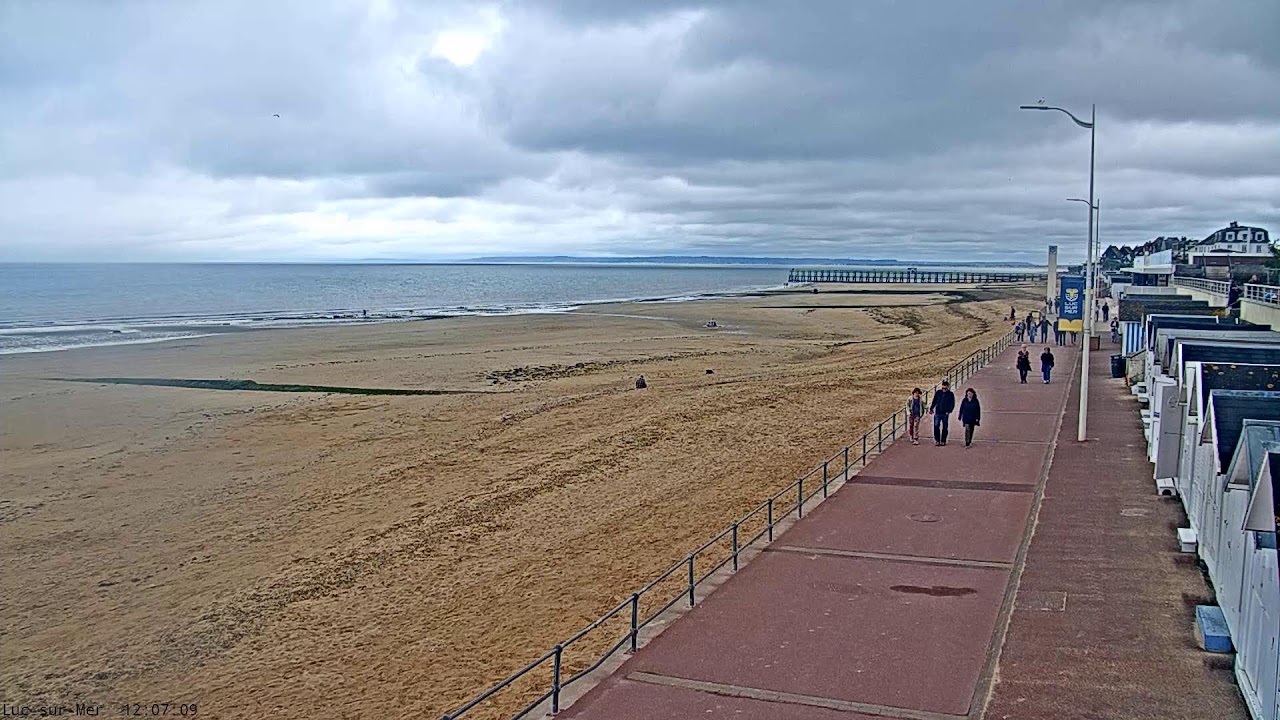
Where Luc-sur-Mer is located and why it is worth seeing
The Norman coastline harbors dozens of small towns, each living at its own rhythm. Luc-sur-Mer is situated on the Côte d'Nacre coast in the Normandy region, Calvados department — a stretch of sandy beaches and chalk cliffs stretching between Caen and Honfleur. This is a place where the English Channel meets green pastures, and the air smells of salt and meadow grasses. The town is compact — the population of Luc-sur-Mer is over 3,228 people — but in the summer months it fills with tourists, surfers, and tide enthusiasts. If you have not been here yet, Luc-sur-Mer webcams online will let you feel the atmosphere of this place before the suitcase is packed.
Origin of the name: sacred grove by the sea
The town's name is older than most Norman castles. The name Luc-sur-Mer is attested as "Lou" in 1077 and derives from Old French *luc* ("tree") or Latin *lucus* ("sacred grove"). Over nearly a thousand years, a port town grew around the grove, then a fishing village, then a resort — but the name remained. It recalls that long before the concrete seafronts, there were trees here that were revered as sacred. Today no trace of that grove remains, but the word "Luc" still sounds like a promise of tranquility and greenery at the water's edge.
D-Day: Sword Beach and the British landing
On June 6, 1944, the Normandy coast became the scene of the largest naval operation in history. The beach at Luc-sur-Mer was one of the first landing points for British troops on June 6, 1944, on the Sword Beach sector. The eastern wing of Sword passed directly through this town. The British 3rd Infantry Division approached the shore at dawn, and by noon the main forces had already advanced inland. Today memorial signs stand on the seafront, and the town museum preserves photographs of those hours. When you look at the peaceful beach through a Luc-sur-Mer webcam, it is hard to imagine that this same sand 90 years ago received the first waves of Europe's liberation.
The casino on the seafront: history and architecture
The resort life of Luc-sur-Mer was built around gambling and sea bathing as early as the beginning of the 20th century. The Luc-sur-Mer casino belongs to the commune and is located on the seafront at 20, rue Guynemer. This is not a private establishment but a municipal one — the profits from its operation go toward the town's improvement. The building stands right by the water, and from its halls there is a view of the bay. In the evening, when the lighting reflects off the wet sand after low tide, the casino becomes the main architectural accent of the seafront. Luc-sur-Mer webcams often capture this very section — with its columns, flags, and promenade filled with strolling couples.
Villa Louis in Lion-sur-Mer: Belle Époque heritage
Neighboring Lion-sur-Mer is separated from Luc by only a strip of beach, and together they form a unified resort ensemble. In neighboring Lion-sur-Mer stands Villa Louis, built in 1864 as a casino for Pierre Joseph Pasquet. In 1903 the owner's son converted it into a residence, but the facade retained the opulence of the Second Empire. The villa sits on an elevation, and from its terrace the entire bay is visible — from Douvres to Honfleur. This is one of those architectural monuments that do not shout about themselves but set the tone for the entire coast. A walk between Luc and Lion along the water's edge takes no more than half an hour — and in that time you can see how the Norman aristocracy of the 19th century imagined the ideal vacation.
The nature of low tides: crabs, mussels, and chalk cliffs
The English Channel is famous for tides that recede kilometers from the shore. In Luc-sur-Mer this becomes a daily natural spectacle. On the beaches of Luc-sur-Mer between the rocks at low tide live green crabs, decorator crabs, velvet crabs, mussels, and shellfish. Locals know the tide schedules by heart and go out "hunting" with buckets. The chalk cliffs exposed at low tide preserve impressions of ancient mollusks — this geology is millions of years old. Luc-sur-Mer webcams online show the beach at different phases of the tide: an hour ago the water reached right up to the houses, and now a vast sandy plain stretches to the horizon, and people walk across it with nets and shovels.
Summer festival: music for 10,000 voices
The cultural life of the town is not limited to the casino and the promenade. The annual Luc sur Mer Tribute Fest music festival gathers around 10,000 visitors over two days. This is a tribute to legendary bands — cover artists perform hits by Queen, The Beatles, AC/DC, and other rock giants. The stage stands right by the sea, and the sound carries across the water. For a town with a population of three thousand, ten thousand guests is an event that changes the scale of reality for the weekend. If you watch Luc-sur-Mer webcams on festival days, you can see how the seafront turns into an open-air concert hall.
The town's atmosphere: why people return here
Luc-sur-Mer does not claim to be the capital of Norman tourism. There is no Louvre, no Eiffel Tower, no crowds with selfie sticks. But there is what large cities have long lost: a measured rhythm, the smell of freshly caught fish at the dock, the cries of seagulls over low tide, bicycle paths along the coast. The town suits those who want to hear their own breathing on the ocean shore. Luc-sur-Mer webcams convey exactly this feeling — calm, unhurried, genuine. Turn on the broadcast in the evening when the seafront lights come on, and you will understand why the Norman coast inspired the Impressionists.
Which cameras show the town
This page collects Luc-sur-Mer webcams — from panoramic views of the seafront to cameras aimed at the beach and the bay waters. Choose the broadcast that interests you: morning tide, evening promenade by the casino, or daytime port life. All cameras work in real time, and you can observe the city exactly at the moment it lives — with its fogs, sun, low tides, and rare tourists who do not yet know they have found one of the quietest corners of Normandy.