

🏙️ Naha Webcams Online — Watch the City in Real Time
2 cameras
Port City in Southern Okinawa
Naha is the administrative capital of Okinawa Prefecture and the main city of southwestern Japan. It sits on the western coast of the island of the same name, where Naha Bay has for centuries welcomed trading junks from China, Korea, and Southeast Asia. Today the city concentrates the bulk of the archipelago's life: about 60% of Okinawa Island's population lives in Naha, and the prefecture's only railway — the urban monorail — runs along its streets.
The city is compact and dense: from the business district near the port to the former royal capital of Shuri, you can walk in an hour. It is this "human" scale that makes Naha an ideal place for observation through a lens: Naha webcams in real time show both the sea harbor and the pedestrian flows of central streets, and the roofs of old neighborhoods against the turquoise horizon of the East China Sea.
Historically, Naha was the port of the Ryukyu Kingdom but not its political center — power sat in Shuri, a little further into the mountains. Today the city has absorbed the former royal capital, and this dual identity — "port plus throne" — is still readable in the layout: below bustles commercial Naha, above dozes the ceremonial one.
Shuri — Residence of the Ryukyu Kings
Shuri Castle is the city's calling card and the symbol of all Ryukyuan statehood. The exact date of its construction is unknown: researchers associate it with the Sanzan era, when the island was divided into three warring principalities (Shuri Castle — Wikipedia). In 1429, the lord of Shuri, Shō Hashi, united these principalities, founded the Ryukyu Kingdom, and made the fortress his residence — and it remained the royal court until 1879, when the monarchy was abolished.
Shuri's fate has been a difficult one. Almost all the historical buildings of the Ryukyu era perished in the fires of World War II: practically all monuments of that era were destroyed. On the castle ruins, the occupation administration opened the University of the Ryukyus in 1950, which remained here until 1975. Then began a systematic revival: restoration work unfolded in the 1980s, the castle opened to visitors in 1992, and the Shureimon Gate with its famous arch was restored even earlier. In 2000, Shuri and other monuments of the Ryukyu Kingdom were inscribed on the UNESCO World Heritage List.
Red lacquered columns, dragons on stone railings, the view from the observation deck over the roofs of Naha — Shuri is beautiful and photogenic from any angle. Its silhouette often appears in the frame of city broadcasts, so romantics searching online for "Shuri Castle live" find it here, in the landscape of the southern capital.
Kokusai-dori: Naha's "Magic Mile"
The city's main street is Kokusai-dori, International Street. Its length is about 1.6 km, and for its ability to restore commercial life literally from the ashes, it was nicknamed the "Magic Mile" (Kokusai-dori — facts and legends). The name "international" comes from the Ernie Pyle Theater — a cinema for American military personnel built after World War II that gave rise to street trade around it (history of the street's name).
Today it is a two-kilometer marathon for the eyes: souvenir shops with shisa (protective "tears" of Okinawan glass), bakeries with purple sweet potato buns, mugs of awamori, famous Don Quijote doughnuts, shisa lion sculptures above the entrances. On weekends, the central section is closed to pedestrians — and it is during these hours that the flow of people on street cameras is especially lively. If you want to understand how Naha breathes, watch the broadcast from Kokusai-dori: one street replaces an entire guidebook.
Makishi Market and the Flavors of the Southern Islands
In the neighborhood behind Kokusai-dori hides the city's main gastronomic theater — the Makishi Public Market. Its origins are prosaic: shortly after the war, a black market grew up near the Kainan bus stop, and in 1950 the city authorities officially established it as a municipal market (history of Makishi Market). It is easy to reach on foot — turn off International Street into shopping alleys like the covered Heiwa-dori passage (how to get to Makishi).
Here they sell fragrant tofu, purple taro, smoked pork of all cuts, fresh reef fish, and on the upper floor there are eateries where your purchases will be cooked on the spot. Naha is the only place where the smell of the market is felt even through the screen, but visually the display cases with icy mountains of seafood are a scene that a webcam conveys quite faithfully.
Temples, Parks, and the Cradle of Karate
Naha is not just shopping. Within the city lies Onoyama Park, where you can get acquainted with Okinawan culture: there are Shinto shrines, including the entrance to the Okino-gu temple, and sports facilities (Onoyama Park and Naha temples). Let us clarify a popular misconception: we are talking specifically about Onoyama — Omura Park is located in the city of Omura in Nagasaki Prefecture on Kyushu, and has nothing to do with Naha.
A separate pride of the island is martial arts. Okinawa is recognized as the birthplace of Okinawan-te, the art from which most modern styles of karate grew (Okinawa — birthplace of karate). In Naha, monuments to masters stand right along pedestrian routes, and in the city's halls kata are still practiced to this day. However, the city's oldest "training" remains maritime trade: Naha's port still receives both cargo ships and ferries to neighboring islands.
Climate and Getting Around the City
Naha's climate according to the Köppen classification is subtropical moderately humid oceanic; in the warm half of the year, the region regularly lies in the path of typhoons (Okinawa climate). The air temperature practically never drops below +9 °C, although gusty wind can snatch an umbrella from your hands. One look at the city's online camera — and it's clear whether to wear a windbreaker and wait for rain, which in Naha often comes suddenly and leaves just as suddenly.
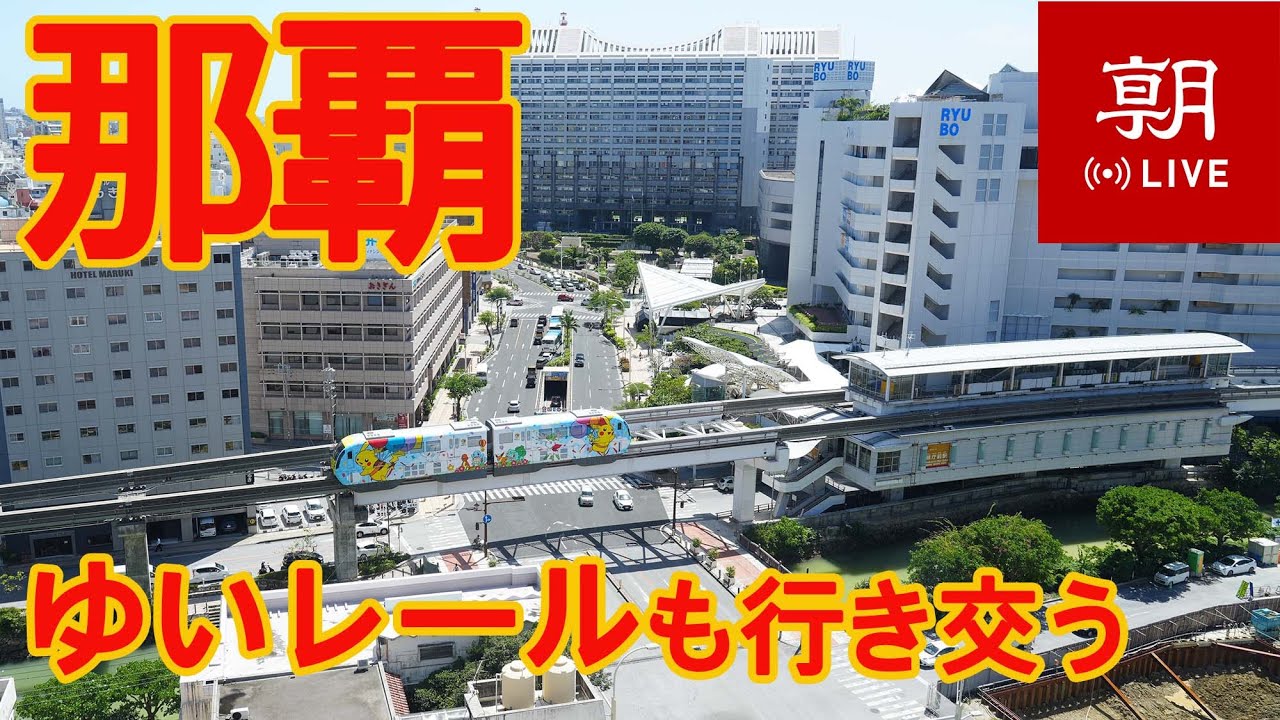
Getting around the city is convenient: the Yui Rail monorail connects the airport with the center and the Shuri district, buses cover the rest, and the historic center is best explored on foot. Car rental is popular for trips to the northern beaches and capes of the island, but for Naha itself it is unnecessary.
What the Cameras Show
The catalog on this page collects Naha broadcasts covering its key panoramas. The water viewpoint is the port and harbor: you can see ferries docking, cranes moving, and the water changing color from lead-gray to emerald. Street cameras look at Kokusai-dori and neighboring shopping districts — the density of passersby easily reads the city's pulse. Separate lenses are aimed at the Shuri district: castle walls, the Shureimon Gate, and the roofs of old neighborhoods. Finally, coastal observation points show the embankments, the monorail, and the sea horizon of Okinawa Island.
Each webcam works free and without registration, broadcasting live in HD quality, around the clock. Choose a point — the port, International Street, Makishi Market, Shuri — and watch Naha as its residents see it: alive, noisy, and always under a fresh sea breeze.