Church of the Savior on Blood in St. Petersburg — Online Webcam
Where History Became Stone
On the embankment of the Griboyedov Canal, among the classical facades and baroque silhouettes of the Northern capital, stands a church that breaks away from the entire architectural ensemble of the city. The Cathedral of the Resurrection of Christ on the Blood — commonly known as the Savior on Blood — was founded October 18, 1883 on the very spot where March 1, 1881 Emperor Alexander II was fatally wounded by the People's Will terrorists. Construction lasted 24 years — from 1883 to 1907, and today this structure, standing 81 meters tall, remains one of the most recognizable symbols of St. Petersburg.
If you want to see this church without the tourist hustle, the live webcam allows you to examine it in detail — from the colorful domes to the reflections in the waters of the canal.
Architecture That Argues with the City
St. Petersburg is a city of European classicism: strict columns, symmetrical facades, pastel tones. And in the midst of all this — an explosion of colors that recalls 17th-century Moscow rather than the imperial capital on the Neva. The church was built in the pseudo-Russian style — a movement that in the late 19th century became a response to the search for national identity in architecture.
Onion domes, kokoshniks, bright tiles, patterned masonry — all of this references Moscow's St. Basil's Cathedral and ancient boyar chambers. The building deliberately contrasts with its surroundings, and this was the intent of architect Alfred Parland: the memorial church was meant to be not just part of the city, but its spiritual center, visible from afar.
Mosaic That Covers Everything
Inside, the Savior on Blood produces an impression that cannot be conveyed through photographs. Walls, vaults, columns, the iconostasis — literally every square centimeter is covered in mosaic. The total area of the mosaic decoration is 7065 square meters — making it the largest collection in Russia and one of the largest in Europe.
Craftsmen worked on the mosaic based on sketches by more than 30 prominent artists — among them Viktor Vasnetsov, Mikhail Nesterov, Nicholas Roerich. This is the only case in Russian architecture where mosaic became not merely decoration but the dominant feature of the entire interior space. The designs are executed in the technique of so-called 'Russian mosaic' — smalta was laid directly on the wall without preliminary layer firing, creating the effect of a living, slightly uneven surface.
Soviet Legacy: From Vegetable Warehouse to Museum
After the 1917 revolution, the church shared the fate of many religious buildings. In the 1930s, they wanted to dismantle it for building materials, but the war intervened. During the Siege of Leningrad, a morgue operated within the cathedral walls, and after the opening of the Road of Life, the building was turned into a vegetable warehouse. Hence the folk nickname 'Savior on Potatoes' — ironic but accurate.
In 1970, the church was placed under the wing of the 'St. Isaac's Cathedral' museum, and a long restoration began that took nearly 30 years. In 1997, the Savior on Blood opened as a museum, and in 2004, religious services resumed — first in separate chapels, and then in the main space.
Griboyedov Canal: Water as a Mirror of History
The church stands right next to the Griboyedov Canal — the former Catherine Canal, which in 1881 was the site of the tragedy. It was here, on the embankment, that the People's Will terrorists planted a mine that exploded under the emperor's carriage. Alexander II sustained fatal wounds and died a few hours later in the Winter Palace.
Today, the canal is one of the most picturesque waterways of St. Petersburg. The bridges across it are adorned with cast-iron railings with marine motifs, and the embankments are paved with granite. The webcam with a view of the church also shows this water surface, in which the cathedral's domes are reflected — it looks especially beautiful during the white nights or with evening illumination.
Why the Savior on Blood Is More Than Just a Church
This structure is a unique hybrid of a monument, a museum, and an active place of worship. On the church walls are installed 20 memorial plaques describing the reforms of Alexander II — from the abolition of serfdom in 1861 to judicial and military reforms. The church was conceived as an atoning sacrifice by the son of the murdered emperor — Alexander III, who personally oversaw the progress of construction.
The height of 81 meters was chosen not by chance: it is symbolically linked to the birth year of Alexander II — 1818. Whatever detail catches the eye — the mosaic, the domes, the granite base, or the bronze crosses — everything serves one idea: the church as eternal memory.
How to Get There and When to Watch
The church is located in the very center of St. Petersburg, within walking distance of Nevsky Prospekt. The nearest metro stations are 'Gostiny Dvor' or 'Nevsky Prospekt'. If you are watching the broadcast from home, keep in mind: the best time for online viewing is in the evening hours, when the artistic illumination turns on and the domes begin to glow with warm gold against the dark sky.
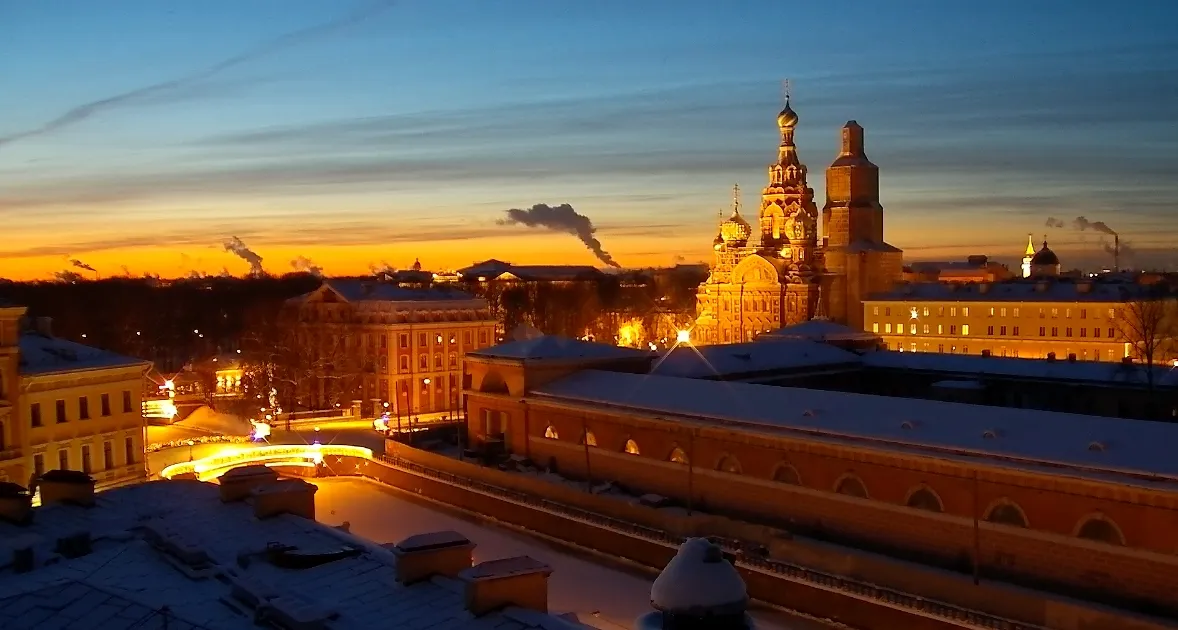
During the white nights (from May to July), the church is visible almost in daylight conditions even at midnight. In winter — a completely different picture: snow on the roofs of neighboring buildings, steam from chimneys, and the silhouette of the cathedral, illuminated by the embankment lanterns.
What You Can See on the Camera
The online camera broadcasts a view of the Church of the Savior on Blood from the foreground, where the roofs of historic buildings with characteristic arched elements are visible. On the right side of the frame is the cathedral itself with its colorful domes and crosses, illuminated in the dark. In the foreground is the Griboyedov Canal with a bridge, lit by street lamps. In the background — urban development, trees, and industrial chimneys. The sky over St. Petersburg is often painted in a gradient from orange to blue — it looks especially striking at sunset.
The live webcam allows you to observe the life of this corner of St. Petersburg: rare passersby on the embankment, reflections of the domes in the canal water, the changing light throughout the day. This is not just a broadcast — it is a window into history, frozen in stone and mosaic.
Similar cameras
Find similar