

🏙️ Webcams Galați online — watch in real time
2 cameras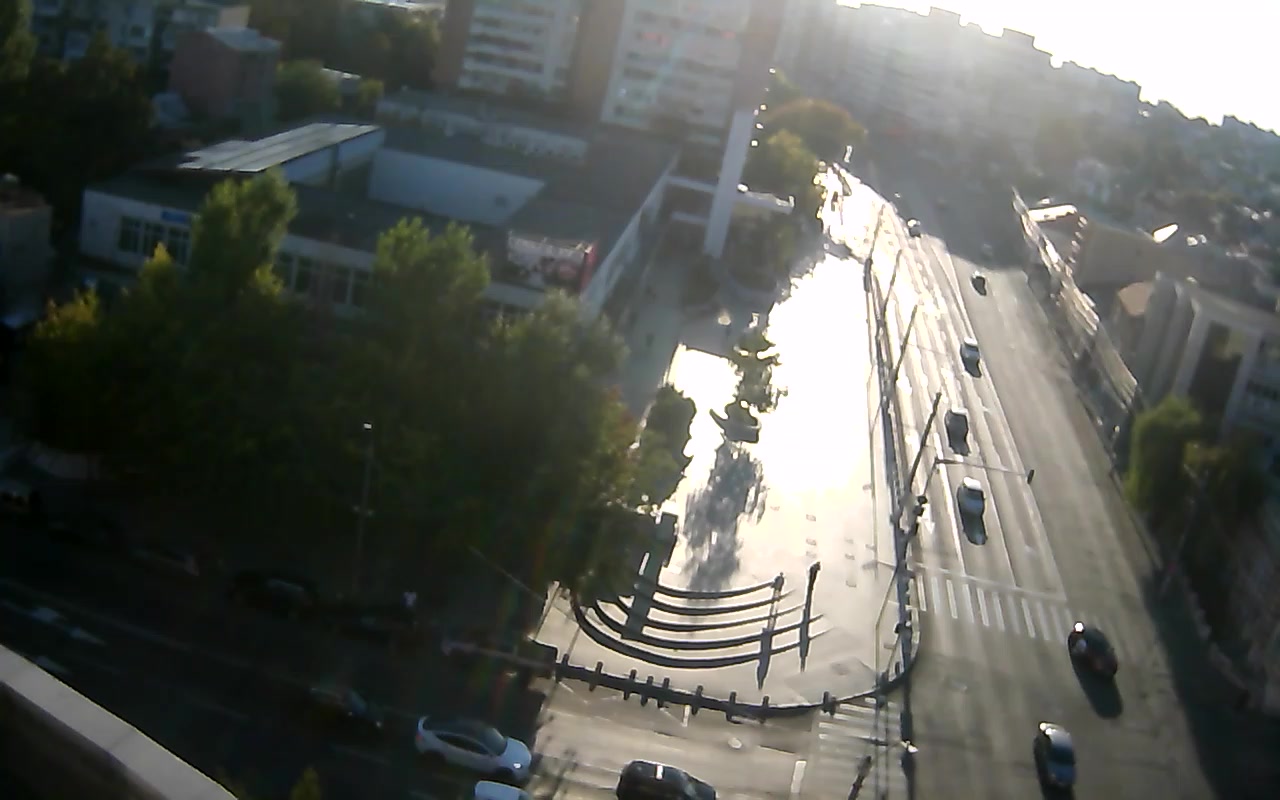

Galați — the Danube crossroads of Eastern Europe
Where the Siret and Prut rivers merge with the waters of the Danube stretches one of Romania's most underrated cities. Galați covers an area of 246.4 km² on the left bank of the great river, serving as a gateway between Central Europe and the Black Sea. It is a city where industrial might stands alongside baroque facades, and port cranes rise above ancient cathedrals. For those who want to see this with their own eyes, Galați webcams online open a window into the daily life of the Danube port.
From Cuman steppes to industrial giant
The city's name has its roots in Turkic dialects — presumably derived from the Cuman word "Kalat," meaning fortress or fortified settlement. The first reliable references date back to the 10th–13th centuries, when trade routes between Byzantium and Slavic principalities passed through these lands. By the 19th century, Galați had become one of the region's key ports, and by the early 20th century a fully-fledged city harbor with docks, passenger halls, and administrative buildings was already operating here.
The city's industrial history is marked by unexpected twists. From 1925 to 1945, a Henry Ford automobile plant operated in the port zone, assembling cars for the Romanian market. After the war, the terminal changed its profile — cruise ships began docking here, and industrial potential was redirected toward metallurgy and shipbuilding. Today, according to 2011 data, Galați's population stands at 249,432, making it the seventh-largest city in the country.
The port that never sleeps
The Danube port of Galați is the largest on the river and one of the most important in Eastern Europe. It provides connections with dozens of countries — from Germany to Far Eastern ports. The city's waterfront presents a colorful picture: cargo terminals sit alongside promenades, and massive port facilities are framed by green plantings. From the Danube embankment, a panorama opens up where the river surface is interrupted by islands and sand spits — it is this view that most often ends up in the lenses of street cameras.
Architectural portrait of the center
The central part of Galați underwent a major reconstruction in the mid-20th century. In 1956, under the direction of architect C. Frumușacu, one of the first completed architectural complexes of socialist Romania was created here — five-, eight-, and nine-story residential buildings, a hotel, and administrative buildings arranged in a unified ensemble. However, among this development, earlier monuments have also been preserved: the Cathedral, the 20th-century Orthodox Church of St. Nicholas, the Palace of Justice, and the opera house, which has undergone restoration.
A special place in the city's landscape is occupied by the Dandelion Fountain — which has become the unofficial symbol of Galați and a favorite meeting spot. Nearby are 17th-century churches, reminders that the modern industrial city grew on the foundation of an ancient trading settlement.
Domnească Street — the city's artery
Domnească Street has been known since 1905 and bears a "princely" name — in memory of the times when the road to the ruler's residence passed along it. Along it stand the university, museum, city hall, and other landmark buildings. The street's name also gave its name to the State Nature Reserve "Pădurea Domnească," established in 1993 on an area of 6,032 hectares — a vast forested area on the city's outskirts, where oak groves and rare plant species have been preserved.
Bridges connecting the banks
The Danube bridge near Galați is an engineering structure worthy of attention in its own right. It is the third longest road suspension bridge across the Danube in Europe, connecting the Romanian bank with the Moldovan one. For travelers and explorers, it serves not only as a transport artery but also as an observation deck: from the bridge, port facilities, river islands, and the vast expanse of water are visible.
Cultural life and green oases
Beyond its industrial giants, Galați surprises with its cultural diversity. The Botanical Garden with rare plant specimens, the Museum of Modern Romanian Art, and the "Paul Păltânea" History Museum are key points of attraction for those interested not only in economics but also in the city's soul. The metallurgical plant and shipyards shape the economic profile, but behind the facades of factory buildings lies a living city with parks, promenades, and street cafés.
Industrial character and everyday life
Galați is a city of workers, engineers, and sailors. It is home to a metallurgical plant, shipbuilding, marine equipment manufacturing, chemical, textile, and furniture industries. This profile shapes the rhythm of life: port shifts, factory whistles, freight traffic through the central streets. Galați webcams allow you to see this dynamics in real time — both during the day and at night, when the port lights reflect in the dark waters of the Danube.
What the cameras show
Online broadcasts from Galați cover key points of the city: the port and Danube waterfront, central Domnească Street, the railway station, and adjacent squares. HD-quality cameras allow you to observe ship traffic on the river, watch port machinery in action, or simply enjoy the view of the Danube embankment. The live stream is available free of charge and without registration — just select the point of interest to find yourself on the banks of one of Romania's most colorful cities.