

🏙️ Webcams Murter online — watch the Croatian island in real time
2 cameras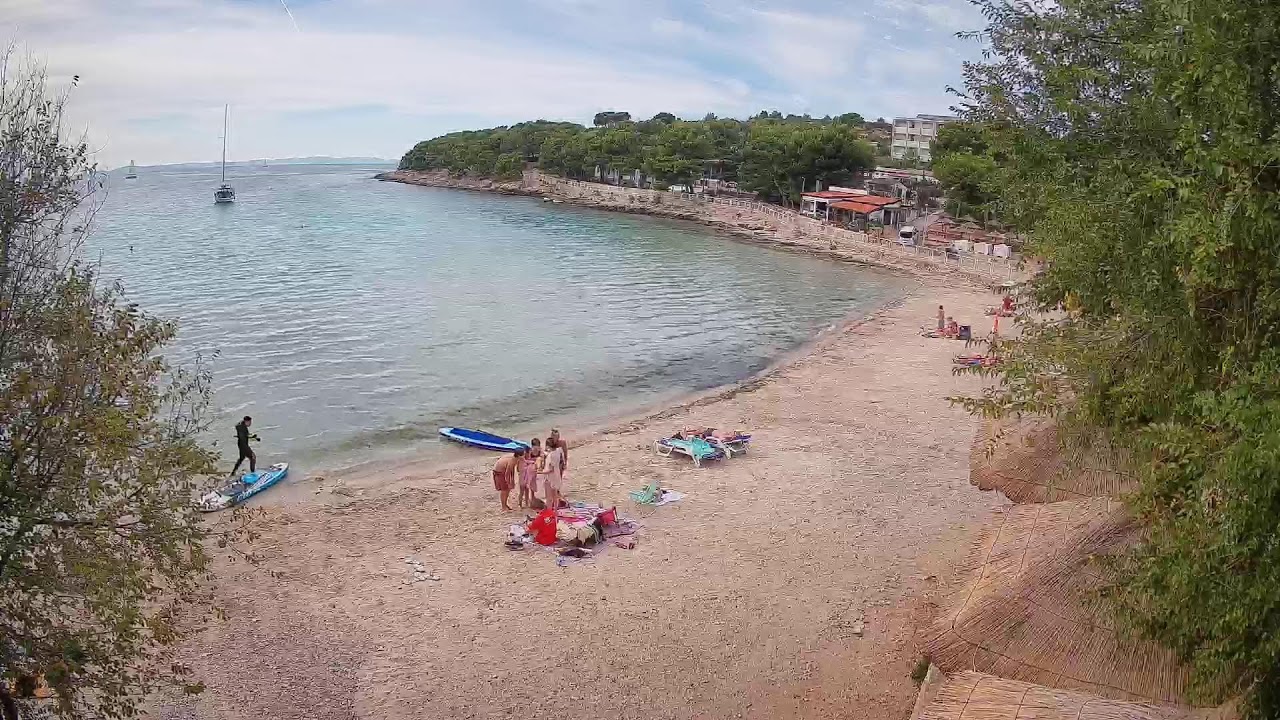

Murter Island: sun, stone and the Adriatic
Murter is an island of contrasts, where ancient Roman mosaics sit alongside centuries-old olive groves, and fishing gaeatas are still built by hand just as they were three hundred years ago. This place in the northwestern part of the Šibenik archipelago attracts visitors not with mass tourism, but with an authentic Dalmatinian atmosphere. There are no high-rise hotels here — only stone houses, narrow streets and the smell of the sea mixed with the aroma of rosemary.
The island covers an area of about 18.7 km², and it is separated from mainland Croatia by a strait just 20 meters wide. The drawbridge in Tisno connects Murter to the mainland, and crossing it takes just a couple of minutes. The highest point of the island is Mount Raduč at 125 meters, offering a panorama of all four settlements: Tisno, Betina, Jezera and the town of Murter.
Kolentum: the lost Roman city
Hramina Bay holds a two-thousand-year-old mystery. Here, at a depth of 3-4 meters, lie the remains of the Roman settlement of Kolentum, which flourished in the 1st century AD under Emperors Nero and Vespasian. Archaeologists have discovered multi-story houses, thermae, reservoirs and paved streets — typical Roman architecture of Dalmatia.
Today, Kolentum is an archaeological park with trails and observation platforms. The beach at the foot of Gradina Hill allows you to combine swimming with exploring the ruins. Snorkeling enthusiasts can spot mosaic fragments and amphorae underwater — the city was plundered by pirates in the 2nd century, then suffered an earthquake and never recovered its former glory.
Betina: wooden boats and maritime tradition
The village of Betina is a living open-air shipbuilding museum. For several centuries, they have been building the Betina gaeata — a traditional wooden boat 5-8 meters long, known for its excellent seaworthiness. In 2011, Croatia's only Museum of Wooden Shipbuilding opened here, where masters pass on skills to young people without blueprints, relying on oral tradition.
Family shipyards still accept orders — boats are built from local oak and olive wood. Every year, Betina hosts the Traditional Shipbuilding Fair with a wooden boat regatta and workshops. This is not a museum exhibit, but a living culture where every stroke on the hull is the memory of ancestors.
Olive oil and Dalmatian cuisine
Murter is one of the sunniest places in the Adriatic: about 2,500 hours of sunshine per year. This climate is ideal for olive groves, with some trees over 400 years old. Local varieties — Bianchera, Oblica and Levantina — produce cold-pressed oil with a fruity flavor and a slight bitterness, which has won international awards multiple times.
On Murter, you should try peku — meat or octopus baked under a cast-iron lid over coals. Fresh grilled fish, caramel pudding rožata with rose petal liqueur, and Croatian doughnuts fritule with raisins — this is the taste of real Dalmatia, far from tourist buffet tables.
Four faces of the island: Murter's settlements
Surprisingly, different dialects exist on this tiny island — each of the four settlements speaks its own way. Tisno is the gateway to the island with the drawbridge. Jezera is a fishing village with a waterfront lined with cafes. Betina is the capital of shipbuilders. The town of Murter is the administrative center with the highest population density.
On Vidovica Hill in the town of Murter stands the Church of St. Michael. The climb to the top is worth the effort: from there you can see the entire island, the mainland and the Kornati archipelago — over a hundred islands scattered across aquamarine waters.
Kornati: an archipelago without electricity
Kornati National Park is managed from Murter, and it is from here that boats depart to the 89 islands of the archipelago, declared a protected area in 1980. This is the densest archipelago in the Mediterranean: on an area of about 320 km² there are about 140 islands, islets and reefs.
There is no electricity or freshwater sources on Kornati — only stone cottages of fishermen and shepherds, empty in winter. Crystal-clear water allows you to see the bottom relief at a depth of several meters, and the "crown" rocks at the southern tip of the islands are the park's calling card, attracting divers and yachtsmen from all over Europe.
Secret coves and wild beaches
In addition to the popular sandy Slanica beach, Murter hides dozens of secluded coves. Slanica on the southeastern coast is a rare sandy beach, ideal for children. Ladinke is a rocky cove with turquoise water, accessible only on foot or by boat. Hršovulja on the northern side of the island is famous for its wild landscapes, and Sasunj is a gravel shore far from tourist routes.
The old village of Betina Gornja on the hill above Betina is an abandoned settlement that is slowly being restored. It offers the best panoramic view of the island and neighboring archipelagos. This is a place for those seeking peace and an authentic atmosphere without embellishment.
Legends and myths of Murter
The island's name is still debated. According to one version, it comes from the Latin mortarium — a mortar that locals carved from stone. According to another — from the Celtic "mor" (sea) and "tartar" (fortress). Locals tell a legend about a church that sank beneath the waves on the site of the current strait: on stormy days, the ringing of bells can supposedly be heard from the bottom.
A legend about hidden gold is connected to the Roman ruins of Kolentum — the Romans supposedly sealed treasures in underground tunnels before fleeing. And the small islet of Otok Love off the coast is called the Island of Love: according to legend, lovers who swim across the strait together will be together forever.
What the cameras show
Murter webcams online allow you to see the island in real time: from the Betina waterfront with masts of wooden boats to the panoramic view from Vidovica Hill. Cameras in Hramina Bay show the marina and approaches to the Kolentum archaeological park, while broadcasts from Jezera show the fishing harbor with fishing boats.
Watching Murter webcams is also worthwhile for the weather: the island is famous for sunny days, but in winter the bula comes — a cold northern wind that makes the rigging on yachts hum. In summer, the cameras show aquamarine coves and yachts swaying at anchor — a living picture of Mediterranean paradise, unspoiled by high-rise hotels and crowds of tourists.