

🏙️ Webcams Karakol online — watch the city in real time
1 cameras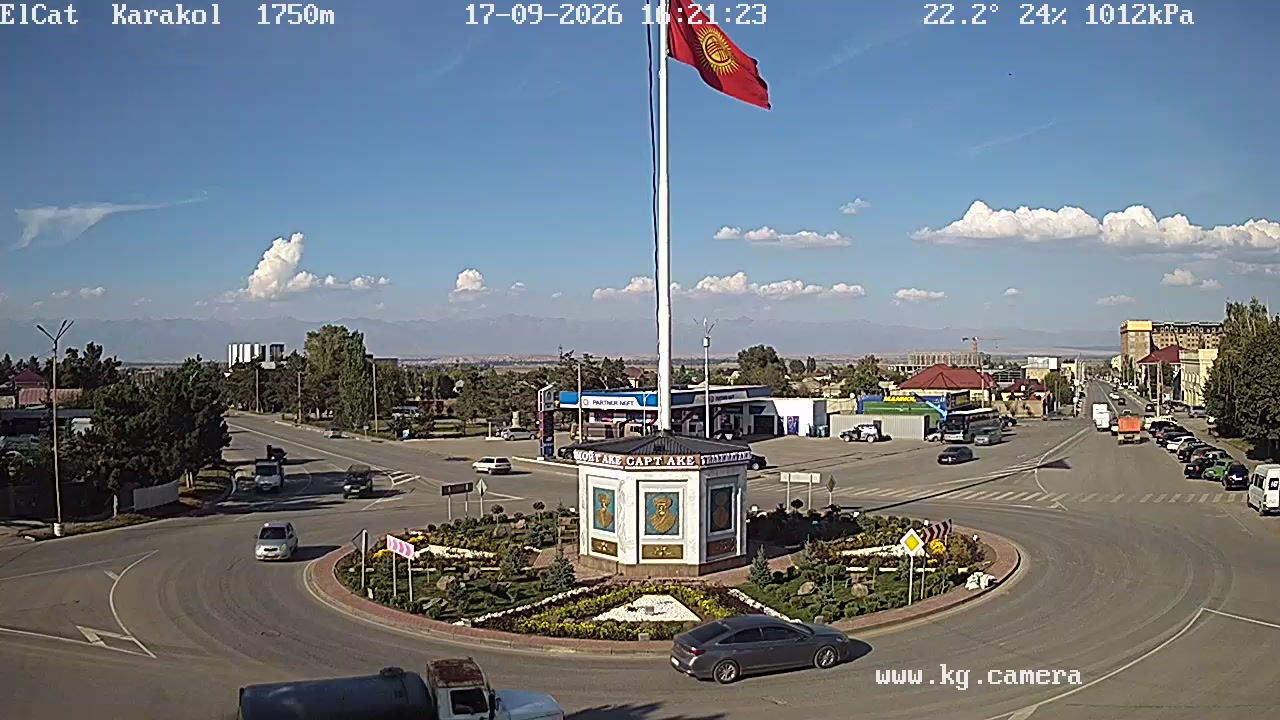
On the northeastern shore of Issyk-Kul, at the foot of the Terskey Alatau mountain range, lies a city often called the gateway to the Tian Shan. Karakol is a place where mountaineering culture meets Silk Road trading traditions, and Chinese architecture coexists with Russian and Kyrgyz customs. Here you can see a working mosque built without a single nail, and visit the museum of the famous explorer whose expeditions mapped Central Asia.
Historical Karakol: from military post to gateway to the Tian Shan
The city began as a Russian Empire outpost on the eastern edge of the Issyk-Kul valley. Karakol was founded in 1869 as a Russian military post at an altitude of about 1690 meters above sea level. The name translates from Kyrgyz as "black hand" — according to one version, because of the shadow from nearby mountains, according to another — because of the color of the water in mountain rivers.
In the late 19th century, Karakol quickly became an important trading hub. Caravans passed through it, connecting the Fergana Valley with China's Xinjiang. In 1888, after the death of the great explorer Nikolai Przhevalsky, the city was renamed Przewalsk — a name it bore for over a hundred years. The historical name was returned in 1991, when Kyrgyzstan gained independence.
During the Great Patriotic War, the city received evacuees from besieged Leningrad. This period left a deep mark on the multicultural character — descendants of those settlers still live here today, and Russian culture is organically woven into the local color.
Dungan Mosque: Chinese architecture at the foot of the mountains
In the center of the city stands a structure often mistaken for a Buddhist temple or a Chinese pagoda. In reality, this is a working mosque built in 1907–1910 by the Dungans — descendants of Chinese Muslims who moved to Central Asia after the uprising of the 1870s.
The uniqueness of the mosque is that it was built entirely of wood without a single nail. The architect is considered to be the Chinese master Pan Lo, who created the eight-slope minaret about 26 meters high. The facade is decorated with carvings featuring Buddhist and Taoist motifs: dragons, lotus flowers, mythical creatures. This is a rare example of the synthesis of Islamic and Eastern cultural traditions.
The Dungan Mosque remains active and open to visitors. It is located in the central part of Karakol, and is visible from afar — the building looks especially impressive against the backdrop of the snowy peaks of Terskey Alatau.
Przhevalsky Museum: the last refuge of the great explorer
Nikolai Mikhailovich Przhevalsky — a man who inscribed his name in the history of geography. He was the first European to describe the wild camel, Przewalski's horse, and many other species of Central Asia. The last months of his life the scientist spent here, in Karakol, preparing for another expedition to Tibet. He died in 1888 from typhoid fever and was buried in a park on the shore of Issyk-Kul.
The museum was founded in 1957 on the site where Przhevalsky lived and worked. The park around the museum was laid out during the explorer's lifetime — he personally planted the first trees here. Today the collection includes personal belongings, maps, herbaria, taxidermied specimens of discovered animals. Near the museum is the scientist's grave and a sculptural composition — the explorer with a gun and a dog.
Karakol Bazaar: flavors of the Silk Road
The market has been operating since the late 19th century — it is one of the oldest in Kyrgyzstan. It operates daily, but the real life happens on Sundays, when farmers and traders come from all over the Issyk-Kul region.
Here you can try kurut — dried milk balls that Kyrgyz travelers took with them to the mountains, fresh kumis and baursaks. But the real gems of the bazaar are Dungan and Uyghur delicacies: lagman, plov, samsa, manti. Livestock trading takes place in a separate area — cows, sheep, horses. Spices, dried fruits and nuts remind us that the Great Silk Road once passed through these places.
The bazaar in Karakol is the best place to the feel local multiculturalism. Russian, Kyrgyz and Dungan sellers trade side by side, and the air is filled with the aromas of spices and fresh baked goods.
Multicultural character: traditions of Kyrgyz, Dungans, and Russians
This is a city where cultures of different nations are intertwined. Kyrgyz, Russians, Dungans, Uzbeks, Uyghurs — they have all contributed to the local way of life. The tradition of hospitality is sacred here: in every home, a guest will definitely be offered tea with flatbreads — refusing is considered bad manners.
Nowruz, the Persian New Year, is celebrated on March 21. They prepare nokhot — salted water with grains, symbolizing renewal. Dungan weddings last three days and are lavish celebrations with unique cuisine. The Kyrgyz tradition of bata — elders' blessings — is mandatory before any important endeavor, whether it is a wedding or a trip to the mountains.
Issyk-Kul: the lake that never freezes
Two kilometers to the east begins Issyk-Kul — the second largest mountain lake in the world. Its depth reaches 668 meters, and the water is so mineralized that the lake does not freeze in winter. This creates a unique microclimate: it is rarely colder than -10°C here, and there are about 300 sunny days per year.
In summer, tourists from all over the world come to the shores of Issyk-Kul. But even in autumn and spring, the lake is magnificent — the mountains around are painted in incredible shades, and the water becomes transparent to the very bottom. A non-freezing body of water surrounded by snowy peaks is a sight worth seeing at least once in a lifetime.
Jety-Oguz and surroundings: red rocks and gorges
30 kilometers east of Karakol lies the Jety-Oguz Gorge — one of the most photographed places in Kyrgyzstan. The red sandstone rocks have been given the names "Seven Bulls" and "Broken Heart". According to legend, the broken heart is a memory of a woman who threw herself from the cliff upon learning of her beloved's death.
To the west of the city stretches Ak-Su — a gorge with glaciers and alpine meadows. In summer, the valley is covered with poppies, edelweiss and eremurus. One of the most popular trekking routes passes here — to the Tepliy pass at an altitude of 3900 meters. Snow leopards, argali, maral, and golden eagles inhabit the surroundings of the city.
The Dead Lake with medicinal mud is also located near Karakol — a local analog of the Dead Sea. The water in it is so saturated with minerals that it is impossible to drown in it.
What the cameras show in the city
Karakol is a city with a unique atmosphere, and it is best conveyed through live observation. Webcams in Karakol are installed to cover key points: central streets, bazaar district, mountain panoramas. They allow you to see how the city changes throughout the day — the morning bustle of the market, the daytime quiet of the coastal streets, the evening lights against the backdrop of mountain slopes.
To see the city in detail, choose a camera with a view of the center — this way you can observe the movement, architecture, and daily life of local residents. For nature lovers, cameras with panoramic coverage showing the surroundings of the city and mountain ranges are suitable.
Watching this city in real time is an opportunity to assess its scale and rhythm without leaving home. It is worth lingering at the screen: it has everything that makes Central Asia attractive — ancient traditions, majestic nature, and sincere hospitality.