

Novye Vatutinki Residential District in New Moscow — Online Webcam
History and Origin of the Name
The name of the residential complex refers to the historic settlement of Vatutinki, located nearby. The land around the future residential complex has a long history — in the 16th century, by decree of Ivan the Terrible, it was granted to boyar families for estates and patrimonies. In 1812, during the Patriotic War, it was here that the Russian army fought its first major battle against Napoleon.
The modern history of the district began in 2011, when the foundation of the first buildings was laid. And already in 2012, the territory became part of Moscow as part of a large-scale expansion of the capital — this is how New Moscow (TiNAO) came into being. Since then, former dacha lands have been transformed into one of the capital's largest residential projects.
Architectural Concept and Layout
The project represents a comprehensive development of a territory spanning 153.6 hectares. The district is divided into four microdistricts: the Central microdistrict with high-rise buildings totaling over 1 million sq.m., the Southern microdistrict with low-rise buildings (fully completed, home to 4,500 residents), as well as Desna and Zarechny, which are currently under construction.
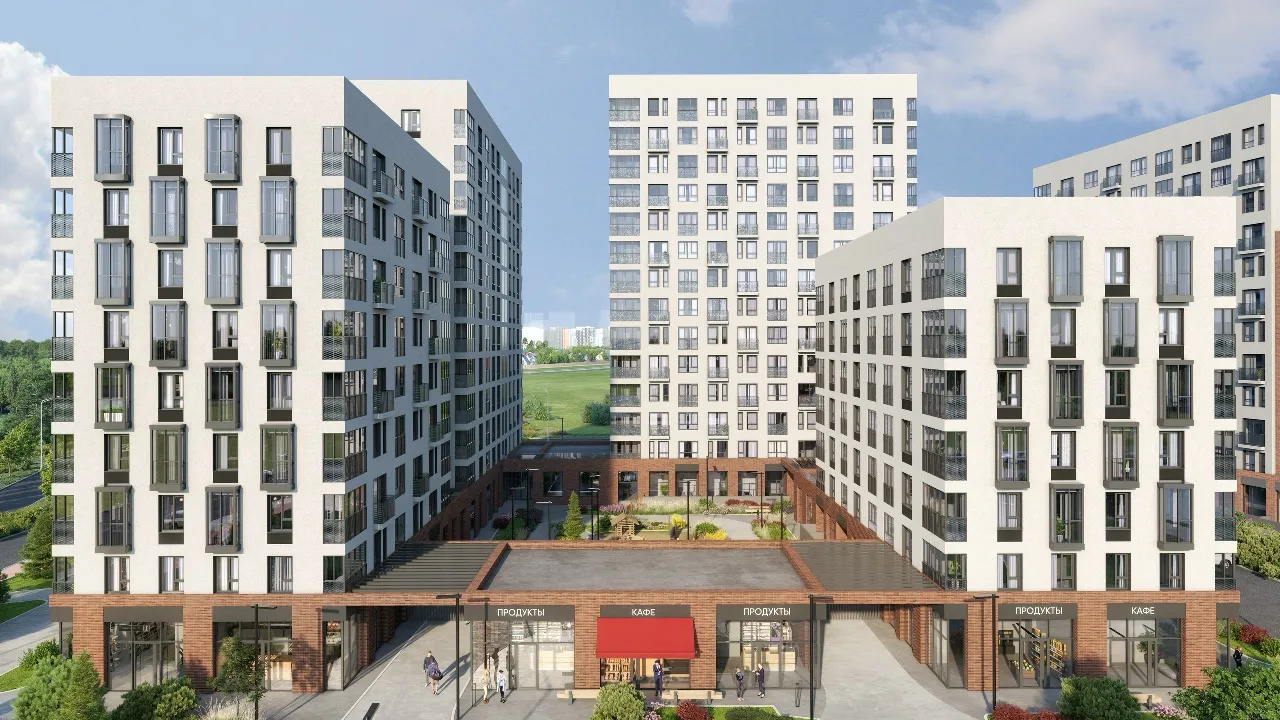
Buildings are constructed using panel series P-3M, P-44T, P-44K, 111-M, as well as monolithic technology. The central axis of the complex is a picturesque pedestrian boulevard. Spacious courtyards, a traditional residential block with commercial spaces on the ground floors — grocery stores and cafés. Visually, the district looks like a modern urban quarter with landscaped courtyards and park areas.
Infrastructure for Residents
Novye Vatutinki follows the "city within a city" principle. The district has 5 kindergartens with 1,410 places and 3 schools for 3,850 students. Nearby there is a polyclinic, sports and playgrounds, barbecue areas, bike paths, and an ice rink.
The ground floors of residential buildings house commercial spaces — grocery stores, cafés, and service facilities. This allows residents to handle everyday needs without leaving the district. Interior courtyards are designed with landscaping, walking paths, and recreation areas.
Natural Environment and Ecology
One of the main advantages of the district is its natural surroundings. Novye Vatutinki borders a landscaped forest area of 9 hectares. The Desna River flows through the district — the central natural axis, along which a park with an embankment and beach has been arranged.
Surrounding the complex are ponds, forests, dacha settlements, and sanatoriums. There are no industrial facilities in the area, making it an ecologically favorable zone. The only drawback is the proximity of the Kaluzhskoye Highway, which creates background noise.
Transport Accessibility
The distance from the residential district to the MKAD via Kaluzhskoye Highway is 14 km. By car, the Moscow Ring Road can be reached in approximately 10 minutes. The development stretches from Kaluzhskoye Highway to the village of Penino and the cottage community "Primeville".
The surrounding area still retains its dacha character — sanatoriums, garden cooperatives, and fields. However, as the project is implemented, infrastructure will develop and transport accessibility will improve.
Development Stages and Prospects
Construction of the district began in 2011 with the laying of the foundation for the first buildings in the Central and Southern microdistricts. The Southern microdistrict has been fully completed. The Central one is nearing completion. Currently, the Desna and Zarechny microdistricts are being actively built.
To date, more than 833,000 sq.m. of housing have been built, with over 100 buildings delivered. The planned completion of construction for the entire district is set for 2035. By this time, the volume of construction is planned to triple, making the district one of the largest projects in TiNAO.
What the Camera Shows
The online camera broadcasts a view of the Novye Vatutinki residential complex in New Moscow. On the screen — modern high-rise residential buildings with light facades and dark window frames, balconies. On the ground floors are commercial spaces — grocery stores and cafés.
Between the buildings is an interior courtyard with greenery, walking paths, recreation areas, and landscape design. Around the complex, green spaces, trees, and open areas are visible. The architectural style is a modern residential quarter with commercial development on the ground floors. Pedestrian zones and courtyard areas create a sense of a well-arranged urban space.
The webcam in real time allows you to observe the life of this young Moscow district — how residents move around, shops operate, and lighting changes throughout the day. It's one way to see how New Moscow is developing without leaving home.


