Carbis Bay, St Ives — Live Webcam Streaming Online
Turquoise Water and Golden Sand: Why Carbis Bay Is Unique
St Ives is a town in southwest Cornwall that twice won the title of Best UK Seaside Town at the British Travel Awards in 2010 and 2011. But the real gem lies just a mile from the centre — the sheltered Carbis Bay with water so clear it seems artificial. This turquoise hue is no filter or colouring. It's all about the fine white sand, crushed shells and maerl — red algae that cover the seabed. Sunlight passing through the purest water reflects off the sandy bottom and returns the blue and green parts of the spectrum. The sheltered bay allows heavy particles to settle, leaving the water crystal clear — which is why the beach regularly receives the Blue Flag award for water quality and environmental standards.
The Artists' Town: How St Ives Became a Centre of British Modernism
In 1877, a railway was built to St Ives, making the town accessible to London artists. The unique quality of local light — soft, diffused, reflecting off the sea — attracted landscape painters here. But the real revolution happened in 1928, when Ben Nicholson and Christopher Wood discovered the self-taught artist Alfred Wallis. This event marked the beginning of the "St Ives School" — a movement of British modernism and abstraction.
In 1920, Bernard Leach and Japanese master Shoji Hamada founded the Leach Pottery, which became a centre of ceramic art. And in 1939, sculptor Barbara Hepworth moved to St Ives — her workshop and sculpture garden are now preserved as a museum managed by Tate. The Tate St Ives gallery opened in 1993 on the site of a former gasworks and today displays works by Hepworth, Naum Gabo, Patrick Heron and other artists associated with Cornwall.
The G7 Summit and Carbis Bay Hotel: When the World Watched Cornwall
In June 2021, Carbis Bay found itself at the centre of world attention. The 47th G7 Summit was held here on 11–13 June — on the grounds of the hotel and surrounding Carbis Bay Estate. Presidents and prime ministers of the world's leading democracies stayed at the Carbis Bay Hotel, built back in 1894. Hotel owner Stephen Baker noted that it was an unforgettable experience for the entire team — serving world leaders went on around the clock.
But long before the politicians, this bay served as a training base for the military. During World War II, the Cornwall region was used to prepare for D-Day — the Allied landings in Normandy. Manoeuvres and troop training took place on the surrounding grounds.
Legends of St Ives: Mermaids, Tailless Cats and Five-Year Dances
The town's name is associated with the Irish princess Ia (Saint Ia), who in the 5th century wanted to preach Christianity in Cornwall. According to legend, she was refused a place on a ship, after which she crossed the sea on a leaf or tiny boat, but was killed by pagans. The town's name — St Ives — derives from her name.
In the nearby village of Zennor, there is the famous legend of the Zennor Mermaid. According to the tale, a mermaid fell in love with local chorister Matty Trevallion and lured him into the sea, where he disappeared forever. The local church still has a bench decorated with an image of a mermaid — you can see it with your own eyes.
Atop a hill in St Ives stands the 18th-century obelisk of John Knill (Knill Monument). According to his will, every five years on 25 July, a strange ritual takes place here: ten girls dance around the monument to music. This custom was conceived as a celebration of life and the repose of Knill's soul and is still observed to this day.
And in St Ives, there is also a legend about tailless cats — supposedly they appeared because cats got stuck in the narrow doors of fishermen's houses and had to gnaw off their tails to get out.
Subtropics in England: The Gulf Stream and Carbis Bay Palms
Thanks to the warm Gulf Stream current, subtropical plants grow in Carbis Bay, including palms — an unusual sight for England. This creates a unique landscape often compared to the Mediterranean. The beach is famous for its golden sand and calm waters, making it one of the best family beaches in Cornwall.
Carbis Bay is part of the famous South West Coast Path walking route, which runs along the cliffs above the bay. From here, there are breathtaking views of the bay and neighbouring beaches. And the St Ives Bay Line railway connects Carbis Bay to the centre of St Ives in just 5 minutes — one of the most scenic train journeys in the UK.
Surfing, SUP Boarding and Family Holidays
Carbis Bay is sheltered from strong waves, making it ideal for swimming, SUP boarding and kayaking. During the season, RNLI lifeguards are on duty, making the beach safe for families with children. For surfing enthusiasts, nearby beaches Gwithian, Porthmeor and Praa Sands are among the best surf spots in Cornwall.
The beach is part of the UNESCO World Heritage Site "Cornwall and West Devon Mining Landscape" and is located in an Area of Outstanding Natural Beauty (AONB). Historically, the bay was a centre of tin mining and fishing — these traditions have shaped the character of the region.
What the Camera Shows
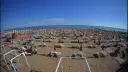
The live webcam broadcasts a panorama of Carbis Bay in St Ives. In the frame — the turquoise water of the bay, the golden strip of beach, the Carbis Bay Hotel against a backdrop of green slopes. In good weather, palms and subtropical vegetation are visible, giving the landscape a Mediterranean character. The camera operates in real time — you can observe the changing light throughout the day, tides and beachgoers. This online camera allows you to see one of the most beautiful corners of Cornwall without having to travel — just open the stream at any time of day.
Similar cameras
Find similar





Author's other cameras
All camerasComing soon