

🏙️ Webcams Thassos Online — Watch the Greek Island in Real Time
1 대의 카메라
The Emerald Island of the Aegean Sea
Thassos is the northernmost major island of Greece, located just 6 nautical miles (about 11 km) from the mainland port of Keramoti. This distance is so short that in clear weather the lights of Kavala on the mainland are clearly visible from the island. The island earned the nickname "Emerald of the Aegean" thanks to its lush vegetation, unusual for most Greek islands. Pine and chestnut forests descend right to the coastline, creating a contrast with the snow-white beaches and emerald waters.
The area of Thassos is about 380 sq. km, and its highest point — Mount Ipsario (Ay-Yannis) rises to 1205 meters. The island is geologically an extension of the Rhodope mountain system on the mainland, and in prehistoric times it was connected to Macedonia. Today, Thassos webcams allow you to observe this unique nature in real time — from the port harbor of Limenas to the mountain slopes.
The Marble That Built the Ancient World
Thassos is the only Greek island with its own reserves of white marble, which was quarried back in antiquity. Thassos marble was used to build monumental city walls up to 9 meters high, temples, and sculptures. It was exported throughout the ancient world and was valued on par with Parian and Pentelic marble. Mining was carried out in quarries on the southern coast, in the Aliki area, and ceased only in the 7th century AD, leaving behind huge columns and blocks that still lie at the mining site.
Modern quarries are located in the north of the island, near the village of Panagia, and marble continues to be extracted. The snow-white stone with crystalline texture remains one of the most prestigious finishing materials in the world. If you watch Thassos via webcam, you can notice how marble is woven into modern architecture — from building facades to the waterfront of Limenas port.
Ancient Theater with a Sea View
One of the main attractions of the island is the ancient theater of Thassos, built in the 3rd century BC on the slope of the acropolis near the sanctuary of Dionysus. Its main feature is the breathtaking view from the stage to the sea and the ancient agora. Unlike most ancient Greek theaters, where there is a wall behind the stage, here a panorama of the coastline and mainland Greece opens up.
The theater accommodated from 3,000 to 5,000 spectators, and its orchestra had a diameter of about 20 meters. The architecture of the structure creates perfect acoustics — according to legend, a coin dropped on the orchestra can be heard even in the top row. In the Roman period (2nd century AD), the theater was modified for gladiator fights and wild animal spectacles: a trench was dug around the orchestra and a high protective wall was installed. Today, the restored theater is used for the annual cultural festival "Kavilaria", where ancient Greek tragedies and comedies are performed.
Myths and Legends of the Island
According to ancient Greek mythology, the island is named after Thassos — son of Poseidon (according to another version — son of Agenor or a Phoenician king). Thassos set out to find Europa, who was abducted by Zeus in the form of a bull, but did not find his sister and settled on this island. Another legend says he was a descendant of Heracles, who arrived on the island and drove out the local monsters.
There is a myth that the nymphs gave the island amazing fruits, and Dionysus himself made its vineyards famous throughout the world. According to legend, it was off the coast of Thassos that the nymphs saved shipwrecked sailors by turning them into dolphins. These myths reflect the rich history of the island, which was a center of winemaking even in Ancient Greece.
From the Paleolithic to the Delian League
The first traces of human presence on Thassos date back to the Paleolithic — about 100,000 years ago. In the 8th century BC, Phoenicians arrived on the island, mining gold and establishing the cult of the god Melqart. Around 720-708 BC, Greeks from the island of Paros founded a permanent colony, bringing the cults of Artemis and Dionysus.
During its heyday (5th century BC), Thassos was one of the richest islands in the Aegean Sea, controlling mines on the mainland. The Thassians minted their own coins depicting Dionysus and grape clusters. In 465 BC, the island attempted to withdraw from the Delian League, leading to a prolonged siege. Athens won, destroyed the city walls, confiscated the fleet, and imposed a huge tribute. Today, archaeological excavations in Limenas are uncovering new pages of this history.
Traditional Products: Oil, Honey, and Wine
Thassos is famous for its unique food products. A rare variety of olive trees called "Throumba" grows here, the fruits of which are not picked but left to fully ripen, turn black, and shrivel on the branch. Oil from such olives has an incredibly rich taste and is considered elite.
The island is known for pine honey, which accounts for about 60% of all honey production on Thassos. It is collected from pine resin and has a dark color, thick texture, and less sweet taste than flower honey. Thyme honey, goat and sheep milk cheeses (including feta and kefalograviera) are also produced here, and modern wineries continue ancient traditions, producing wines from local grape varieties.
Limenas — The Capital of the Island
Limenas (translated as "port") is the capital of Thassos and the main port of the island. It is here that the main harbor is located, from which ferries depart to mainland Greece. The city is surrounded by pine forests and olive groves, and its architecture combines modern buildings with ancient ruins.
Limenas is home to the main archaeological attractions: the ancient agora (marketplace), sanctuaries of Heracles, Dionysus, Artemis, and Poseidon, as well as the ruins of temples of Apollo, Athena, and Pan. The port promenade is a popular place for walks, especially at sunset when the sun sets behind the mountains, and at night you can watch the lights of Kavala on the mainland. Thassos webcams at Limenas port allow you to see this atmosphere in real time.
Nature and Beaches of Thassos
The island is dotted with springs and freshwater sources, making it exceptionally fertile for the Aegean Sea. White sand beaches — "Golden Beach", "Paradise Beach", and others — are washed by emerald clear water. The mountain range with marble outcrops creates unique landscapes that can be observed through webcams installed at various points on the island.
Thassos is an ideal place for those who want to combine beach relaxation with exploring history. Ancient quarries in Aliki, mountain villages with traditional architecture, monasteries, and Byzantine churches — all this makes the island multifaceted. And the ability to watch Thassos online via webcams allows you to plan your route in advance or simply enjoy the beauty of Greek nature without leaving home.
What the Cameras Show
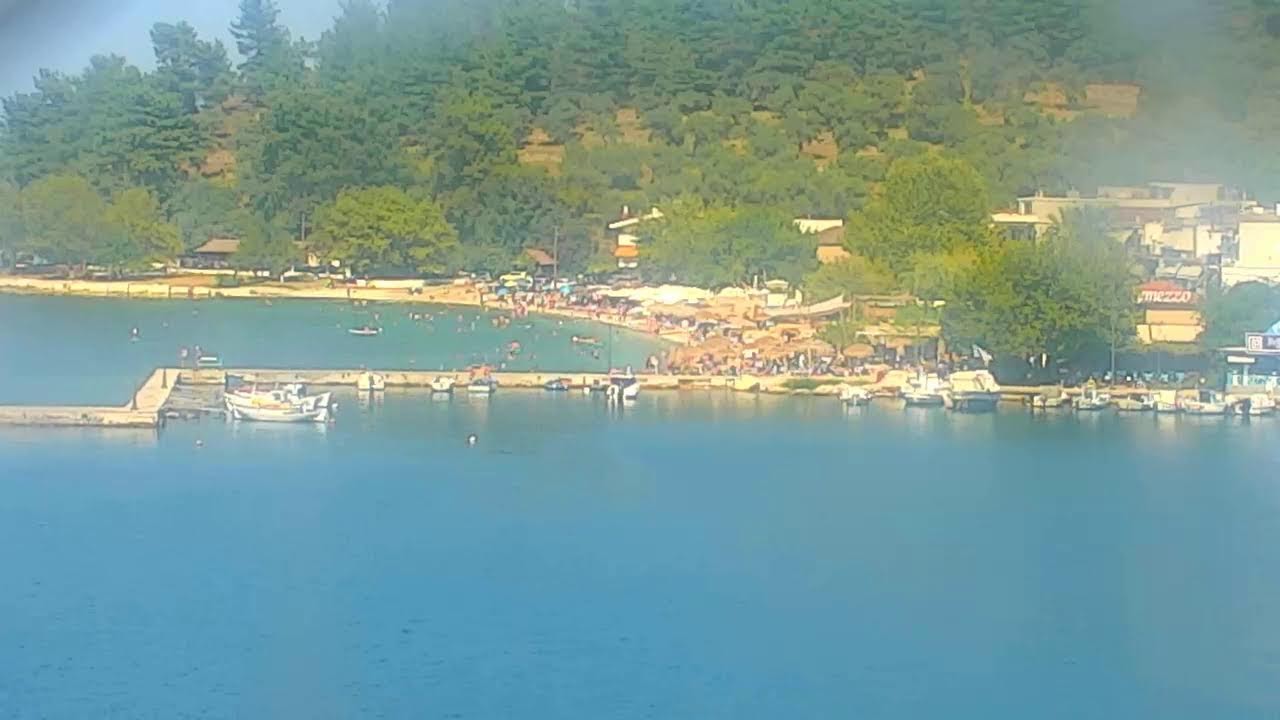
Webcams are installed at key locations on the island of Thassos: Limenas port (the island's capital), where you can watch ferries arrive and harbor life; coastal and mountain views; cameras in beach and resort areas. The most popular streams show Limenas port with a view of mainland Greece — Kavala is visible both day and night.
Choose any Thassos webcam from the catalog to watch the island in real time. Whether you are planning a trip or simply want to enjoy the beauty of the Aegean Sea, online streams allow you to see the marble streets, pine forests, and azure bays of this unique Greek island.